
Explore What Is Credit Note: Your CFO's 2026 Insights
Learn what is credit note, why it matters, and how CFOs use it for accounting accuracy, tax compliance, & to reduce DSO in 2026.
A credit note is a legally binding document that reverses part or all of a charge on a previous invoice while preserving the original invoice as part of a clean audit trail. It matters because it corrects revenue, receivables, tax, and client balances without rewriting history.
If you lead finance at a professional services firm, you've likely seen the moment. A client approves most of an invoice, then pushes back on one line item. Maybe it's a success fee, a block of advisory hours, or a travel charge that slipped through review. The issue is rarely just billing. It tests process, documentation, trust, and how quickly finance can restore control.
That's why the right answer to “what is credit note” isn't “a refund document.” That answer is too small. In practice, a credit note is a control mechanism. It lets you resolve disputes without weakening your books, preserve a defensible audit trail, and keep the client relationship intact while maintaining cash discipline.
In professional services, that balance matters. You don't want partners promising ad hoc concessions over email while AR chases the full amount. You also don't want controllers holding the line so rigidly that a manageable billing issue becomes a client retention problem. The credit note sits in the middle. Used well, it gives finance a structured way to say yes, no, or partially, with precision.
The Reality of a Disputed Invoice
A consulting firm sends a month-end invoice to a long-standing client. Most of the bill is routine. One line isn't. The client disputes a tranche of hours tied to change requests they believe were never fully approved. The engagement partner wants to preserve goodwill. AR wants to collect the undisputed balance now. The controller wants support before touching revenue.
At this point, weak firms improvise. Someone says, “Just revise the invoice.” Someone else says, “Leave it open and we'll settle later.” Both approaches create avoidable noise. The client doesn't know what's officially owed. AR ages a balance that isn't fully collectible as billed. Finance loses a clean record of what changed and why.
The disciplined move is to document the adjustment, not overwrite the past. If you're sending supporting schedules or annotated backup to the client, it also helps to securely share PDF documents so the dispute package, approval trail, and final credit note stay aligned.
Practical rule: Never solve a disputed invoice with an informal email concession alone. If the balance changes, the books need a formal document that changes it.
Inside the firm, this is also an invoice reconciliation issue, not just a collections issue. Teams that already have a defined process for matching invoices, approvals, and settlements usually resolve these situations faster. If your workflow is still loose, this guide on invoice reconciliation discipline is a useful companion.
A disputed invoice is a finance stress test. The credit note is what turns a messy negotiation into a controlled accounting event.
A Credit Note Defined for Financial Leaders
A credit note is not a courtesy letter. It is an accounting document with legal and tax consequences.
Per Stripe's explanation of how a credit note works and why it matters for tax compliance, a credit note is a formally documented, legally binding instrument issued by a seller to a buyer that reduces the amount owed on a previous invoice. It serves as a mandatory requirement for tax compliance when an invoice containing tax is reduced or canceled post-issuance, and it must reference a specific original invoice.
That last point matters more than many teams realize. A credit note cannot stand alone. It exists only in relation to a prior invoice. If there is no original invoice reference, you don't have a clean adjustment. You have a documentation problem.
What the document actually does
In plain finance terms, a credit note is the negative side of an invoice. It doesn't erase the original bill. It offsets it. That distinction protects your audit trail and gives both parties a clear record of what changed.
A sound credit note should make four things obvious:
- Which invoice is being adjusted
- What amount is being reversed
- Why the adjustment is being made
- Whether tax is being reversed along with the charge
That's the foundation for clean AR aging, defensible month-end close, and less back-and-forth with clients.
Where firms get confused
The confusion usually comes from overlap in language. Teams use “credit memo,” “refund,” “write-off,” and “discount” interchangeably. They aren't interchangeable.
Document | Issued By | Purpose | Impact on Seller's AR |
|---|---|---|---|
Credit Note | Seller | Reduce a prior invoice, partially or fully | Lowers accounts receivable tied to that invoice |
Debit Note | Buyer | Formally request a reduction or correction from the seller | No direct AR change until seller accepts and issues adjustment |
Refund | Seller | Return money already collected | May follow a credit note, but is not itself the invoice adjustment record |
Discount | Seller | Lower price, either before or after billing | If granted after invoicing, it should be documented through a credit note |
The trade-off is straightforward. If you want speed, people will be tempted to bypass documentation and “just fix it.” If you want control, you need a formal adjustment process. Good finance leaders build both. They make the process fast enough that nobody feels pressure to work around it.
A credit note protects the relationship and the ledger at the same time. That's why it belongs in the controller's toolkit, not just in billing operations.
In U.S. systems, you'll often see credit memo instead of credit note. Operationally, the idea is the same. The seller is reducing a prior invoice rather than asking for new payment.
Common Triggers for Credit Notes in Professional Services
Professional services firms don't deal with product returns in the usual sense. Their credit note triggers come from execution, scoping, pricing, and client management.
Billing errors and scope corrections
The most common trigger is simple. The invoice is wrong.
A law firm may bill a time entry to the wrong matter. A CPA firm may invoice work that was rolled into a fixed-fee arrangement. A consultancy may bill expenses that were excluded in the MSA. In each case, the original invoice has already created a receivable. If you need to reverse part of it, the credit note is the proper instrument.
Scope changes are another frequent source. A client approves phase one, then pauses phase two after the invoice has gone out. If the invoice included work that won't proceed, finance shouldn't leave AR to “work it out later.” The cleaner move is to issue a partial credit note tied to the original billing.
Service recovery and goodwill credits
Some credits are technically optional but commercially necessary.
A retained search firm misses a delivery milestone and offers a service credit against the next invoice. An agency agrees to reduce fees after a campaign launch slips. A fractional CFO practice grants a modest credit because onboarding took longer than promised. These are client relationship decisions, but they still need accounting discipline.
That's where finance should be involved early. Partners may frame the concession as goodwill. Controllers need to frame it as a documented reduction in an existing receivable or a credit against future settlement, depending on the arrangement.
If a partner says “give them a break,” finance should ask two questions. Is this reducing an issued invoice, and what support will sit behind the adjustment?
Cross-border work raises the stakes
For firms with international clients, timing becomes a compliance issue, not just an operational one. In cross-border tax settings such as GST or VAT adjustments, delayed issuance can trigger legal penalties. Data indicates that 40% of international AR disputes stem from improper credit note timing under new 2025 EU digital tax rules, as noted in this discussion of credit note timing in cross-border AR disputes.
That doesn't mean every dispute is a tax problem. It means your process can create one if teams wait too long to formalize an agreed adjustment.
In practice, the firms that handle this well do three things consistently:
- Document the trigger clearly with emails, SOW references, or client approvals.
- Assign ownership fast so the adjustment doesn't sit between billing, AR, and engagement leadership.
- Issue the credit note promptly once the amount is agreed.
The firms that handle it poorly let the dispute sit in shared inboxes while month-end moves on.
The Journal Entries and Financial Statement Impact
Controllers usually care less about the label and more about the posting. That's the right instinct. A credit note matters because it changes recognized revenue, receivables, payables, and in many cases tax.
Here's the key point from Square's overview of how credit notes affect financial tracking: when a company issues a credit note, it reduces sales revenue and decreases accounts receivables on the balance sheet. For the buyer, it reduces costs recorded as expenses and decreases accounts payable, ensuring accurate financial tracking for both parties.
A simple visual helps anchor the mechanics.
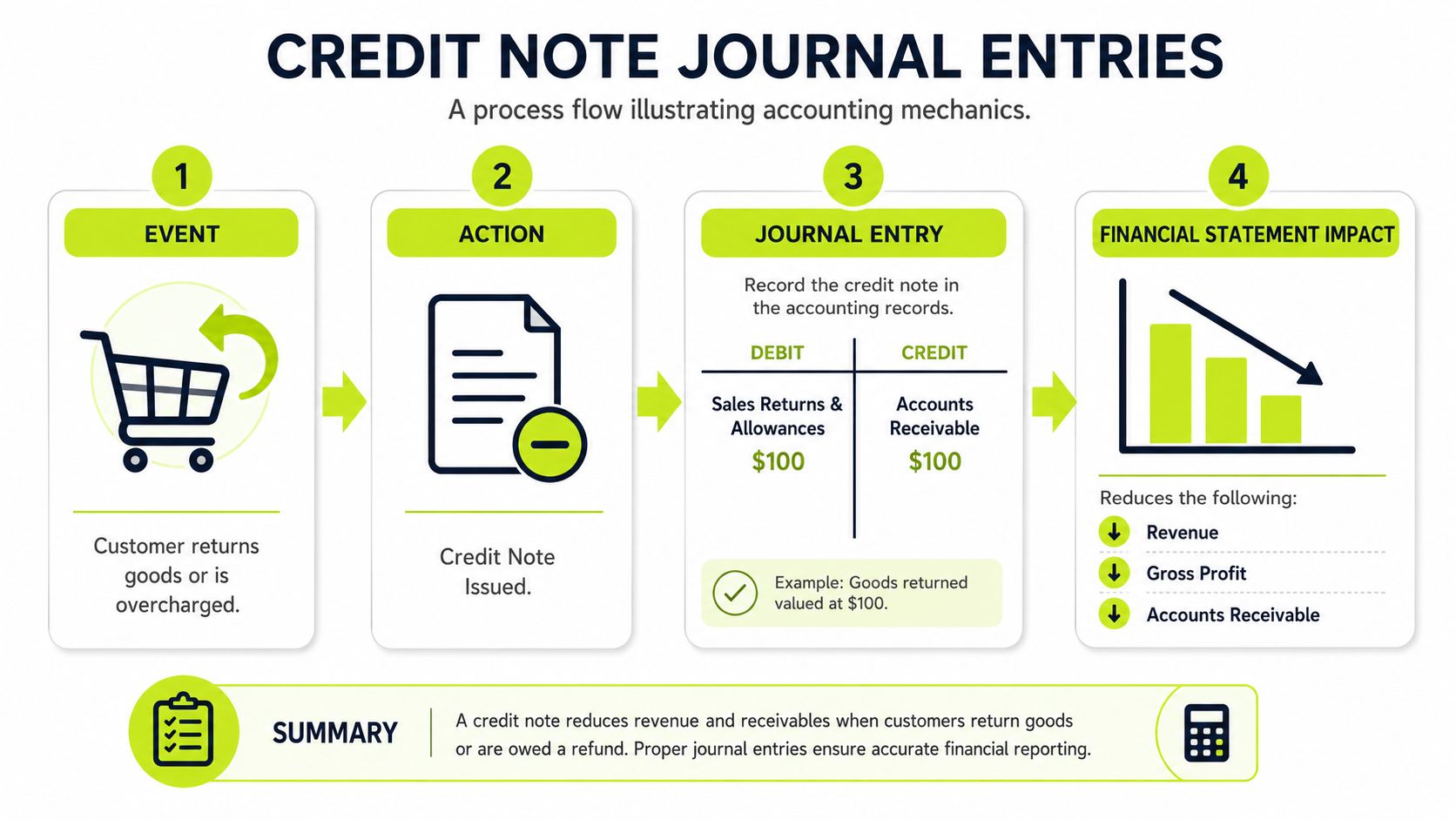
On the seller's books
For your firm, the credit note reverses some portion of what was previously recognized.
Typical effect:
- Debit revenue reduction account, such as sales returns and allowances, or the relevant revenue account
- Credit accounts receivable
If tax was included on the original invoice, the credit note should also reverse the applicable tax amount in line with your accounting and tax setup. The goal is simple. You should not carry receivables or revenue that no longer reflect the agreed commercial position.
A partial credit works the same way. Only the agreed portion is reversed, while the undisputed balance remains collectible.
On the buyer's books
From the client's side, the entry moves in the opposite direction.
Typical effect:
- Credit expense, cost, or prepaid account previously recorded
- Debit accounts payable, or recognize the credit balance if already paid
This is one reason clients often ask for the formal credit note before releasing payment on the remainder. Their AP team needs an official record that matches what your AR team is saying.
For firms that want a deeper lens on how adjustments move through the statements, this breakdown of financial statement impact from AR events is worth reviewing.
Why the P and L and balance sheet both matter
A surprising number of operating teams think of credit notes as “just AR paperwork.” They aren't.
They affect:
Area | Seller impact | Buyer impact |
|---|---|---|
Profit and Loss | Revenue decreases | Expense decreases |
Balance Sheet | Accounts receivable decreases | Accounts payable decreases |
Tax records | Tax on the reduced amount is reversed where applicable | Input or claimed tax position is adjusted where applicable |
That's why finance should resist pressure to “fix it superficially.” Superficial fixes often leave one statement corrected and another untouched.
A short walkthrough can help teams internalize it, especially when training new billing managers or partner admins.
Keep the original invoice intact. Post the correction through the credit note. That's what preserves the audit trail and makes downstream reconciliation possible.
A practical close checklist
Before posting a credit note at month-end, finance should confirm:
- Original invoice match: The credit note references the exact invoice being adjusted.
- Reason support: The file includes partner approval, client agreement, or dispute documentation.
- Tax treatment: Any tax reversal follows the original invoice treatment.
- Open balance update: AR aging reflects the revised collectible amount, not the outdated gross figure.
That discipline keeps the close clean and avoids reopening settled disputes in the next period.
How Poor Credit Note Processes Inflate Your DSO
Most firms don't think of credit notes as a DSO issue until the numbers stop making sense.
When a disputed invoice sits in AR awaiting approval, documentation, or correction, the receivable often stays open at the full billed amount. Collections sees a larger outstanding balance than the client agrees to pay. Finance reports aging that includes dollars no longer collectible as invoiced. DSO rises for the wrong reason.
That's why timing matters. Invopop notes in its discussion of why prompt credit note issuance matters that issuing credit notes promptly is critical because delays can distort financial reporting and artificially inflate outstanding receivables. That matters even more in an environment where 1 in 10 invoices go unpaid, costing enterprises $200B annually.
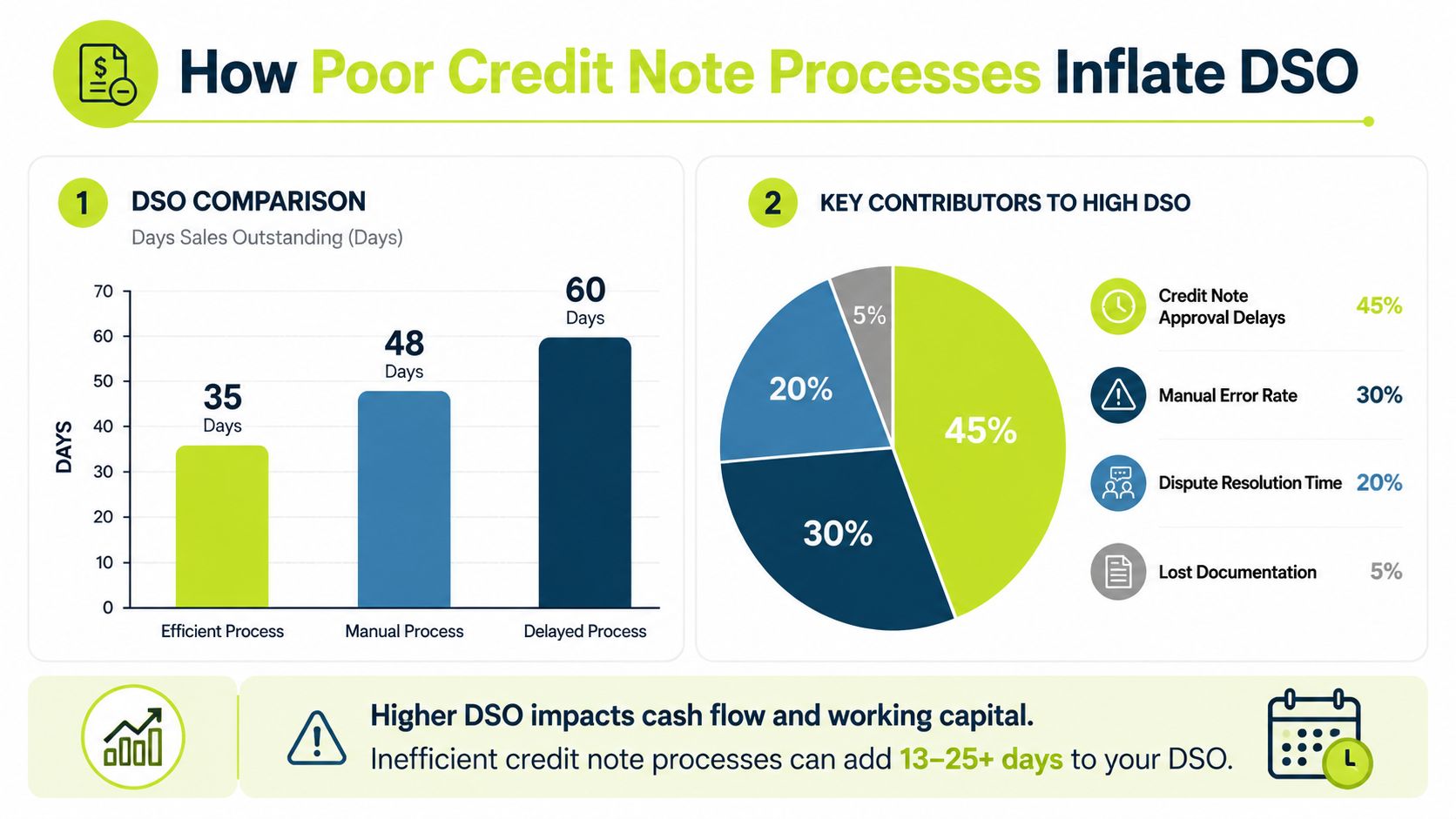
What actually goes wrong operationally
The inflation usually comes from process drag, not accounting complexity.
A partner agrees to a reduction but doesn't tell billing. Billing emails AR but doesn't attach support. AR stops collection activity because the amount is “under review.” The client withholds payment on the entire invoice, not just the disputed portion. By the time the credit note is issued, the undisputed cash is late too.
In professional services, this hits two pressure points at once. It weakens cash forecasting and muddies team accountability. Collections looks slower than it is. Engagement leadership thinks clients are stretching payments. Often, the problem is unresolved invoice adjustment workflow.
Why the undisputed balance gets trapped
Clients rarely separate the disputed and undisputed pieces as neatly as finance would like. If your invoice is under question, many AP teams put the whole thing on hold.
That creates a hidden cost. A delayed credit note doesn't just postpone the adjustment. It often postpones cash on the clean portion as well.
The longer a dispute sits without a formal credit, the more likely the entire invoice stops moving through the client's payment queue.
For firms tracking collections performance, that can produce false conclusions. You may push collectors harder when the issue really sits upstream in approvals and billing governance. If you're reviewing this metric often, it helps to revisit how Days Sales Outstanding should be interpreted when disputes and adjustments are stuck in process.
What works and what doesn't
The difference is rarely philosophical. It's procedural.
What works
- Same-day triage: Finance classifies the issue as dispute, error, or commercial concession quickly.
- Partial collection discipline: AR continues pursuing the undisputed portion once the revised amount is clear.
- Approval boundaries: Partners can recommend credits, but finance controls issuance.
What doesn't
- Email-only approvals: They create ambiguity and weak support for close and audit.
- Reissuing invoices casually: This breaks history and confuses the client's AP records.
- Letting credits wait for month-end: That may feel tidy internally, but it distorts AR in the meantime.
A slow credit note process is one of those small operational flaws that steadily erodes working capital control. CFOs who want to reduce DSO have to fix it at the source, not just demand better collection calls.
Using Automation to Manage Credit Notes and Improve Cash Flow
Manual credit note handling usually breaks in the same places. Approvals get buried. Original invoice references go missing. The client gets one answer from the partner and another from AR. Someone rekeys data into the accounting system, and reconciliation picks up the error later.
That's why accounts receivable automation matters here. Not because credit notes are glamorous, but because they sit at the junction of billing, collections, accounting, and client communication. If any handoff fails, the adjustment lingers and cash slows down.

Where automation helps most
A strong workflow connects the credit note directly to the invoice, routes it through the right approval path, and updates downstream records without duplicate entry.
For professional services firms, the practical wins usually come from these areas:
- Invoice linkage: The system enforces reference to the original invoice instead of relying on free-text notes.
- Approval routing: Disputes above a threshold can move to a controller or CFO, while routine billing corrections stay with finance operations.
- Client communication: The customer receives the formal adjustment promptly, along with the revised balance due.
- System sync: The posted credit updates the ledger and AR aging without waiting for manual reconciliation.
If you're using QuickBooks AR automation, this matters even more. Small and midsize firms often outgrow spreadsheet-based dispute handling before they realize it. QuickBooks can be a solid accounting core, but the operational layer around approvals, outreach, and dispute management often needs more structure.
The measurable case for AR software
There is good evidence that AR automation changes finance capacity, not just convenience. In Billtrust's report on the ROI of AR automation software, a study of 500 finance professionals found that 100% of respondents reported measurable gains including faster payments and accelerated cash flows, with two out of three AR professionals recognizing a 50% weekly productivity increase.
That doesn't mean every firm will see the same pattern. It does show that once teams remove manual bottlenecks, the gains appear in the places CFOs care about most. Payment timing, throughput, and staff capacity.
Why AI AR automation changes the equation
Basic automation moves tasks. AI AR automation can improve judgment at the workflow level.
A mature setup can identify which invoices are likely to stall because of documentation gaps, route disputed balances differently from standard follow-ups, and adapt outreach based on client behavior. In a professional services context, that matters because not every dispute should trigger the same treatment. A strategic client with a scope disagreement should not receive the same collection path as a chronically late payer ignoring approved invoices.
That's also why AR software for professional services should reflect how firms bill in practice. Time and materials, retainers, milestone invoices, success fees, and pass-through expenses all create different credit note patterns. Generic AR tools often understand the invoice but not the commercial reality behind it.
Good automation doesn't remove judgment. It gives finance a cleaner operating lane for applying judgment consistently.
Visual ideas worth using internally
If you're trying to improve your own process, three visuals tend to get buy-in from partners and operations leaders:
- A dispute aging waterfall showing how much open AR is waiting on credit approval versus true collection effort.
- A cinematic month-end close board with invoice issued, dispute raised, credit approved, and cash applied as separate stages.
- A side-by-side dashboard comparing gross AR to adjusted collectible AR after pending credits are reflected.
Used correctly, automation helps firms improve cash flow, tighten control, and reduce DSO without turning every client issue into a finance fire drill.
Conclusion A Framework for Control and Clarity
The best way to think about a credit note is simple. It is not an admin form. It is a tool for financial control.
When firms issue credit notes accurately and on time, they keep the audit trail intact, protect tax compliance, show a truer receivables position, and resolve client disputes without losing operational discipline. That's especially important in professional services, where billing often reflects judgment, changing scope, and relationship nuance rather than simple unit pricing.
The firms that struggle usually don't have a policy problem. They have a process problem. Approvals are slow. Documentation is scattered. AR is left to collect balances that no longer reflect the actual agreement. That's where DSO gets distorted and client friction grows.
Some firms handle overflow by outsourcing parts of the function, especially when they need help to reduce DSO and scale collections without overloading internal teams. Others tighten internal workflows and system controls. Either path works better when credit note handling is treated as part of AR strategy, not an afterthought.
Control comes from consistency. Clarity comes from documentation. A credit note gives you both when the process around it is built properly.
Resolut automates AR for professional services, helping finance teams manage billing, disputes, collections, and cash application with more consistency and less manual drag. If you want a more accurate receivables picture and a steadier way to improve cash flow, Resolut is built to support that work in a way that stays consistent, accurate, and human.