How to Calculate Net Accounts Receivable
Net accounts receivable equals gross invoices minus losses, discounts, and credits. A formula, a firm example, and the cash tied up in DSO.
Net accounts receivable is gross receivables minus the allowance for doubtful accounts and any discounts, credits, or other amounts that won't become cash. For example, $68.334 million of gross receivables less a $1.334 million allowance leaves $67.000 million of net accounts receivable.
You're in a forecast meeting, looking at an aging report that appears sufficient to cover payroll, partner distributions, and upcoming vendor payments. Then someone mentions a disputed scope change, a client who's stopped replying, and a payment that arrived but hasn't been matched.
The aging total hasn't changed. Your confidence in the cash has.
For CFOs, controllers, and owners of professional services firms, net accounts receivable is an estimate, not a collectible fact. The useful question isn't just what the ledger says clients owe. It's how much they'll pay, what evidence supports that judgment, and when the money should reach the bank.
Net Accounts Receivable Formula You Can Use
Calculate net accounts receivable by subtracting expected credit losses and other uncollected adjustments from gross open invoices, counting each deduction only once.
Start with the receivables control account, then reconcile it to the customer subledger. Don't begin with a spreadsheet total that excludes inconvenient accounts or includes invoices already settled.
The accounting formula is gross accounts receivable minus the allowance for doubtful accounts. For cash planning, also identify approved discounts, credits, and other adjustments that aren't already reflected in that gross balance or allowance.
Work through the balance in book order
Gross accounts receivable is your starting population of open customer invoices. Confirm that the reporting cutoff matches the trial balance and that receipts, credit notes, and invoice adjustments have been posted.
Next, subtract the allowance for doubtful accounts, also called an allowance for expected credit losses. This is a valuation estimate, not permission to cancel the customer's obligation or stop appropriate collection activity.
Then address credits, discounts, and specifically identified amounts that won't become cash. The QuickBooks accounts receivable guide distinguishes receivable balances from amounts that won't be collected in cash, which need appropriate bad-debt treatment.
From gross invoices to net accounts receivable
Line | What it is | Effect on planned cash |
|---|---|---|
Gross accounts receivable | Open customer invoices at full billed amount | Starting point; overstates cash if used alone |
Allowance for doubtful accounts | Expected credit losses, a valuation estimate | Subtract; invoices still exist |
Credit balances and credit memos | Amounts owed back to clients or already credited | Subtract or reclass; not inbound cash |
Approved discounts | Discounts customers are expected to take | Subtract from the collectible balance |
Other identified noncollectible amounts | Specific disputes or balances management won't collect | Subtract; don't leave them in the forecast |
Net accounts receivable | Remainder after those deductions | Best single accounting view of realizable receivables |
Use this as a close checklist, not an instruction to deduct every item again. A posted credit memo may already reduce gross receivables. A disputed balance may already be covered by the allowance.
Double-counting deductions understates the asset just as surely as ignoring them overstates it. Also review customer credit balances separately, since amounts owed back to clients may require reclassification rather than indiscriminate netting against unrelated invoices.
Check the arithmetic against an actual disclosure
A U.S. public-company receivables disclosure filed with the SEC reports $68.334 million gross, a $1.334 million allowance, and $67.000 million net for its latest reported year. The allowance was approximately 1.95% of gross; the prior-year figures were $58.250 million gross, a $937,000 allowance, and $57.313 million net, with an allowance rate of about 1.61% and net receivables growth of approximately 16.9%.
The arithmetic is straightforward. The interpretation requires more care: gross growth isn't equivalent future cash, and a changing allowance can indicate changing credit quality.
Close control: Every deduction should have an owner, supporting evidence, and a clear answer to whether it's already reflected in the ledger.
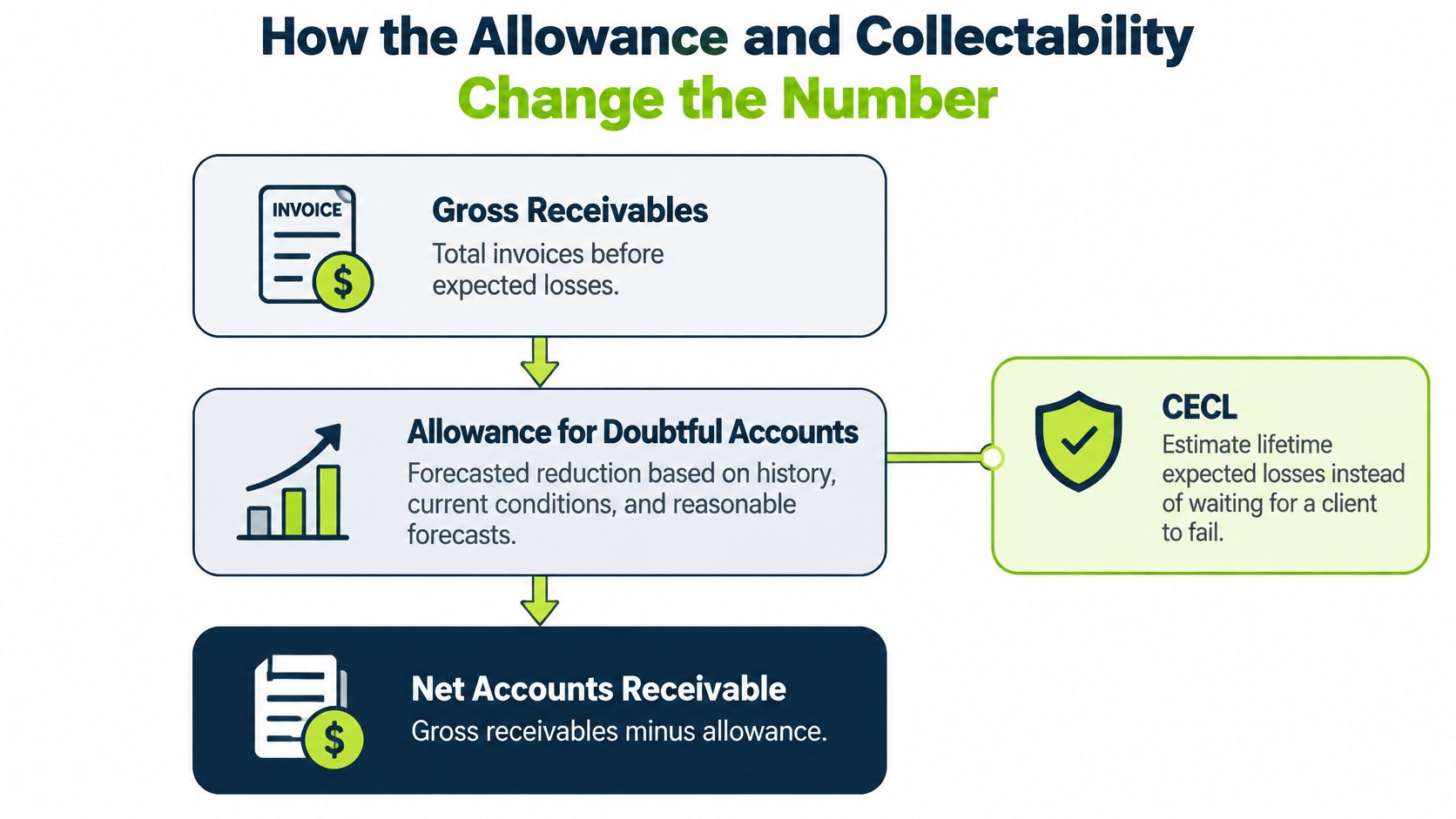
How the Allowance and Collectability Change the Number
Treat the allowance as a forecast, not a plug that makes the balance sheet look reasonable. A fixed percentage becomes difficult to defend when your client mix, payment behavior, or economic exposure changes.
The Federal Reserve's joint statement on the credit-loss accounting standard explains how CECL shifts measurement toward expected lifetime credit losses using historical experience, current conditions, and reasonable forecasts. You don't wait for a client to fail before recognizing an expected loss.
Confirm your firm's applicable adoption requirements and filer classification with your accounting adviser, including the effect of ASU 2019-10. Don't use an early implementation schedule as a substitute for checking the requirements that apply to your entity.
The relationship between the accounting balances is simple; the evidence behind the allowance isn't.
Build an evidence-based close memo
The controller's memo should explain why the estimate changed, or why it didn't. Include these inputs:
- Client-specific credit problems. Record insolvency concerns, funding constraints, adverse credit changes, and significant customer concentrations.
- Aging migration. Identify balances moving into older categories, especially where the same clients repeatedly miss revised payment dates.
- Historical write-offs. Compare loss experience with the current portfolio rather than applying a company-wide rate without examining the mix.
- Open disputes. Separate billing corrections, scope disagreements, and genuine inability to pay. Assign each dispute an owner and next action.
For IFRS reporters, the BDO guide to IFRS 9 explains the use of provision matrices and adjustments to historical loss rates for current conditions and reasonable, supportable forecasts. Last year's loss rate is a starting point, not this year's answer.
Segment the portfolio when clients don't share meaningful risk characteristics. A long-standing corporate client disputing a purchase-order reference shouldn't automatically receive the same treatment as a financially stressed client who has stopped communicating.
Document the adjustment, the evidence, and the approver. A practical allowance for uncollectible accounts framework can help formalize that review without turning every invoice into a separate accounting model.
Separate the accounting balance from recovery evidence and timing
Consider two invoices that are both 60 days past due: one client is discussing a scope dispute, while the other no longer responds; an SEC-filed receivables policy also describes failure to pay within 90 days, combined with failure to engage on an alternative arrangement, as evidence that recovery may no longer be reasonably expected.
That's a company-specific judgment, not an automatic write-off deadline. Aging alone doesn't capture the difference between an unresolved administrative issue and a deteriorating debtor.
Keep these views distinct:
View | Question it answers | Evidence to review |
|---|---|---|
Reported net AR | What carrying value does the accounting policy support? | Approved allowance methodology and adjustments |
Operationally collectible AR | Which balances appear recoverable now? | Contactability, disputes, partial payments, broken promises, credit changes |
Expected cash timing | When should recoverable balances arrive? | Payment arrangements, dispute milestones, credible commitments |
A lower overdue balance can conceal deterioration if the team re-ages invoices, grants repeated concessions, or concentrates only on easy accounts. Review original due dates and the cost of concessions alongside collection results.
A more optimistic estimate doesn't create liquidity. Better evidence makes the estimate more useful.
A Worked Example for a Services Firm
Consider an illustrative architecture practice with $18 million in annual fees and approximately $1.5 million in monthly credit sales. These are hypothetical operating figures, not a reported client result.
At month-end, the practice has $2.4 million in gross accounts receivable. Two clients are in active billing disputes, and the controller's documented assessment supports a 3% allowance, or $72,000.
Expected early-payment discounts total $18,000, and open credit memos total $25,000. For this example, neither adjustment has already reduced gross receivables, and neither is included in the allowance.
Build the month-end number
Illustrative net accounts receivable for an $18 million firm
Line | Notes |
|---|---|
Gross accounts receivable | $2,400,000 of open invoices |
Less allowance at 3 percent | $72,000, reflecting the assessment of two clients in billing disputes |
Less expected discounts | $18,000 of early-pay discounts likely to be taken |
Less credit memos | $25,000 already credited, not inbound cash |
Net accounts receivable | $2,285,000, the realizable balance the books currently support |
Same gross, allowance at 5 percent | $120,000 allowance; $2,237,000 net, with discounts and credits unchanged |
The calculation is:
$2,400,000 − $72,000 − $18,000 − $25,000 = $2,285,000.
Now assume sales and gross receivables stay flat, but new evidence supports a 5% allowance. The allowance rises to $120,000, and net accounts receivable falls to $2,237,000.
That $48,000 decline is a collectibility signal, not a sales miss. Management should ask what changed in the underlying evidence rather than explaining the movement as ordinary billing volatility.
Post the estimate separately from a write-off
To increase the illustrative allowance from $72,000 to $120,000, record:
Account | Debit | Credit |
|---|---|---|
Bad-debt expense | $48,000 | |
Allowance for doubtful accounts | $48,000 |
Recording the additional expense increases the allowance and reduces net receivables. It doesn't remove an invoice from the customer ledger.
A subsequent write-off of a specifically identified $10,000 invoice, already covered by the allowance, uses a different entry:
Account | Debit | Credit |
|---|---|---|
Allowance for doubtful accounts | $10,000 | |
Gross accounts receivable | $10,000 |
Gross receivables and the allowance both decline by the same amount, so net receivables don't change at the moment of that write-off. A later recovery is actual cash received; record it under the firm's recovery procedure rather than inflating the old invoice balance to improve the forecast.
For your own close, fill in a working paper from the trial balance:
- Gross receivables: __
- Current allowance amount and percentage: __
- Expected discounts not already posted: __
- Credits not already reflected: __
- Net accounts receivable: __
- Last quarter's allowance percentage: __
Require an explanation for the movement in the percentage. An unchanged rate deserves scrutiny when the underlying portfolio has changed.
What Net Receivables Mean for Cash and DSO
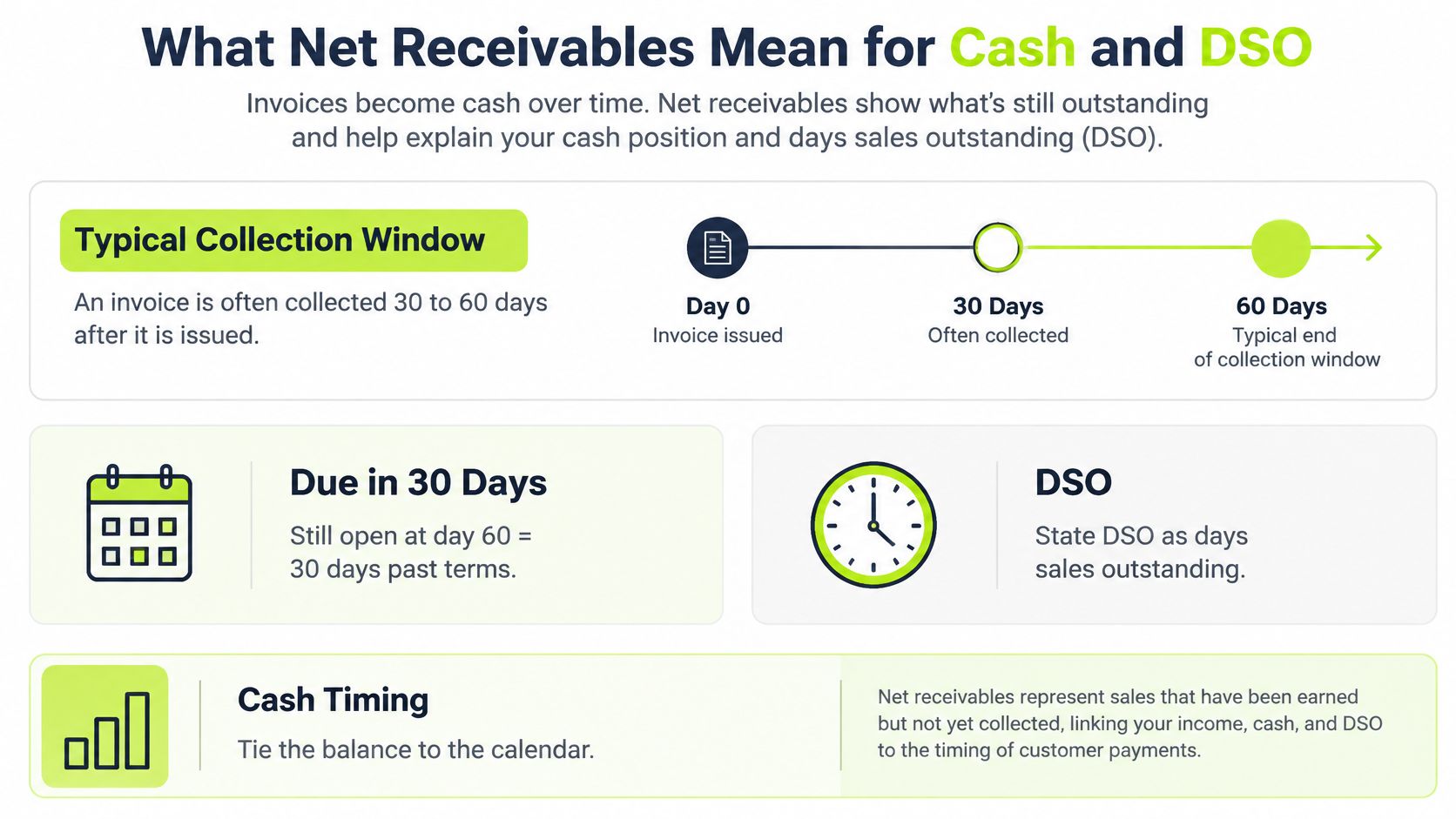
At $1 million in monthly credit sales, an additional DSO day represents approximately $33,333 still tied up in receivables, and 10 fewer days represents roughly $333,333 of working capital before disputes, write-offs, or seasonality, using the relationship described in the QuickBooks accounts receivable overview. That guide describes a typical collection window of 30 to 60 days after invoice issuance.
An invoice contractually due in 30 days but still open at day 60 is therefore 30 days beyond terms. Contract terms and actual collection timing are different inputs to the forecast.
Translate days into dollars
DSO = accounts receivable ÷ credit sales × days in the measurement period.
For the illustrative scale comparisons below, assume annual fees are entirely credit sales and spread evenly across the year. Divide annual fees by months to obtain monthly sales, then divide monthly sales by 30; these are planning calculations, not observed performance benchmarks.
Cash tied up per extra day of DSO
Annual fees | Cash per extra DSO day | Cash from 10 fewer days |
|---|---|---|
$3 million | About $8,333 | About $83,333 |
$12 million | About $33,333 | About $333,333 |
$18 million example | About $50,000 | About $500,000 |
Using that same monthly-sales method, an illustrative firm near $50 million in annual credit fees has approximately $138,900 tied up per additional day. Real cash release will differ when billing is concentrated around milestones or clients pay seasonally.
The collection calendar helps connect an accounting balance to a cash expectation.
Choose the numerator for the decision
Use net accounts receivable when you're examining the receivable amount you expect to realize. Retain gross DSO as a process measure because it preserves visibility into billing volume and delays without letting allowance changes improve the apparent collection result.
Keep the definition consistent across periods. The guide to calculating days sales outstanding is useful for setting that measurement policy, while the MyOfficeOps guide to faster payments provides additional context for connecting DSO to collections work.
The practical levers are straightforward: invoice when completed work is approved for billing, include clear payment instructions, offer electronic payment, review aging by client, and escalate under a written rule.
Measurement discipline: To reduce DSO and improve cash flow, measure actual collection progress, not just a smaller reported receivables balance.
How Accurate Application Protects the Balance
Cash can be in the bank while an invoice still appears unpaid. A bare deposit or an unmatched receipt can leave invoice-level aging overstated, distort the allowance analysis, and trigger an unnecessary reminder.
Before pursuing an overdue client, inspect the payment record and remittance detail. The operational question is whether the receipt has cleared the correct open invoice, not whether the bank balance increased.

Enter the payment against the invoice
The QuickBooks payment-entry workflow calls for the customer, amount received, payment method, deposit account, and invoice or invoices being paid. It supports partial payments and the application of relevant credits and discounts.
Use that order as the team's application checklist:
- Customer: Confirm the legal customer and account, especially where a parent company pays for several entities.
- Amount received: Match the receipt to remittance advice and investigate differences rather than forcing a match.
- Payment method: Record how the client paid so the receipt can be traced.
- Deposit account: Select the appropriate destination, including Undeposited Funds where the workflow requires it.
- Invoices paid: Apply the receipt to the specific balances and leave legitimate partial balances open.
Receiving payment and reconciling a bank deposit are different steps. Undeposited Funds can hold recorded receipts before the bank deposit is assembled and reconciled.
Don't solve an application problem by posting another receipt. Trace the existing transaction first, then correct the match or classification without duplicating cash.
For a visual companion to the payment workflow, use this walkthrough.
Automate the control, not the assumption
At firm volume, accounts receivable automation should preserve the same discipline: release approved invoices, apply receipts promptly, and stop follow-up when payment is confirmed. QuickBooks AR automation is useful when it keeps accounting status and outreach aligned, not when it merely sends more messages.
Evaluate AI AR automation on exception handling as well as cadence. The team should retain judgment over disputed scope, sensitive client relationships, and unsupported promises to pay.
For finance teams standardizing both sides of working capital, SIX ERP's accounts payable automation steps offer a useful comparison for designing controlled workflows. Keep payment authorization on the payable side separate from receipt matching on the receivable side.
Track unapplied receipt value, unresolved matching exceptions, paid invoices contacted in error, and the time needed to clear application issues. These measures show whether the workflow produces cleaner information.
AR software for professional services should sound like the firm. A payment reminder is a client conversation, and an accurate status matters as much as a consistent tone.
Reconcile Net Receivables Before You Forecast Cash
Use this month's net accounts receivable in the forecast only after the allowance matches current client evidence, disputed and silent accounts aren't hidden in a blended rate, and unapplied receipts have been cleared.
A reconciled total is the starting point. The remaining task is to assign credible timing to the balances management expects to recover.
Run a short close routine
- Pull the balances: Gross receivables, the allowance, open credits, and expected discounts.
- Recompute net: Tie the result to the ledger and investigate differences through a documented accounts receivable reconciliation.
- Compare the estimate: Put the current allowance percentage beside last quarter's and explain the movement.
- List missing evidence: Identify broken commitments, unresolved disputes, and other invoice-level facts the current estimate doesn't yet reflect.
That exception list defines the gap between the reported number and the operating forecast. Give each material item an owner and a next decision.
For firms serving healthcare clients, Clarity's discussion of recovering aging revenue for medical practices provides a sector-specific comparison. Keep the distinction clear between professional-services client invoices and medical-practice revenue workflows.
Keep follow-up connected to the forecast
Resolut automates follow-ups, scores which customers will pay late, and forecasts cash. When QuickBooks Online is connected, invoice payment status syncs live; Resolut also detects paid stamps on uploaded PDFs and automatically turns off outreach for that invoice, while users can mark an invoice paid manually in one click.
The person stays in control of tone, and invoice accuracy remains the firm's responsibility. Use automation to keep operational evidence current, then make the forecast decision from supported amounts and credible payment dates.
Resolut automates AR for professional services, consistent, accurate, and human. If you want follow-up activity and cash expectations to stay aligned, visit Resolut and explore how it can support a more dependable receivables forecast.