Payment Reconciliation Process: A CFO Guide to Faster Close
Learn how the payment reconciliation process helps CFOs close books faster and more accurately.
The month-end close is on the calendar, cash is tighter than the revenue report suggests, and someone in finance is still chasing down a stack of unmatched payments that should've cleared days ago. In a professional services firm, that usually means the books look “almost done” while the question stays open, where did the money land, and what's still sitting in exceptions?
That gap is why the payment reconciliation process matters. It's not just a bookkeeping routine. It's the control layer that tells a CFO whether cash is visible, whether AR is behaving, and whether the team is spending time on real issues or cleaning up avoidable noise.
Why Payment Reconciliation Deserves Your Attention
A lot of firms treat reconciliation like a back-office chore that can wait until the end of the week or the end of the month. That works until a partner asks why collections look fine on paper but the bank balance says otherwise. Then the team starts digging through deposits, processor reports, fee deductions, and stale exceptions, and the close gets longer because the process was never built to surface breaks early.
That's the hidden cost. Manual reconciliation can leak 1–2% of net revenue, and in marketplace-style environments the leakage can reach 2–3% of gross payment volume according to Corpay's payment reconciliation guidance, which also notes manual data-entry error rates at month-end around 2–5%, dropping to roughly 0.01% with automation. Corpay's payment reconciliation overview makes the operating risk clear, even before you get to staffing strain or audit cleanup.
For smaller professional services firms, the issue is usually less dramatic and more constant. Fees get netted off, reference numbers are missing, and someone has to decide whether a break is timing, a short pay, or a real problem. That is why the process belongs in cash management, not only in accounting. It also connects directly to bank reconciliation for small businesses, because the same mismatches that slow the books also hide the cash position.
Practical rule: if the exception queue keeps growing faster than the books close, reconciliation has become a cash-visibility problem, not a clerical one.
AI-assisted matching changes the economics because it cuts the time spent on routine comparisons and leaves fewer items for analysts to chase by hand. Mature deployments now reach 85–95% straight-through match rates, reduce manual matching time by 70–80%, and shrink exception queues to 5–15% of transactions in the benchmark data from Stealth Agents' 2026 research on AI payment reconciliation automation. That matters because every item that clears automatically is one less item sitting in a human inbox at month-end.
For CFOs and controllers, the payoff is not speed for its own sake. It is cleaner cash visibility, fewer unresolved breaks, and a close process that does not depend on heroics from one overloaded analyst. It also makes cash application work easier to manage, especially when teams rely on cash application in accounting to reduce manual touchpoints and keep the reconciliation queue from turning into a backlog.
The Six-Step Reconciliation Workflow That Actually Works
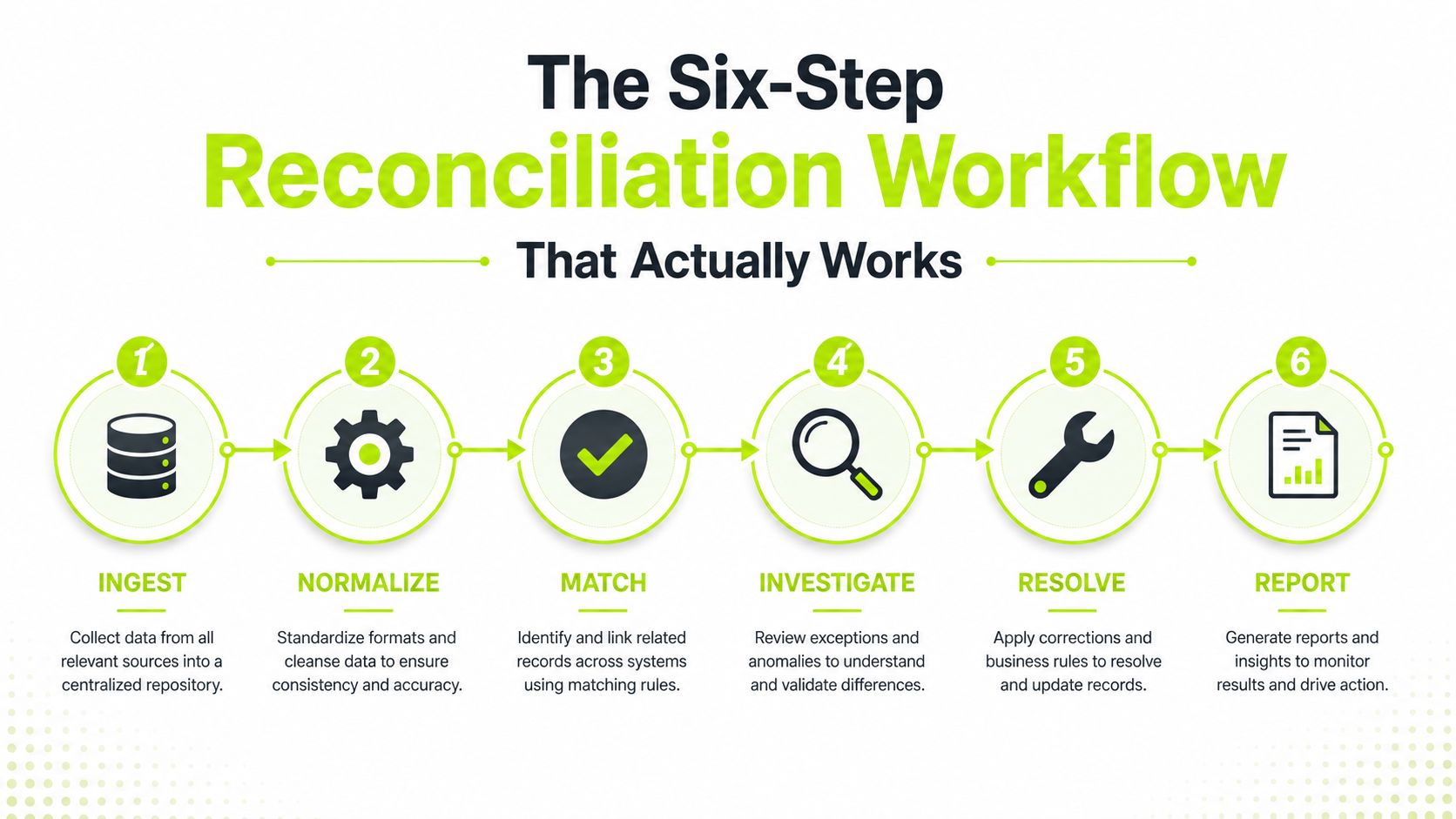
The strongest reconciliation workflows don't start with matching. They start with data discipline. If bank files, processor exports, ERP entries, and billing records all arrive in different formats, the team ends up manually translating the same payment three or four times before anyone even sees the mismatch.
1. Ingest raw source data
Pull the raw records from payment rails, processors, banks, invoicing systems, and the ledger. The goal is to capture the unedited source, not a spreadsheet someone has already massaged. That keeps the audit trail intact and makes later exceptions easier to explain.
2. Normalize into one schema
Many firms lose hours here. Settlement files, order records, and bank feeds need to be mapped into a shared structure so amounts, dates, references, fees, and currencies line up. Without that normalization, matching becomes an exception-management exercise instead of a deterministic close process, which is exactly the failure mode described in Payrails' payment reconciliation process guide.
3. Match on stable identifiers
Date-only or amount-only logic is too weak for real finance operations. Transaction-level identifiers and settlement-file references are safer because they reduce false positives and make the match explainable. If you need a broader primer for smaller teams, bank reconciliation for small businesses is a useful contrast, but professional services firms usually need a more rigorous payment-level view.
4. Flag and classify unmatched items
Unmatched items belong in a controlled queue, not in ad hoc email threads. Classify them by root cause, timing gap, fee deduction, FX variance, chargeback, duplicate payment, or missing reference data. That classification turns the queue into a management tool instead of a pile of loose ends.
5. Investigate and resolve breaks
The analyst should not be guessing. They should be asking whether the issue came from upstream data quality, rail variability, or policy around gross versus net amounts. A cash application workflow often intersects here, especially when open invoices need to be tied to a payment that arrived net of fees, which is why a reference point like what is cash application in accounting is helpful for teams linking AR and reconciliation work.
6. Post adjustments and close
The final step is not “match complete.” It's recording the adjustment in the ERP or general ledger, documenting who ran the work, and confirming what remains open before period close. That's the point where the process becomes a control, not just a task.
For operators, the best model is simple. Let systems clear the clean majority, and let humans spend time only on the exceptions that need judgment. That's how the workflow stays fast without losing control.
Common Failure Modes and How to Diagnose Them
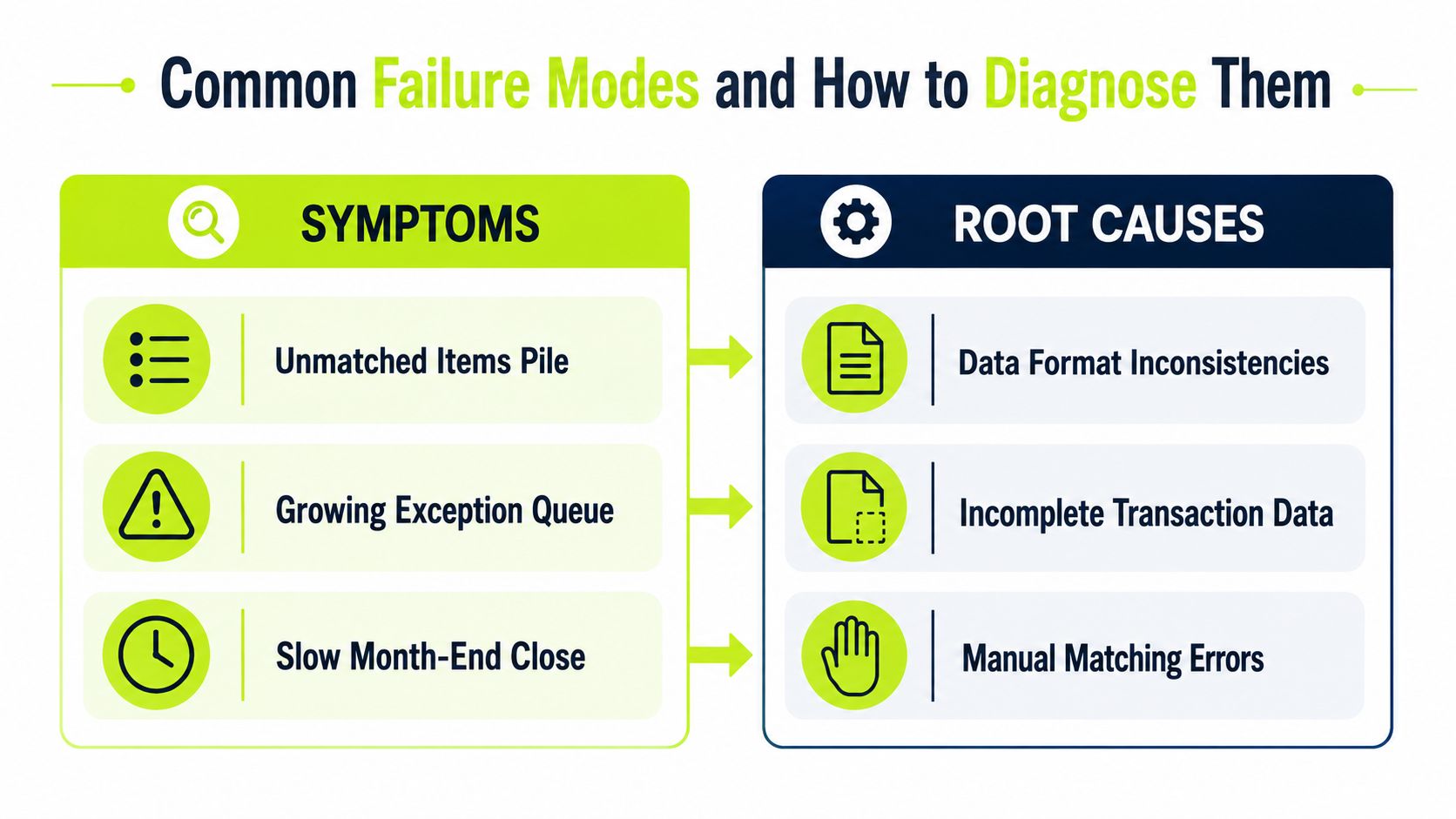
When reconciliation starts slipping, the symptoms are usually visible before the cause is. The queue grows, the close drifts, and the team spends more time explaining breaks than clearing them. The hard part is telling whether the root problem sits in data quality, rail behavior, or accounting policy.
Start with the data layer
If settlement files, order records, and bank feeds don't map cleanly to a shared schema, matching quality falls fast. That's the most technical failure mode because it makes every downstream problem look like a finance issue when the issue is upstream formatting. Mismatched references, partial settlements, missing fields, and inconsistent file structures are all signs that normalization is weak.
Separate timing issues from true discrepancies
Some breaks are just timing. Others reflect partial settlements, chargebacks, refunds, or fees that change the final net amount. If your process treats every mismatch the same way, the queue turns into a bottleneck because no one knows what can be cleared automatically and what needs investigation.
The most useful question is not “what didn't match?” It's “what category of break is this, and who owns the resolution?”
Watch for policy problems
A lot of teams try to reconcile gross and net values without first deciding how fees, withholding taxes, and FX variance should be treated. That's where accounting policy becomes the bottleneck. Optimus' payment reconciliation guide is one of the few neutral sources that calls out the operational difficulty of multi-currency and fee-heavy reconciliation, which is exactly where many firms get stuck.
The diagnosis should be practical. Ask three questions. Is the data source reliable across PSPs and banks? Is the payment rail introducing partials, delays, or deductions? Or is the accounting policy unclear on how to book the adjustment?
Track the right KPI
Matched rate alone doesn't tell the whole story. The metric that matters operationally is unresolved-exception rate by category, plus time-to-resolve for each break. Those two numbers tell you whether the issue is upstream data quality, payment rail variability, or policy ambiguity. They also show whether the team is improving or just getting faster at handling the same mess.
Once you can classify the break, you can fix the process. Before that, the queue just looks busy.
Automating Cash Application and Exception Resolution
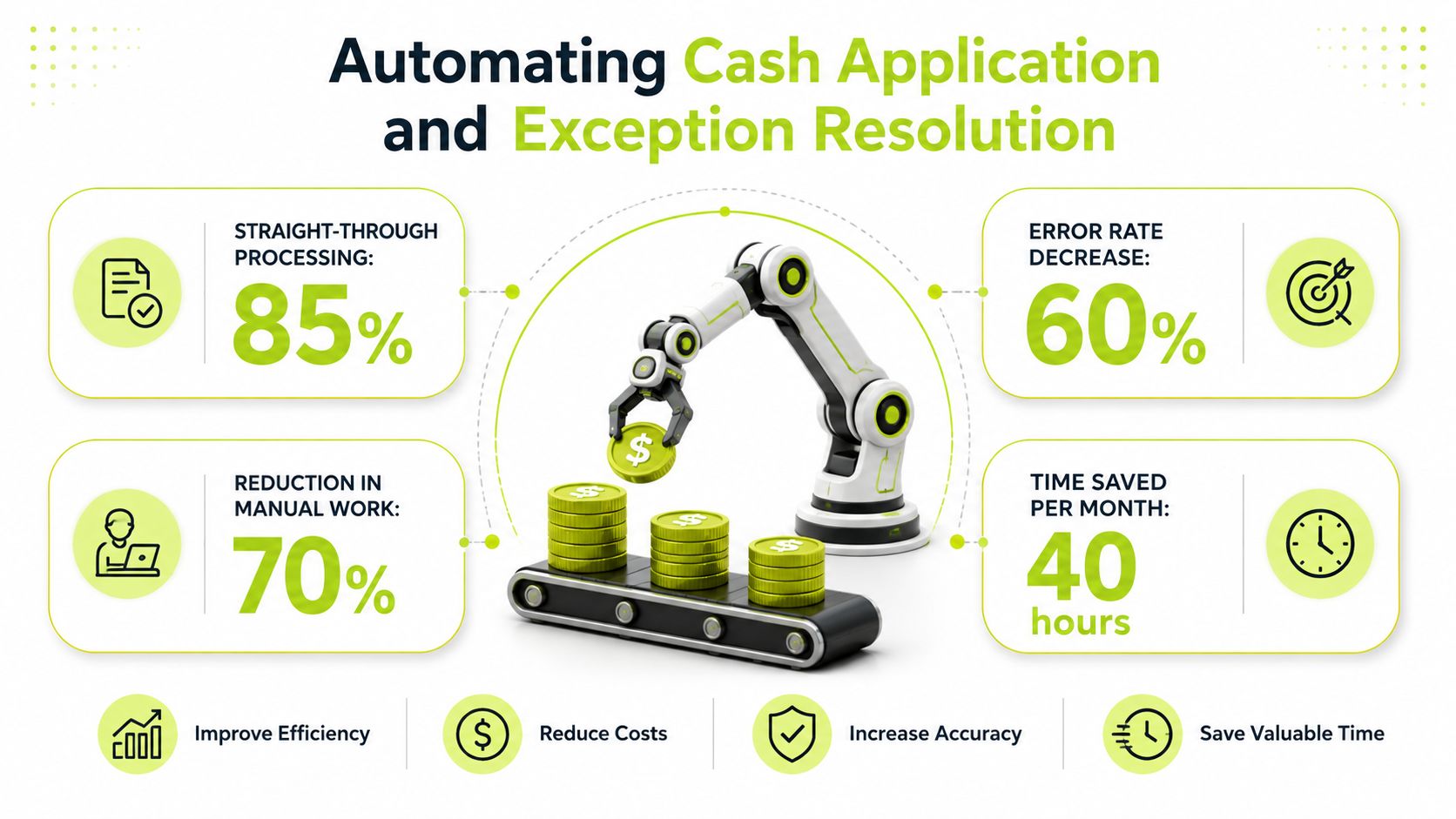
Automation changes reconciliation work by shifting the team away from line-by-line matching and toward exception control. In mature deployments, AI payment reconciliation systems are built to push clean matches through quickly, reduce manual matching time, and shrink exception queues to a manageable slice of the total volume, as shown in Stealth Agents' benchmark research. The operational value shows up fast, less manual grind, fewer unresolved breaks, and a tighter close.
What good automation does
Good automation starts with rules, not magic. It uses stable identifiers, normalized data, and reviewer approval on the exceptions that need judgment. The system clears clean matches, routes fee-related or FX-related breaks to the right owner, and preserves the audit trail as it goes. For a practical implementation view, the automated payment reconciliation guide is a useful reference point.
Where human review still belongs
Co-pilot mode matters because not every break should be auto-posted. Short payments, duplicate deposits, refund reversals, and unusual chargebacks still need a person to confirm the accounting treatment. AI-assisted reconciliation is supposed to keep judgment focused on the cases that matter, not remove it.
Operational standard: automate the repetitive match, review the ambiguous break, and document every adjustment before period close.
Implementation should fit the finance stack
The best results come when reconciliation is connected to cash application, billing, and the ERP instead of sitting as a standalone file dump. For firms comparing tooling options, the guide to RPA automation helps frame where workflow automation ends and finance controls begin. One platform in this space is Resolut, which combines cash application with AR workflow orchestration and automatic payment application, so the same payment record can move through matching and posting with less manual handling.
Implementation is rarely instant. Teams usually get the biggest gains by tightening reference discipline first, then automating clean matches, then layering exception routing on top. The ROI shows up in faster close speed, fewer unmatched items at month-end, and less analyst time spent hunting for data that should have been structured upstream.
A short video walkthrough can help teams see how these controls work in practice.
Cross-Border Complexity and Real-Time Reconciliation
Cross-border reconciliation gets messy because the payment you expect is rarely the amount you settle. Gross payment, processing fees, taxes, withholding, and FX conversion can all change the final number before it reaches the ledger. That's why a simple invoice match stops being enough once a firm operates across PSPs, banks, billing systems, and ERPs.
The operational problem is net settlement. Finance teams need to understand why a payment landed short, whether the difference is legitimate, and which ledger account should carry the adjustment. Prosight's piece on real-time reconciliation captures the shift well, from month-end cleanup to continuous cash-visibility workflows, where exceptions are surfaced as they happen instead of being discovered days later.
That shift changes staffing too. In a batch model, analysts spend the end of the month clearing a backlog. In a continuous model, they triage smaller queues throughout the period, which means ownership, reference discipline, and escalation paths all need to be clearer. Faster posting can expose exceptions sooner, but only if the upstream billing and collections process carries the right identifiers from the start.
The same idea applies to international payments. Resolut's international payments resource is relevant here because cross-border flows rarely fail at the point of payment alone, they fail where currency, timing, and fee logic meet the ledger. That's why real-time reconciliation can't be treated as a software feature. It's a process design choice that affects how quickly cash becomes visible and how confidently controllers can trust the numbers.
Building Controls That Support Audit and Period Close
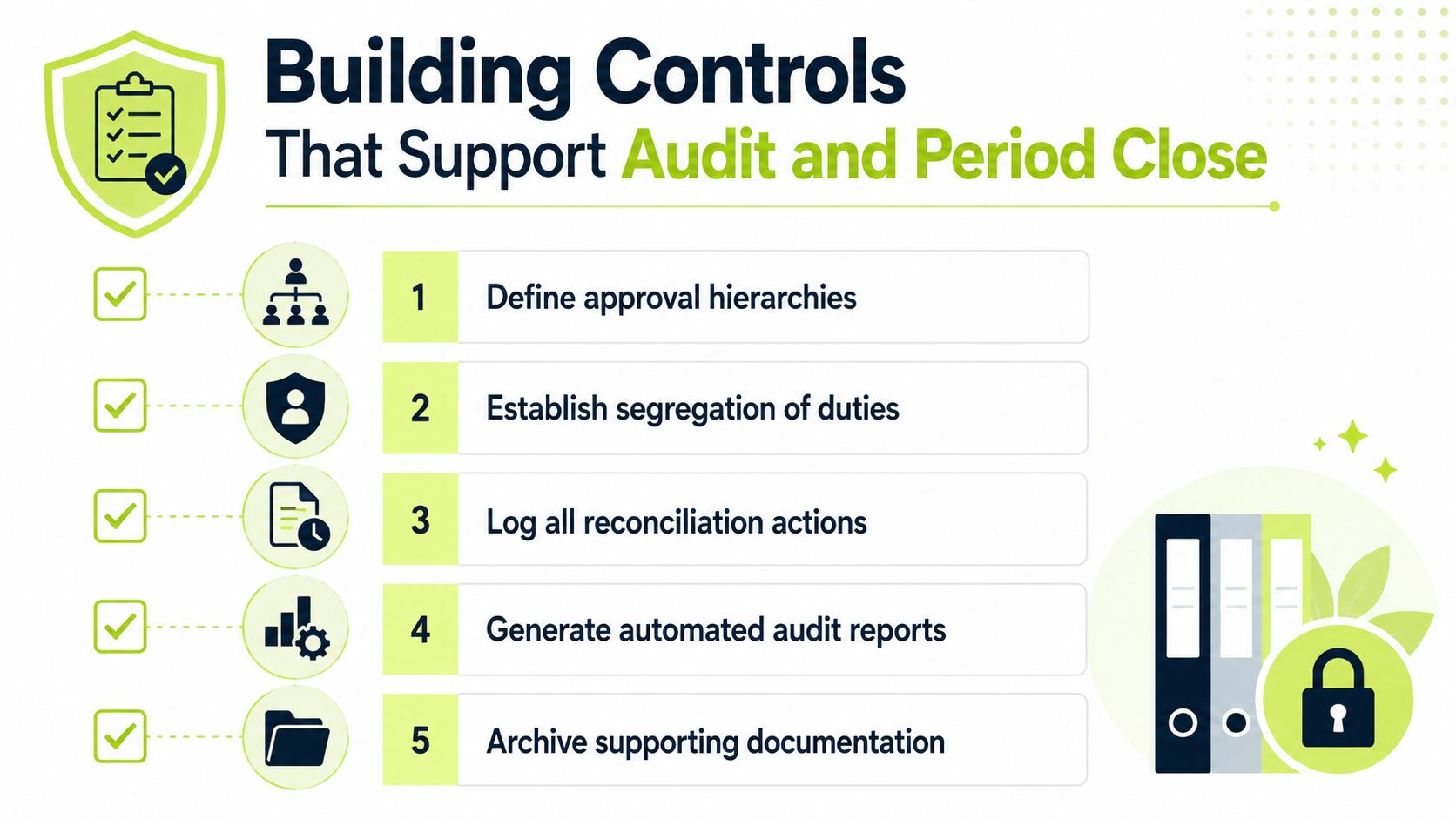
Reconciliation is only useful to a controller if it survives review. Matching transactions is the operational step. The control step is what happens after the match, when adjustments are recorded, ownership is clear, and the work can stand up to audit questions.
Build the close around documentation
Every reconciliation run should say who executed it, what period it covered, and what remains open. That documentation matters as much as the match itself because it gives the reviewer a clear trail from source data to adjusted ledger balances. Ledge's explanation of payment reconciliation controls makes the audit trail requirement explicit, and that's the standard finance teams should hold themselves to.
Separate approval from execution
The person who runs the reconciliation shouldn't be the only person approving the adjustment. Approval hierarchies and segregation of duties protect the control environment and make it easier for finance managers to sign off on the close. If a firm is documenting internal control standards, Logical Commander's internal controls guide is a practical companion for thinking about governance outside the reconciliation screen itself.
Keep the ERP as the source of record
If an exception is resolved, the adjustment belongs in the ERP or general ledger, not only in a reconciliation tool. That keeps subledger activity aligned with financial statements and avoids the common trap where the ops team says a break is resolved but the books still don't reflect it. The audit trail should show the original break, the decision, the adjustment, and the approver.
Reconciliation is finished when the ledger is clean and the documentation is complete, not when the queue looks smaller.
For professional services firms, that distinction matters because client billing, retainers, and project timing can make cash application and accounting timing diverge. A controlled process keeps those differences explainable instead of accidental.
--- Resolut automates AR for professional services with cash application, reconciliation, collections, and billing workflows in one system. If your team wants fewer unmatched items, cleaner close cycles, and better cash visibility without losing human oversight, visit Resolut and see how it fits into your finance stack.