Prompt Payment Discount: A CFO's Working Guide
Prompt payment discount explained for CFOs and controllers. See how 2/10 net 30 affects cash flow, DSO, accounting, and ROI in professional services firms.
A controller at a professional services firm opens the morning cash report and sees the same problem again. The firm has delivered the work, issued the invoices, and booked the revenue, but a meaningful share of the cash is still sitting in client approval queues. Sales wants to preserve relationships, delivery wants to keep projects moving, and finance needs cash without adding another draw to the credit facility.
A prompt payment discount can pull that cash forward. It can also become an expensive habit that erodes revenue. The difference depends on the buyer's payment behavior, the firm's cost of capital, and whether the policy is executed consistently enough to affect cash rather than merely decorate an invoice.
The Two Percent That Changes the Cash Plan
A controller sees a $400,000 invoice run issued on 2/10 net 30 terms. Clients can pay 2% less within 10 days, or pay the full balance on day 30. The decision is whether twenty days of earlier cash justify giving up part of the invoice value.
That is a short-term financing decision, not a bookkeeping footnote.
Under 2/10 net 30, the buyer pays 98% of the invoice within the discount window. The implied annualized value is roughly 36.7% for 2/10 net 30. Buyers with surplus liquidity may treat that discount as an attractive return. Sellers should treat it as the cost of accelerating receivables, then compare that cost with their borrowing rate, cash reserves, and the probability that the buyer will pay late.
A buyer who reliably pays on day 30 can make the discount a working-capital win for the seller. A buyer who usually pays on day 12 may turn the same 2% into a margin giveaway, especially if the firm would have collected almost as quickly without offering it.
Professional services billing adds operational friction. Clients may require invoice review, partner approval, procurement coding, and payment scheduling before funds are released. If a discount changes the actual collection date, earlier cash can fund payroll, subcontractors, tax obligations, or new project work without another draw on the credit facility.
Practical rule: Treat every discount as a financing proposal. Record the revenue surrendered, the expected collection date, and the cash requirement that earlier receipt would cover.
Three questions belong in the policy:
- What does the term mean? Sales, client service, billing, and the buyer must apply the same discount window and due date.
- Does the math work? Compare the annualized cost with the firm's actual financing alternatives and the client's payment behavior.
- Can the team run it cleanly? The invoice, payment portal, ledger, tax treatment, and close process must produce the same result.
A 10-day DSO swing can move six figures through a professional services firm's cash plan when recurring billings and work in progress are substantial. Prompt payment discounts therefore belong in AR planning. They can reduce DSO without increasing debt, but only when customers pay earlier in practice and the surrendered margin stays within the firm's cost-of-capital threshold.
What a Prompt Payment Discount Actually Is
A prompt payment discount is a seller's offer to reduce an invoice balance when the buyer pays before the normal due date. If the buyer misses the early-payment window, the full invoice balance remains due at the stated net date. The terms should appear clearly on the invoice, including the applicable date and the amount payable after the discount.
The notation follows a consistent pattern:
- The first number is the discount percentage.
- The middle number is the number of days available to claim it.
- The final number is the normal due date for the undiscounted balance.
Term Notation | Discount Rate | Discount Window (Days) | Net Due (Days) |
|---|---|---|---|
2/10 net 30 | 2% | 10 | 30 |
1/15 net 30 | 1% | 15 | 30 |
0.5/7 net 45 | 0.5% | 7 | 45 |
So, 2/10 net 30 means the buyer can deduct 2% by paying within 10 days. Otherwise, the full amount is due within 30 days. The same convention applies to 1/15 net 30 and other variations. Controllers who want a short reference for the first example can use this explanation of what 2/10 net 30 means.
Static terms versus dynamic discounting
A static prompt payment discount is part of the seller's standard commercial terms. It's printed on the invoice or included in the contract, and the discount rate and qualifying window remain fixed.
Dynamic discounting works differently. The rebate can vary according to the actual payment date, supplier relationship, invoice characteristics, or a negotiated procurement program. A buyer might see that option inside a procurement portal rather than on every supplier's standard terms page.
The distinction matters operationally. Static terms are easier to explain and forecast, but they may offer the same concession to customers who would have paid early anyway. Dynamic discounting can target available liquidity more precisely, but it requires stronger system rules, approval controls, and payment data.
The discount is voluntary for the buyer. It becomes predictable for the seller only when the firm applies the terms consistently, records the qualifying date correctly, and gives the client a simple way to pay. If sales promises one set of terms, the contract states another, and the invoice shows a third, the finance team will spend close resolving disputes instead of measuring cash conversion.
The Economics Behind a 2 Percent Discount
A 2% prompt payment discount is a cost-of-capital decision, not a bookkeeping footnote. Under 2/10 net 30, the buyer receives 2% off for paying 20 days early. The annualized comparison is roughly 36.7%, but that figure is not a guaranteed investment return. It applies only when the buyer can fund the early payment and would otherwise pay on the net date.
A $250,000 invoice makes the trade-off concrete:
- Discount taken: $5,000
- Cash paid inside the discount window: $245,000
- Cash retained by waiting for the net date: $250,000
- Cash acceleration: 20 days
The buyer pays $245,000 instead of $250,000 and saves $5,000. The seller receives cash sooner but gives up that same $5,000. Finance should compare the concession with the cost of borrowing, the expected cost of delayed collection, and the return available from putting the cash to work.
The discount makes economic sense when the seller has a defined use for earlier cash. It may replace a drawn facility, fund work that would otherwise wait, or reduce exposure to a customer likely to pay late. The calculation changes when the buyer already pays within the discount window without an incentive. In that case, the seller is giving away margin without changing cash behavior.
The right question isn't “Can we afford 2%?” It's “What does the earlier cash replace, and would we pay that cost to obtain the same liquidity elsewhere?”
Late-payment probability should be part of the decision. A buyer with a reliable AP process may pay on day 10 regardless. Another buyer may regularly pay after day 30. Offering the same discount to both customers produces different results. The first case may be a margin giveaway. The second may be a way to reduce collection risk and bring cash forward.
Date discipline also matters. A payment on day 10 instead of day 30 is different from one on day 35 instead of day 45. The accelerated days determine the implied cost, even when the discount rate stays constant. Assess the policy against actual payment behavior, not only the printed terms.
Finance should own the decision while accounting for commercial reality. Segment eligibility by observed payment probability and contribution margin, then review whether the discount changes when cash arrives. That test shows whether the 2% buys working-capital improvement or reduces revenue.
Accounting, Tax, and ERP Treatment of the Discount
The accounting treatment depends on how certain the seller is that the customer will claim the discount. Under the gross method, the seller records the invoice at full value and recognizes the discount when the customer qualifies and pays within the window. Under the net method, the seller estimates the expected concession upfront and recognizes revenue net of that amount when acceptance is probable. ACCA's accounting guidance on discounts explains why the method affects revenue timing and discount-variance visibility.
For a $10,000 invoice under 2/10 net 30, the commercial amounts are $200 of potential discount and $9,800 of discounted consideration.
Scenario | Gross Method Entry | Net Method Entry | Impact on Revenue |
|---|---|---|---|
Invoice issued | Dr Accounts receivable $10,000; Cr Revenue $10,000 | Dr Accounts receivable $9,800; Cr Revenue $9,800 | Gross records full consideration. Net records expected consideration |
Paid inside window | Dr Cash $9,800; Dr Sales discounts $200; Cr Accounts receivable $10,000 | Dr Cash $9,800; Cr Accounts receivable $9,800 | Gross recognizes the concession at payment. Net has already reflected it |
Paid outside window | Dr Cash $10,000; Cr Accounts receivable $10,000 | Dr Cash $10,000; Dr Accounts receivable or discount adjustment $200; Cr revenue or discount reversal $200, according to policy | Net method requires a controlled adjustment when expected take-up changes |
The entries shown are a policy illustration, not a substitute for the firm's accounting framework or auditor's conclusion. Under ASC 606, the expected discount is generally considered part of variable consideration, so the estimate and subsequent changes need a documented basis. Smaller firms using cash-basis bookkeeping may record the economic effect when cash is received, but that doesn't remove the need to define the invoice and tax treatment.
Tax and system configuration
Tax treatment follows the applicable jurisdiction and the consideration paid. UK-facing guidance notes that the discount must appear in the invoice terms and that VAT is accounted for on the discounted consideration when the customer uses the discount, as described by iwoca's explanation of prompt payment discounts. Sales tax and VAT settings should therefore be reviewed with the firm's tax adviser, especially when entities, jurisdictions, or tax-inclusive pricing differ.
ERP behavior needs equal attention. NetSuite, Sage Intacct, and QuickBooks Online can support discount lines or payment adjustments, but the account mapping, tax calculation, payment-date rule, and split-payment behavior depend on configuration. A clean setup normally includes a separate sales discount contra-account, a defined grace-period policy, and reporting that distinguishes claimed, forfeited, and disputed discounts.
The integration layer matters when invoicing, reminders, payment links, and cash application live in different systems. A controller evaluating that handoff can use this overview of ERP system integration for finance workflows as a starting point, then test the exact posting behavior in the firm's environment.
How Discounts Move DSO and Free Up Working Capital
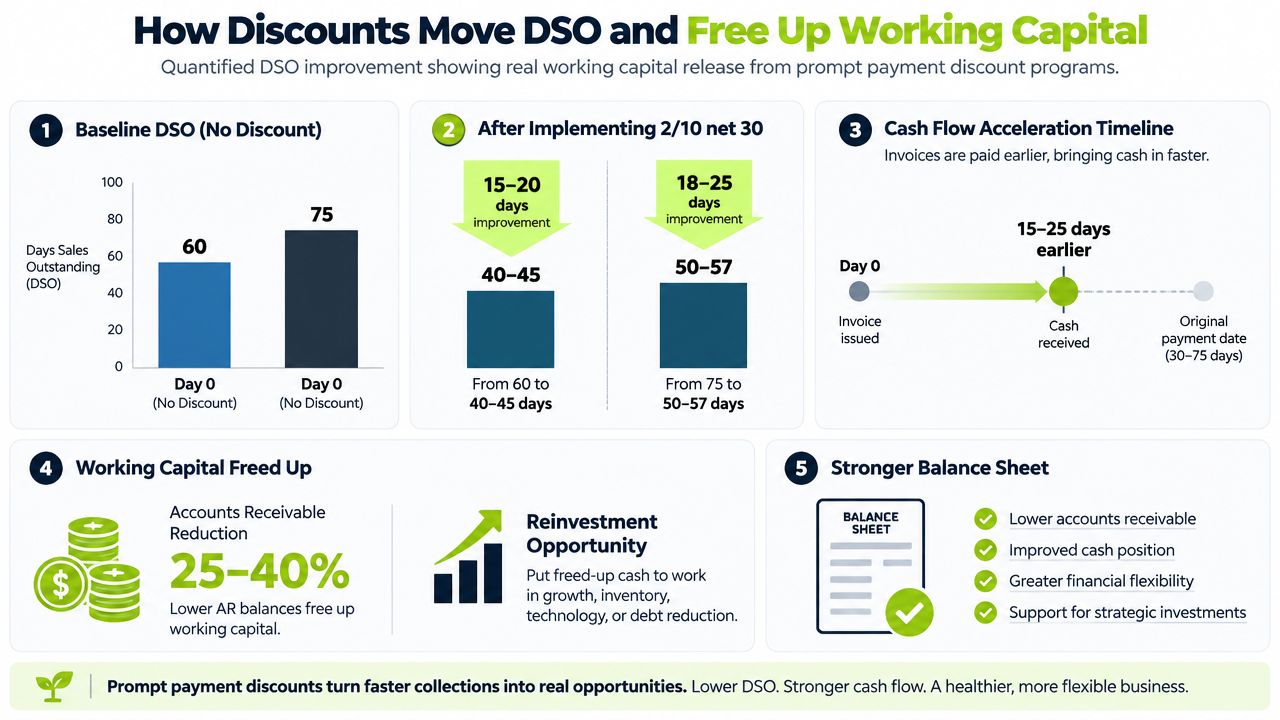
A discount changes DSO only when customers alter their payment behavior. The offer itself doesn't reduce receivables. A client that continues paying after the net date creates no cash benefit, while a client that already pays early may produce a discount cost without any acceleration.
Use the firm's actual aging data to model the policy. Start with the invoices eligible for the offer, measure payment timing before implementation, then compare the result by customer segment. A 60-day or 75-day baseline can be useful as a planning scenario, but it should be treated as a baseline assumption rather than a promised outcome.
The working-capital conversion is straightforward:
Working capital released = annual revenue ÷ 365 × DSO days reduced
For example, a firm with annual revenue of $3,000,000 would associate each day of DSO with approximately $8,219 of receivables, using the formula above. If a discount program removes 15 days from collection timing, the associated receivables release would be approximately $123,288. That is a planning calculation, not evidence that every firm will achieve that result.
A more useful operating model separates customers by behavior:
- Reliable early payers: Test whether they would have paid early without the discount. If so, the concession is likely a pure margin cost.
- Predictable late payers: Compare the discount with collection effort, financing cost, and credit exposure. A modest concession may be cheaper than prolonged follow-up.
- Process-constrained payers: Fix invoice delivery, approval, and payment friction before assuming a discount will change behavior.
The cash-flow benefit also depends on when the payment reaches the bank and when the system applies it. A discount that appears on an invoice but requires manual approval and email confirmation won't consistently deliver the modeled result. An automated AR workflow can calculate the amount, display the deadline, send reminders, and apply the cash against the correct invoice.
For broader working-capital context, the Everglow Prosperity working capital guide for businesses is a useful resource for connecting receivables decisions with the wider cash-conversion cycle. A practical explanation of the DSO metric is also available in Resolut's guide to DSO.
Running a Discount Policy That Holds Up in Close
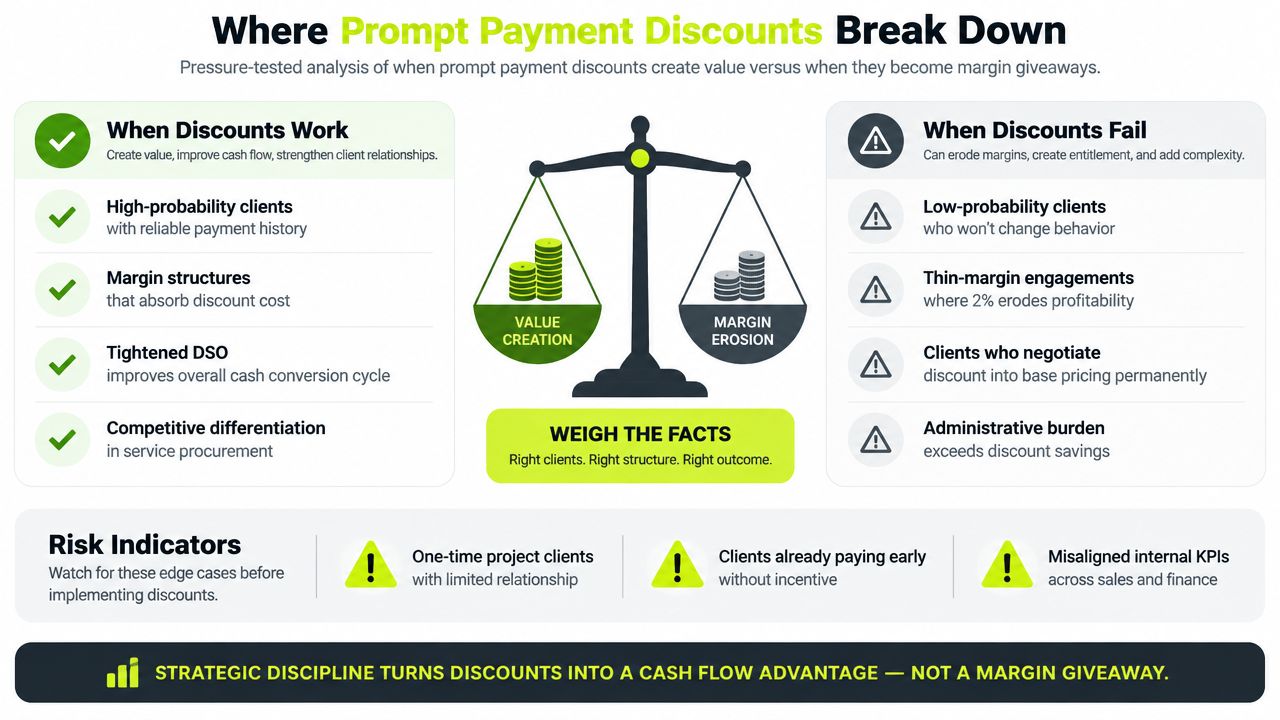
A defensible policy starts before the invoice is issued. Put the terms in the contract, proposal, billing profile, and invoice template. Sales should have a documented approval path for customer-specific overrides, and the invoice should show the discount percentage, qualification date, discounted amount, and normal due date near the total.
The operating cadence should be visible to both AR and commercial leaders.
- Set the rule. Define eligible customers, excluded services, qualifying payment conditions, and treatment of partial payments.
- Publish the terms. Use the same wording in the agreement and on every invoice. Don't rely on a master agreement that the client AP team may never see.
- Monitor take-up. Report claimed discounts, forfeited discounts, and payments received inside and outside the window each week.
- Review exceptions. Identify disputes caused by missing purchase orders, incorrect invoice data, delayed delivery, or customer approval bottlenecks.
- Tie results to aging. Add discount status to the AR review so the team can see which invoices could have converted earlier.
- Close the ledger. Reconcile the sales discount contra-account and investigate unusual movements rather than rolling them into a general variance.
- Reassess estimates. Update the expected discount take-up used in revenue recognition when customer behavior changes.
- Check profitability. Review contribution by customer and engagement after claimed discounts, not just gross billings.
Close discipline: A discount policy isn't complete until the ledger can explain every claimed, missed, reversed, and disputed concession.
System design determines whether the policy survives a busy month-end. Invoice templates need controlled terms, reminders need to fire before the deadline, and payment portals need to show the correct amount without forcing the buyer to calculate it. The cash application process must also recognize whether the customer paid the discounted or full balance.
Procurement and ERP governance become more important as the firm grows across entities and markets. Teams that need background on practical SAP for procurement can use it to frame the connection between supplier terms, approval workflows, and enterprise system controls.
Where Prompt Payment Discounts Break Down
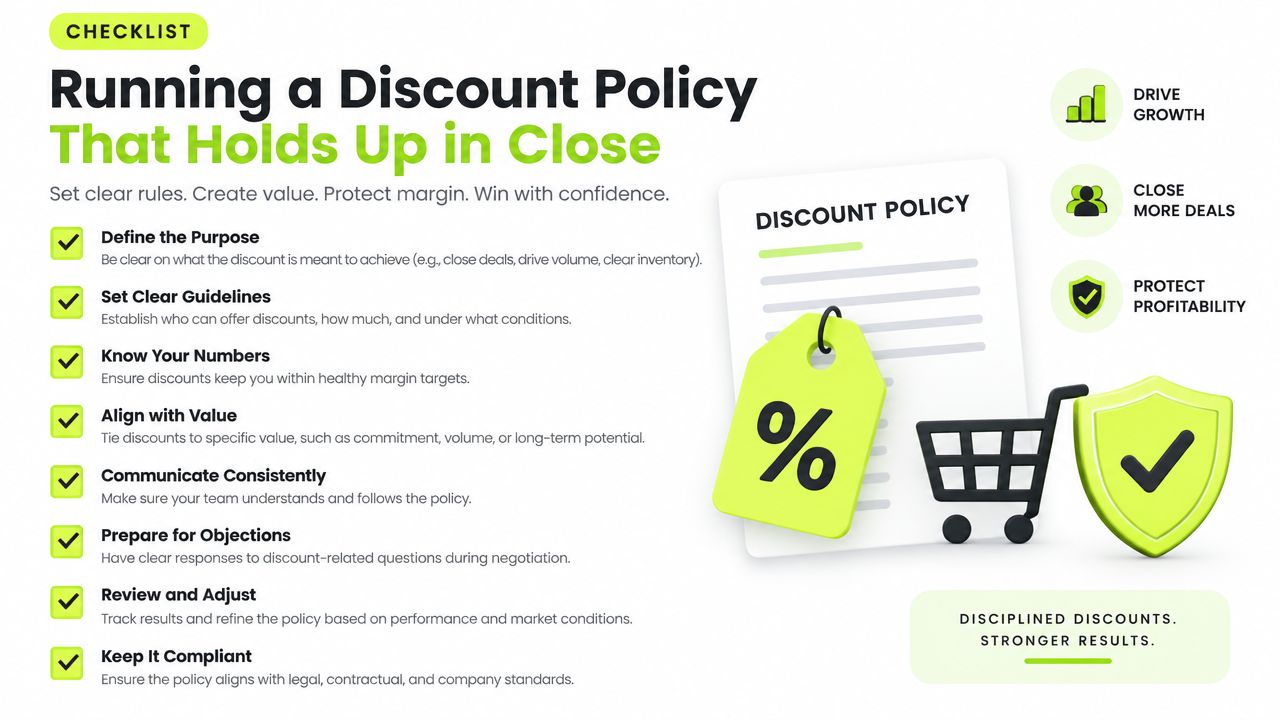
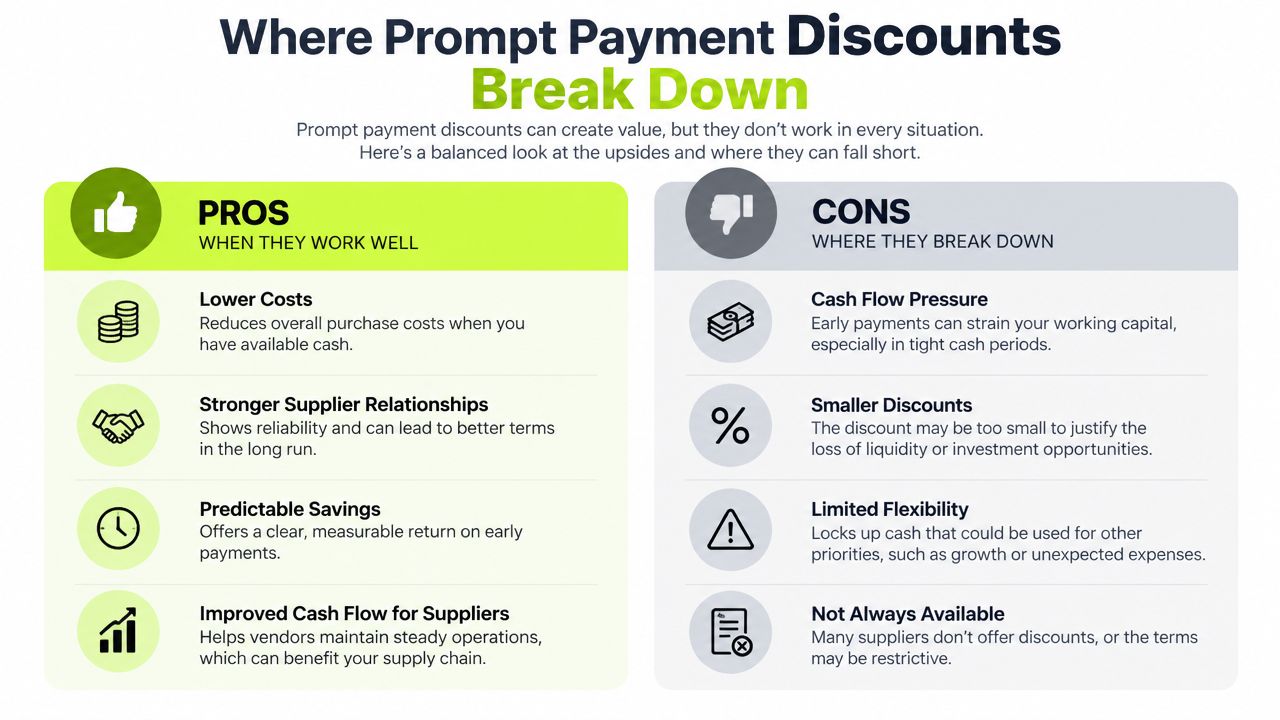
The common belief that discounts are always bad for sellers is too simple. The opposite belief, that every seller should offer them, is just as weak. The economics turn on incremental behavior. If the discount changes a late payment into an earlier payment, it may buy useful liquidity. If it rewards behavior that was already going to happen, it reduces margin without improving cash.
Consider three client profiles.
A client with a low probability of paying on standard terms may justify a concession if it produces a reliable payment commitment and lowers collection effort. That decision should include credit risk, dispute history, and the cost of staff time. A client already paying promptly presents the opposite case. Offering the discount may effectively transfer revenue to the buyer.
Contract structure can eliminate the choice altogether. Some public-sector or large-enterprise customers impose fixed payment terms, while referral-heavy professional services firms need to consider how different treatment affects client perception. A discount offered selectively should have a clear commercial rationale, not an unexplained preference for one account.
Operational failure points
Most failed programs don't fail because the formula is difficult. They fail because the buyer can't act on the offer.
- Buried terms: The discount sits in a footer or contract attachment, so the AP team misses it.
- No date control: The system uses invoice creation date when the contract depends on valid receipt or invoice acceptance.
- Manual approval: The client needs internal email approval before payment, and the window closes first.
- Split payments: The ledger doesn't define whether a partial payment qualifies for a proportional discount.
- Inconsistent exceptions: Sales grants one-off concessions that AR can't identify or reconcile.
Government guidance says agencies should take an offered discount only when it is economically justified, and the prompt-payment clock can depend on invoice validity and receipt date, as described in Treasury guidance on prompt-payment discounts. That principle applies to private firms too. The nominal discount isn't the economic result until the date, eligibility, and workflow are clear.
Turning the Policy Into a Repeatable System
A controller can reduce the policy to four operating controls.
First, print the terms on every invoice. Don't assume the master agreement travels with the invoice. Show the percentage, deadline, discounted balance, and net due date where the client's AP team can see them.
Second, make the payment path immediate. AR software should identify invoices inside the discount window, calculate the amount, and give the buyer a clear payment option. For professional services firms, that means fewer approval emails and less manual checking by the collections team.
Third, report claimed versus forfeited discounts monthly. Claimed discounts show the cost of acceleration. Forfeited discounts show where customers missed the window. Neither number is useful without customer-level context, invoice validity, and payment timing.
Fourth, review the economics quarterly. Compare the effective annualized value of the discount with the firm's current cost of capital, cash needs, collection risk, and administrative burden. Change the policy when the funding environment or customer behavior changes.
Accounts receivable automation, AI AR automation, and AR software for professional services are operational rather than aspirational. The platform must connect invoicing, reminders, payment collection, cash application, and reporting. It should also fit the firm's accounting stack, including a QuickBooks AR automation workflow where QuickBooks Online is the system of record.
Terms without execution become a footnote nobody reads. For firms still managing AR in spreadsheets, Resolut can automate discount-window reminders, payment presentation, and missed-discount reporting as part of a broader workflow designed to reduce DSO and improve cash flow.
Resolut automates AR for professional services, with consistent, accurate, and human workflows for prompt payment terms, reminders, payment collection, and cash application. If your team wants to test whether a discount is creating a working-capital win or a margin leak, visit Resolut to see how the workflow can run without manual chasing.