
Risk Based Pricing for AR: A Practical Guide
Learn how risk based pricing works in B2B accounts receivable, from credit scoring and models to KPIs and compliance, with examples CFOs can act on.
Monday morning starts with the same uncomfortable ritual at many professional services firms. The controller opens Friday's aging report, sees three customers beyond terms, and then takes a banker's call about liquidity. The work has been delivered, the invoices are valid, and yet cash is still sitting on someone else's balance sheet.
Risk based pricing gives the finance team a way to act before that receivable ages. Instead of assigning every client the same terms, credit limit, discount, and collection treatment, the firm uses a structured view of payment risk to decide how much exposure to accept and what protections to require.
For a $3M–$50M professional services firm, this isn't a consumer-lending exercise. It's a practical operating discipline for the invoice ledger, supported by accounts receivable automation, sound judgment, and documented rules.
What Risk Based Pricing Means in B2B Accounts Receivable
A controller reviewing a new customer should ask one question before approving standard terms: what level of unpaid exposure does this buyer justify?
Risk based pricing sets commercial terms according to a buyer's estimated likelihood of paying on time and the potential loss if payment fails. In B2B accounts receivable, the pricing decision can include:
- Payment terms: Net-15, Net-30, Net-45, or another approved period.
- Credit limits: The maximum open balance the firm will carry.
- Payment protections: Deposits, prepayment, personal guarantees, milestone billing, or card-on-file arrangements.
- Commercial incentives: Early-payment discounts or other pricing adjustments that compensate the firm for faster cash.
The operating change is differentiated exposure. A long-standing enterprise customer with a clean payment record may qualify for ordinary terms. A new buyer with limited information, repeated disputes, or rising utilization may require a lower limit, a shorter payment window, or stronger payment protection.
The foundation is a consistent creditworthiness assessment that combines customer information with the firm's own ledger history. A score does not make the decision by itself. It makes the assumptions behind that decision visible, repeatable, and easier to review when sales requests an exception.
The B2B distinction
Consumer credit has a formal U.S. risk-based pricing notice framework. Commercial invoicing generally does not operate under that same notice regime, but finance teams still face legal and reputational exposure. Inconsistent standards for similar customers, poor governance around sensitive information, and undocumented sales exceptions can all create problems.
The decision belongs in the operating process, not in an individual collector's memory. When a score changes a credit limit, invoice term, or approval path, retain the inputs, decision, reviewer, and reason for any override. That record gives the controller a clear basis for revising terms as payment behavior changes.
Risk based pricing also creates a practical feedback loop. The firm can start with limited information, set controlled exposure, observe invoicing and payment behavior, then adjust terms before the balance becomes difficult to collect.
Practical rule: Price the exposure you're willing to carry, not the relationship you hope will continue.
The objective is not to punish customers that pay slowly. It is to stop one client's financing needs from consuming working capital and delivery margin. In the invoice ledger, the firm can set the terms, score the customer, and change the outcome before the receivable ages.
Why Lenders and Finance Teams Price Invoices by Risk
A lender prices risk to protect the return on capital it has committed. An accounts receivable team does something similar, even when it doesn't call the process underwriting.
The firm extends value before it receives cash. It may fund payroll, subcontractors, software, travel, and delivery costs while the client retains the benefit of the service. If the client pays slowly or not at all, the quoted project margin has to absorb financing cost, collection labor, and potential loss.
The useful analogy is an insurance deductible. A buyer with a higher probability or severity of nonpayment should carry more of the protection burden through shorter terms, a deposit, a lower credit cap, or a price that reflects the administrative and funding cost. The rule isn't “charge more to risky customers.” The rule is “don't grant the same unsecured exposure when the expected outcome is materially different.”
Flat terms create hidden concentration
Flat Net-30 terms can look fair because they're simple. They're also easy for sales to promise and difficult for finance to defend when the customer's balance grows.
Suppose a single customer represents 5% of revenue and pays materially slower than the rest of the book. That concentration can hold working capital for weeks, even though the income statement still shows revenue. The opportunity cost appears in delayed hiring, tighter vendor payment decisions, higher borrowing needs, or a reduced ability to accept the next attractive engagement.
Risk based terms make the trade-off explicit. The customer may still receive access to the service, but the firm controls the amount and duration of unsecured exposure.
Customer Risk Tier | Flat Net-30 DSO | Tiered Terms | Expected Bad Debt | Working Capital Impact |
|---|---|---|---|---|
Low | 30 days by policy | Standard terms, approved limit, selective early-pay incentive | Lower relative exposure | Predictable collection cycle |
Medium | 30 days by policy | Shorter limit review, controlled exposure, milestone billing | Moderate exposure requiring monitoring | Cash tied up unless utilization is controlled |
High | 30 days by policy | Prepayment, deposit, guarantee, or short terms | Higher potential loss | Significant funding pressure and collection effort |
The table's point is directional rather than actuarial. A model should connect terms to expected loss, collection cost, and the gross margin available on the engagement.
That connection also supports efforts to reduce DSO. The firm doesn't need every customer to behave identically. It needs the right customers to receive the right amount of credit, with early intervention when their behavior changes.
The Building Blocks of a Risk Based Pricing Model
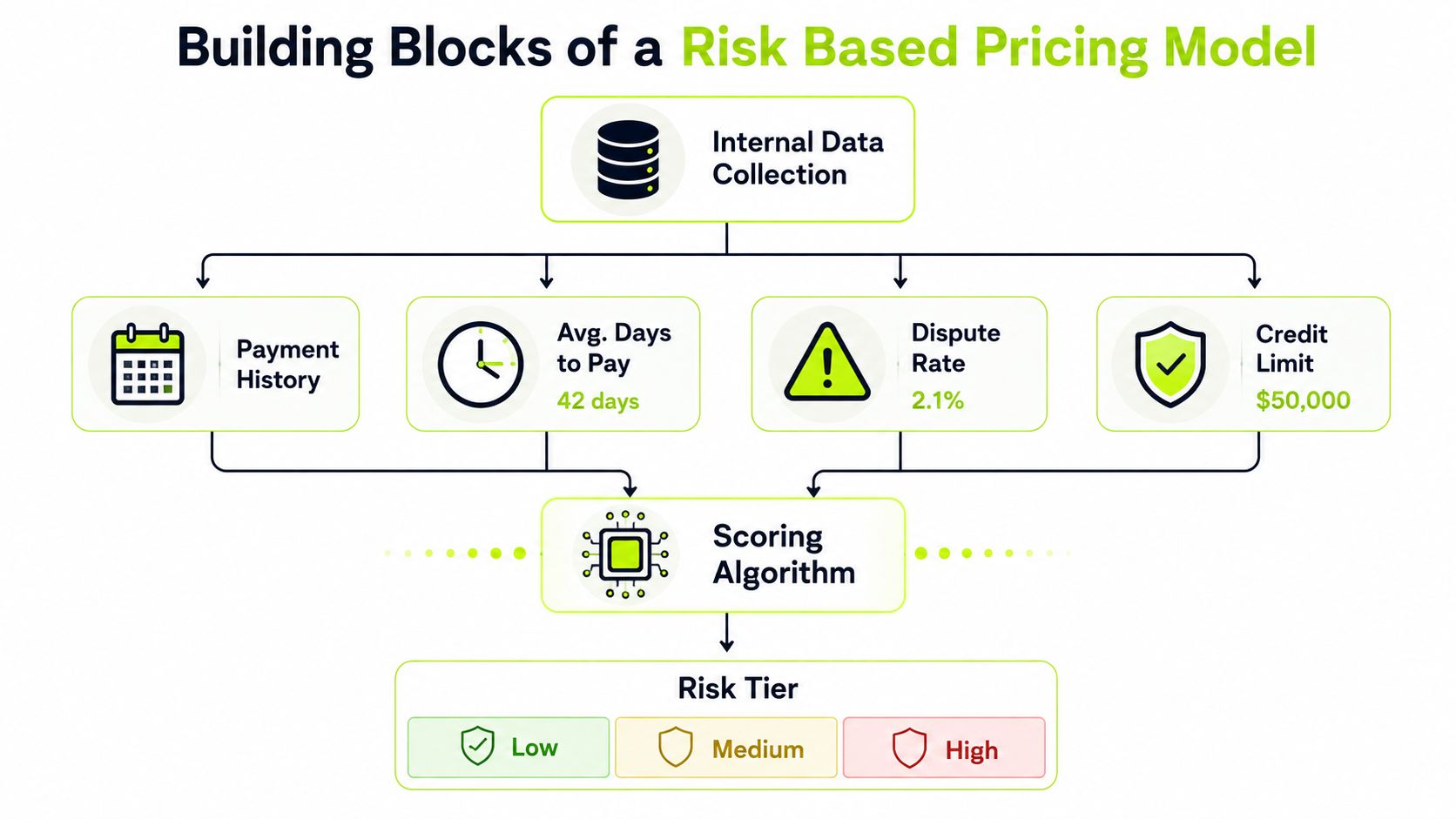
A workable model starts with fields the finance team can explain without a data scientist. The score should reflect both the customer's external profile and the firm's direct experience with the account.
Start with internal payment evidence
Build the first version from the ledger:
- Payment history: Record whether invoices were paid within agreed terms, not only whether they were eventually paid.
- Average days to pay: Use invoice-level payment dates and separate routine payment delay from unresolved disputes.
- Dispute rate: Count valid disputes, administrative disputes, and billing errors separately. A customer disputing invoices because the firm invoices incorrectly shouldn't receive the same risk treatment as a customer disputing valid work without resolution.
- Credit limit utilization: Track the open balance against the approved limit and flag sustained increases.
- Exposure size: Measure the balance relative to trailing receivables, project margin, and the firm's ability to absorb a loss.
External inputs can add context. Commercial bureau information such as D&B PAYDEX and Experian Intelliscore Plus, legal filings, industry SIC codes, and macroeconomic indicators may help, but they should support the ledger rather than replace it. Teams reviewing broader credit risk assessment methods can use the same principle: match the sophistication of the method to the quality of the decision data.
Use a transparent scorecard
A simple formula might assign points to payment performance, days to pay, disputes, utilization, external credit information, and exposure concentration. The exact weights should come from the firm's historical outcomes and be approved by finance leadership.
For a starting score, use clear cut lines:
- Low risk, 80–100: Normal terms and a standard credit limit, with discounts used only when the cash benefit exceeds the margin cost.
- Medium risk, 50–79: Controlled exposure, more frequent review, and terms tied to utilization or project milestones.
- High risk, below 50: Prepayment, deposits, guarantees, shorter terms, or CFO approval before new work begins.
These thresholds are operating choices, not universal truths. They need periodic testing against actual outcomes and should be documented as part of the firm's broader gestione del rischio finanziario practices.
Three examples show how the cut lines work:
- Enterprise buyer, score 88: Approve Net-30 terms and a 5% early-payment discount, provided the discount still protects the engagement's margin.
- Mid-market account, score 62: Approve Net-45 only with a credit cap at 15% of trailing receivables and a scheduled review.
- SMB account, score 34: Move to Net-15 and require either a personal guaranty or a prepayment trigger before additional work is released.
The model earns trust when every score can be traced to fields, weights, and a decision rule. A complicated score that nobody can audit won't improve control.
Choosing the Right Modeling Approach
The best model is the simplest one that changes behavior reliably. A professional services firm shouldn't buy machine learning because the word “AI” appears in a vendor presentation. It should first determine whether the ledger contains enough clean history, volume, and ownership to support the complexity.
Approach | Best Fit | Setup Cost | Explainability | When to Upgrade |
|---|---|---|---|---|
Rules-based scorecard | AR books below $10M with straightforward customer segments | Low | High | When rules create too many exceptions or fail to rank outcomes |
Statistical scoring | Firms with two to three years of clean payment history | Moderate | Good, with documented variables | When calibrated probabilities would improve limit and pricing decisions |
AI or machine learning | AR above roughly $50M, large customer base, and monthly model oversight | High | Lower unless carefully documented | When data volume and operational capacity justify monitoring drift |
A rules-based scorecard is usually the right first build. Ten to fifteen clear if-then flags can segment customers by late-payment history, dispute frequency, utilization, legal events, and exposure. The setup is inexpensive, the approval process is easy to explain, and the controller can change a rule without waiting for a model-development cycle.
Statistical scoring becomes useful when the firm has enough clean payment history to estimate default probability rather than just assign a tier. Logistic regression and PD/LGD-style methods can create more calibrated decisions, but they require consistent outcome definitions. “Paid late” needs a precise meaning, and the team needs to preserve historical records instead of overwriting customer status.
AI or machine learning can identify behavioral patterns that rules miss, such as a gradual change in payment timing across invoice types. It also creates governance work. Someone must monitor drift monthly, review variables, investigate unexpected classifications, and explain a decision to sales, auditors, or a customer.
A less sophisticated model with clean inputs beats a sophisticated model built on inconsistent invoice dates.
Forecasting tools can help the finance team think through exposure and liquidity implications, and a resource on software for strategic forecasting may help compare that category with credit modeling. Keep the use cases separate. Forecasting estimates what may happen to cash and demand. Risk pricing determines what terms to grant a specific buyer.
For firms evaluating credit risk analysis using machine learning, the upgrade decision should come after process discipline. If collectors regularly bypass terms, sales enters incomplete customer data, or cash application posts payments inconsistently, a more advanced model will amplify uncertainty instead of resolving it.
Plugging Risk Based Pricing Into Your AR Workflow
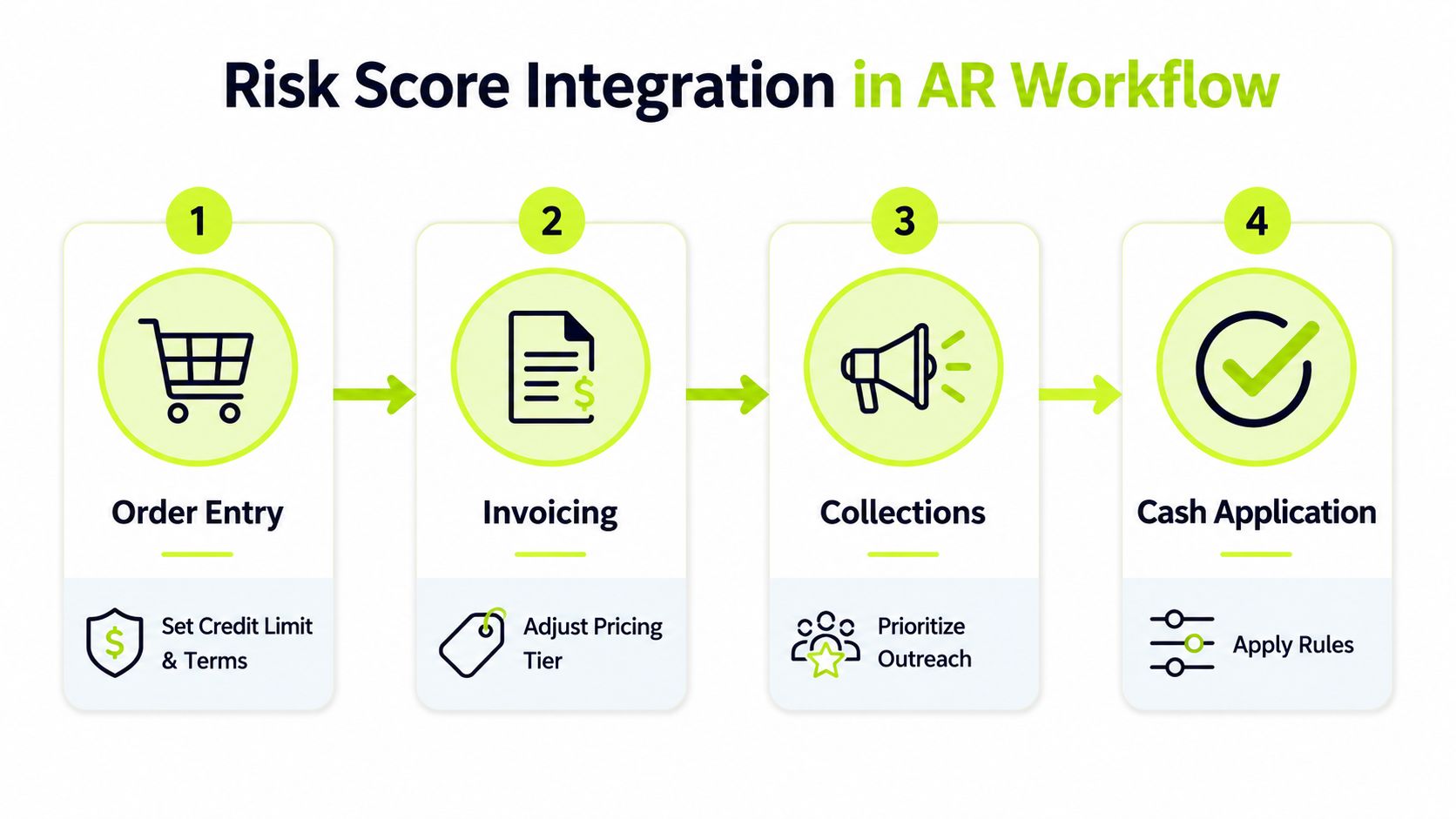
A score has no value if it remains in a spreadsheet after the credit meeting. It has to alter the work queue, the invoice record, and the approval path.
At order entry, the tier should assign a credit limit and payment terms before the statement of work is finalized. A borderline account can enter a hold queue for review. A high-risk customer can require a deposit, prepayment, guarantee, or CFO approval before the team commits delivery resources.
Let the tier control the operating sequence
At invoicing, the approved terms should write into the ERP or billing system. The invoice must show the agreed due date, incentive, milestone requirement, and any approval condition. This prevents a sales representative's informal promise of Net-60 from overriding a high-risk policy without a recorded exception.
Collections should use the same score. A lower-risk account may receive a routine reminder. A higher-risk account should enter a shorter dunning cadence, with a senior collector assigned before the invoice reaches severe delinquency.
Cash application also needs rules. Large or unusual payments should route for review when the customer's open balance, remittance detail, or payment pattern conflicts with the account profile. Automation can accelerate matching, but it shouldn't remove controls around unapplied cash and credit exposure.
Consider a tier B customer with a 12% modeled PD. The firm grants Net-30 terms, a $25,000 credit limit, and a reminder 7 days before the due date. A tier D customer receives COD prepayment or a personal guarantee reviewed by the CFO.
Those decisions should be visible to sales and delivery. Otherwise, the finance team becomes the department that “blocks deals,” rather than the owner of a defined exposure policy.
Connect the tools to the exception path
A practical workflow contains three paths:
- Straight-through processing: Approved terms, ordinary invoices, automated reminders, and routine cash application.
- Review queue: Borderline scores, incomplete bureau data, unusual project size, or a requested sales exception.
- Escalation path: High-risk customers, breached credit limits, repeated broken promises, or new orders placed while overdue balances remain open.
The accompanying video can help teams visualize how those handoffs fit together.
AI AR automation can support, rather than replace, finance judgment. The system should surface the exception, apply the approved communication sequence, and leave the accountable person with a clear decision to make.
KPIs That Tell You the Model Is Working
A risk pricing program should be reviewed through outcomes, not activity counts. More reminders sent doesn't prove that terms improved. The core question is whether the firm is carrying less avoidable exposure without damaging valuable client relationships.
DSO by risk tier is the anchor metric. A blended DSO figure can hide deterioration in a high-risk segment because strong enterprise accounts pull the average down. Pair the tier view with bad-debt write-offs as a percentage of revenue and the share of receivables past due by 30 or more days within each tier.
A calibration check compares predicted default probability with actual payment outcomes. If accounts assigned similar probabilities produce sharply different results, the model may be poorly weighted, the outcomes may be defined inconsistently, or collectors may be applying different treatment to each tier.
The monthly scorecard
KPI | Definition | Target Range | Review Cadence |
|---|---|---|---|
DSO by risk tier | Collection time segmented by customer risk band | Declining in higher-risk bands after controls are applied | Monthly |
Bad-debt write-off rate | Write-offs divided by revenue | Stable or declining relative to the firm's approved plan | Monthly and quarterly |
AR past due by 30+ days | Portion of each tier's receivables beyond 30 days past due | Lower concentration in higher-risk accounts | Monthly |
Calibration accuracy | Predicted default probability compared with actual outcomes | Close alignment by tier and review period | Monthly |
Input drift | Material movement in score variables, including shifts above two standard deviations | No unexplained structural movement | Monthly |
The provided KPI ranges should be treated carefully. One implementation brief describes a program that may trim DSO by 4 to 8 days within two quarters and reduce bad-debt write-offs by 25% to 40%, but those figures aren't universal benchmarks and shouldn't be presented as a promise. Results depend on data quality, customer mix, term enforcement, and the starting condition of the ledger.
Independent AR automation reporting also points to a working-capital effect. A 2026 report projects DSO reduction of more than 4 days, while an industry summary describes common AI-driven AR adoption outcomes of 5 to 10 days or more, as reported by Versapay's accounts receivable automation research. Treat those figures as external directional evidence, not a substitute for your baseline.
Retraining or policy review becomes urgent when tier reclassification churn rises above 10%, overrides spike without a clear business reason, or high-risk accounts continue receiving longer terms. Override data deserves its own report. It shows where the model is wrong, where the policy is unpopular, and where sales incentives may be undermining cash discipline.
Compliance and Pitfalls CFOs Should Plan For
Risk based pricing looks like a mathematical exercise until a customer challenges the decision. The first control is classification. A creditor using a consumer report in a consumer credit decision may have notice obligations under Regulation V when it offers materially less favorable terms than those available to a substantial proportion of consumers, as described in §1022.72 of Regulation V.
Commercial credit isn't automatically outside every consumer-protection concern. Sole proprietors, small-dollar flows, and mixed-use arrangements can create ambiguity. The finance team should document whether the counterparty is being treated as a business, an individual, or both, and legal counsel should review edge cases before the model drives pricing.
The errors that create avoidable exposure
- Inconsistent decisions: Similar customers receive different limits because sales pressure overrides the approved rules without documentation.
- Unclear adverse-action records: The firm can't explain which data influenced a decision or who approved the exception.
- Unintended disparate impact: A seemingly neutral variable acts as a proxy for a sensitive characteristic.
- Uncontrolled data sourcing: Bureau feeds and external information enter the model without documented permission, security, retention, or cross-border transfer controls.
- Model drift: Financial statements become stale, the customer mix changes, or the look-back data excludes failed accounts and creates survivor bias.
- Override creep: Exceptions accumulate until the scorecard becomes an advisory worksheet that nobody follows.
European commercial invoicing adds another practical layer. For many B2B contracts, payment is due within 30 days unless the contract establishes another period, and statutory late-payment interest is commonly the European Central Bank refinancing rate plus 10 percentage points, with a fixed €40 recovery fee allowed in some cases, as summarized in the European late-payment rules reference. Cross-border teams should confirm the governing contract and jurisdiction before adding interest or recovery charges.
A CFO's control checklist should include:
- Governance: Assign a named owner for policy, model changes, and exception approval.
- Versioning: Record the model or rule-set version used for every credit decision.
- Audit trails: Preserve inputs, output, override reason, approver, and date.
- Data controls: Document source, consent basis where relevant, access, retention, and transfer safeguards.
- Outcome testing: Compare predicted risk with actual payment and loss results.
- Human review: Define when a person must approve, reject, or reconsider the output.
A practical compliance automation guide from Cyndra can help frame the broader governance conversation, but software won't make an undocumented policy defensible. The accountable owner still needs to know what the model does and when it should not be trusted.
A Practical Example and Where Automation Fits
Consider a 180-person professional services firm reviewing three open invoices.
The first belongs to a long-standing enterprise client with consistent payment behavior. The firm keeps Net-30 terms with no surcharge because the account's history supports ordinary unsecured exposure.
The second belongs to a venture-backed growth account. The client is commercially attractive but has a less established payment record, so the firm keeps Net-30 and offers a 1.5% early-payment incentive. Finance approves the incentive only after confirming that the faster cash is worth more than the discount given away.
The third invoice belongs to a distributor that has paid late twice. The firm moves the account to Net-15 and requests a personal guaranty before extending additional exposure. The decision is direct, documented, and tied to observed payment behavior rather than a collector's personal preference.
The workflow behind the decision
An AR automation layer can pull the customer scorecard at order entry, write approved terms into the ERP, and route the distributor to a senior collector. If utilization breaches policy, the system can place a hold on new orders and notify the accountable finance owner.
That's the operational difference between a scorecard and a controlled process. The controller doesn't spend Monday reading every invoice and reconstructing every promise. The system sequences the routine work and puts judgment where it belongs, on exceptions, material exposure, and customer conversations that need a senior decision.
QuickBooks AR automation can follow the same principle for smaller firms, provided the workflow preserves approvals, terms, reminders, and reconciliation records. More complex firms may need broader AR software for professional services that connects credit risk, collections, billing, payment options, and cash application in one operating layer.
The model doesn't replace judgment. It makes judgment earlier, more consistent, and easier to audit. That's how a firm can improve cash flow without treating every customer as a problem.
Resolut automates AR for professional services by connecting risk scoring, terms, collections, cash application, and exception workflows in one operating system. If you want to reduce DSO with consistent, accurate, and human-controlled processes, visit Resolut to review how the platform fits your ledger.