Sample Payment Terms: 8 Clauses with Negotiation Notes
Sample payment terms for professional services firms: Net 30, early-pay discounts, late fees, and deposits, with wording and negotiation tips.
You're reviewing payroll, partner distributions, and next month's staffing commitments. The revenue is booked, but the bank balance hasn't caught up. Most firms set payment terms once, in a signed engagement letter, and then stop looking at them. Say a consultancy has Net 30 on paper but collects at day 52. Nobody challenges the difference until someone draws on the line of credit.
The eight terms behind every receivable determine when you can request payment, how much client credit you're extending, and what happens when the buyer misses the deadline. The wording matters, but so do the approval contact, payment method, and person responsible for following up.
For CFOs, controllers, and owners of professional services firms between $3M and $50M, the decision isn't whether shorter terms sound better. It's which terms fit the work, what each concession costs, and whether your team can enforce the agreement without damaging a valuable relationship.
Operating principle: Treat every payment concession as a credit decision, with a cost, an owner, and an approval limit.
These sample payment terms connect clause language to working capital, negotiation, and collections. Use them as drafting starting points for counsel to review, not as universal legal templates. Better terms can help reduce DSO. Consistent follow-up makes them real.
1. Net 30
Net 30 gives the client a defined payment window, not permission to start approving the invoice when that window closes. State the trigger explicitly: invoice date, confirmed receipt, or another agreed event.
The European Commission's late-payment assessment describes a default payment period of 30 calendar days after invoice receipt in relevant B2B circumstances when the contract doesn't specify a payment period. That's a reason to define your contractual trigger carefully, not to assume every jurisdiction treats invoice dates identically.
Sample clause
Payment is due within 30 calendar days of the invoice date. The invoice will show the specific due date and accepted payment methods. Please notify the designated billing contact promptly of any disputed amount and pay the undisputed balance by the due date.
Price the actual collection window
As a simplified illustration using monthly billings, a consulting firm billing $2.4 million annually carries approximately $200,000 in receivables at a 30-day DSO, versus approximately $300,000 at 45 days. The additional working capital exposure is about $100,000, even though the engagement letters haven't changed.
The negotiation position is straightforward: accept Net 30 when the buyer can approve and schedule payment within the window. Don't restart the clock without telling the other side, just because an invoice moved between internal departments.
- Invoice promptly: Send the invoice when approved work becomes billable, rather than waiting for month-end.
- Schedule follow-up: As an operating example, remind clients five days before the due date, on the due date, and seven and fourteen days afterward.
- Check reporting: In QuickBooks AR automation, age open invoices from their contractual due dates and calculate days-to-pay using actual payment dates.

2. Net 15
A design firm billing $500,000 monthly could, illustratively, reduce average receivables by about $250,000 if clients genuinely moved from paying at Net 30 to Net 15. That assumes steady billing and a corresponding change in actual payment behavior.
The qualification matters. Changing the invoice footer won't accelerate a buyer whose approval process still requires multiple signatures and a scheduled payment run.
Make the shorter window feasible
Sample clause
Payment is due within 15 calendar days of the invoice date. Invoices will be delivered to the billing contact identified in the statement of work, with a payment link and a specific due date.
Net 15 suits smaller, frequent invoices and recurring engagements where the client already understands the scope. It's harder to enforce when invoices require fresh procurement approval or detailed acceptance reviews.
Atradius's U.S. payment-practices report distinguishes contractual terms from collection behavior. The operational lesson is to resolve approval bottlenecks before asking the client to accept a shorter deadline.
- Confirm the route: Ask who approves the invoice, who releases payment, and whether a purchase order is required.
- Remove payment friction: Include an ACH or card option and a working payment-portal link in the first invoice email.
- Repeat the agreement: Put the term in the statement-of-work header and invoice footer, with matching language.
The cost is primarily relationship and administration effort rather than an explicit discount. Your negotiation position should be conditional: offer Net 15 with a predictable billing schedule and complete supporting documents. If the client can't meet it, negotiate a deposit rather than maintaining a deadline everyone expects to miss.
3. Net 45 and Net 60 Extended Terms
Extended terms make your firm a short-term lender. An enterprise client's vendor policy may explain the request, but it doesn't remove the financing cost or the risk of doing more work before earlier invoices clear.
In an illustrative annual-revenue calculation, moving a $1.2 million client from Net 30 to Net 60 adds approximately $99,000 in receivables. At an assumed 8% cost of capital, carrying that balance costs roughly $7,900 annually.
Sample clause
Payment is due within the agreed extended period shown on each invoice. Continued delivery is subject to the client's approved credit limit. Any deposit, billing milestones, and rights to suspend future work are specified in the statement of work.
Trade credit for something measurable
Don't negotiate the payment window in isolation. Ask for a deposit, earlier milestone invoicing, a fee adjustment, or firmer volume commitments, and calculate whether the package compensates you.
The QuickBooks January 2025 survey of U.S. businesses with up to 100 employees found cash-flow problems among 60% of respondents offering longer payment terms, compared with 40% requiring immediate payment. That association doesn't establish causation, but it supports treating extended terms as a working-capital decision.
- Set a credit ceiling: Include unpaid invoices and committed work that hasn't yet been billed.
- Review exposure monthly: Compare the client's actual days-to-pay with its agreed terms.
- Define intervention: Name the person authorized to pause additional work when exposure exceeds the approved limit.
A profitable client can still consume more liquidity than you're willing to provide. Keep that distinction visible in the AR dashboard and account review.
4. Due on Receipt
For a completed, accepted engagement, Due on Receipt removes the additional credit period. It works best when the client can pay directly rather than route the invoice through a lengthy approval chain.
Consider an illustrative $1,800 bookkeeping cleanup. The bookkeeper delivers the accepted work and sends an invoice with a payment link. The intended outcome is immediate payment initiation, not an unsupported promise that every payment method settles immediately.
Sample clause
Payment is due upon delivery of this invoice to the billing email address designated in the engagement letter. Accepted payment methods are listed on the invoice. Payment initiation and settlement remain subject to the selected payment method.
Define receipt before it becomes a dispute
A clear Due on Receipt payment policy should distinguish invoice delivery from the client opening the email. Maintain delivery records, handle bounced messages, and confirm the billing address before completing the work.
Due on Receipt works when the client already knows what they're paying for and can act on the invoice immediately.
The financing benefit is a smaller gap between delivery and cash. The trade-off is buyer friction, particularly when procurement expects a formal credit period.
- Use accepted work: Keep sign-off evidence with the invoice.
- Provide payment access: Include an ACH link or an appropriately authorized card-on-file arrangement.
- Separate deposits: For small projects, make the advance payment due on receipt and state that work begins after payment clears.
Don't negotiate this term by insisting that a corporate payment system behave like a consumer checkout. If immediate payment is operationally impossible, collect an advance before delivery or use an achievable net term with clear approval requirements.
5. 2/10 Net 30 Early Payment Discount
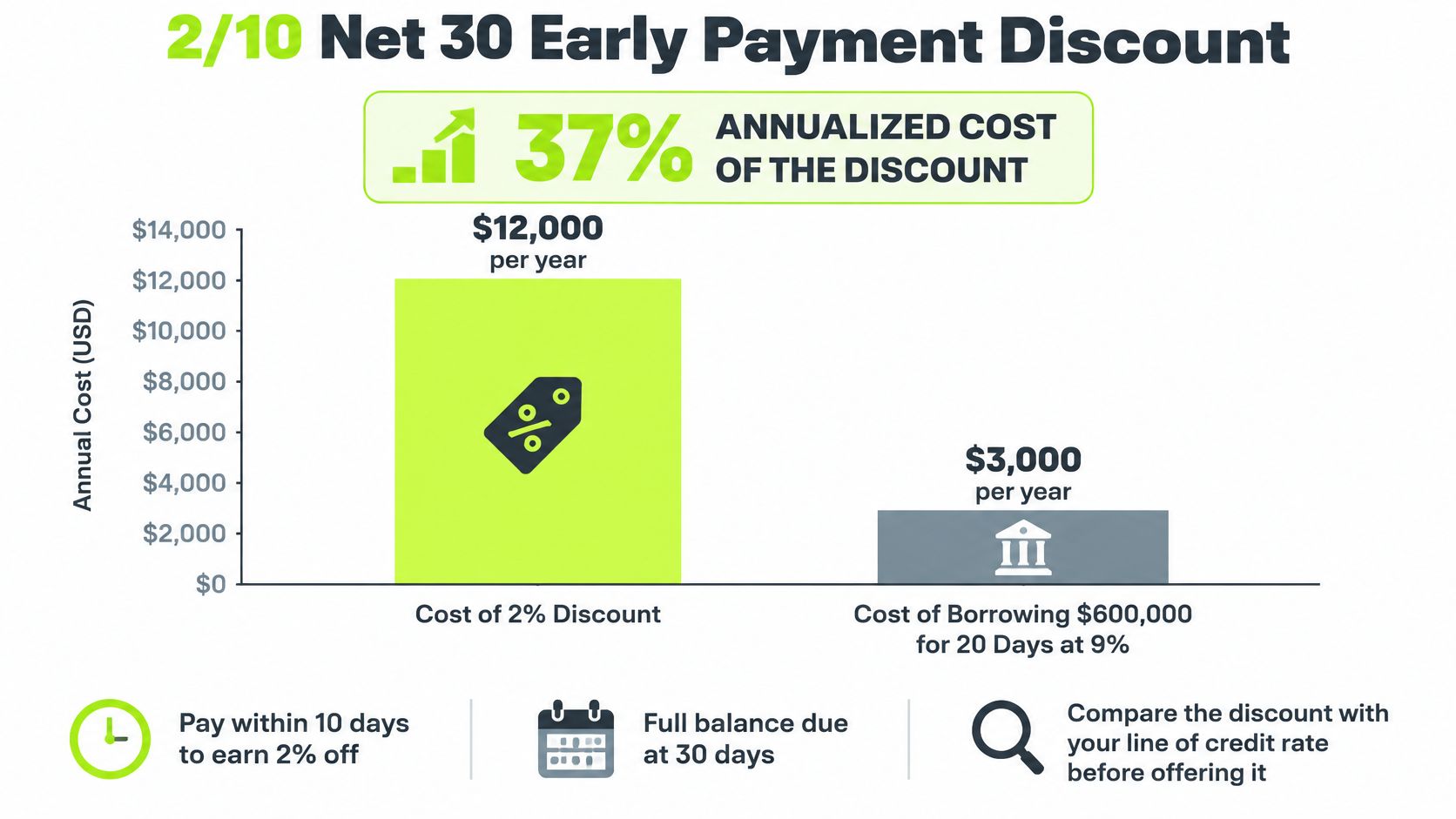
An early-payment discount purchases speed by surrendering revenue. Under 2/10 Net 30, the client receives a 2% discount for paying within 10 days; otherwise, the full balance is due within 30 days.
For a worked illustration, assume $1.5 million in annual billings, with 40% of billing value qualifying for the discount. The annual revenue concession is $12,000. Billing value, not client count alone, determines the dollar cost.
Compare the discount with financing
Using a simple annualized calculation, paying 2% to accelerate cash by 20 days costs roughly 37% annually. Borrowing the illustrative $600,000 of qualifying billings for that acceleration period at an assumed 9% annual rate would cost about $3,000 in aggregate.
That comparison assumes the discount really accelerates payment and that borrowing is available. A discount is especially expensive when clients who already pay early take it without changing their behavior.
Sample clause
An early-payment discount applies only when the qualifying payment is received by the discount deadline stated on the invoice. After that deadline, the full balance is payable by the final due date.
The 2/10 Net 30 explanation provides useful context for expressing both deadlines clearly. Define whether taxes, expenses, and partial payments qualify rather than leaving cash application to interpret the agreement.
- Limit eligibility: Reserve discounts for specific accounts or periods with a documented cash need.
- Record consistently: Confirm the accounting treatment before launch.
- Match accurately: Configure cash application to distinguish valid discounts from unauthorized deductions.
Negotiate the incentive against actual payment acceleration, not the client's promise to pay faster.
6. Retainer and Advance Deposit
An advance deposit funds work before your team incurs the full delivery cost. It also tests whether the client is ready to commit financially, which is useful when the scope requires staffing reservations or outside specialists.
For illustration, a $200,000 engagement with a 40% advance produces $80,000 before the first deliverable. A proposed deposit might fall between 25% and 50%, but that's a negotiation range for the scenario, not a universal market benchmark.
Sample clause
Work begins after receipt of the advance specified in the statement of work. The agreement identifies how the advance is applied, any replenishment requirement, and the treatment of unused funds upon termination.
Distinguish cash received from fees earned
Don't use retainer as a catch-all accounting label. A payment reserving availability, an advance against future services, and a refundable client balance can require different contractual and accounting treatment.
The practical discussion from Bookkeeping and Accounting of Florida on retainers is a useful starting point for separating those arrangements. For lawyers, ABA Model Rule 1.15 is relevant to safeguarding client funds, but counsel must confirm the applicable jurisdiction's adopted rules and advance-fee requirements.
- Define application: State whether the advance offsets current invoices or the final balance.
- Show the balance: Display receipts, applications, and remaining funds on client statements.
- Control replenishment: Set the trigger and identify who pauses work if the balance isn't restored.
The client's cost is paying before receiving the full service. Your negotiation position should explain what the advance funds and offer transparent drawdowns, rather than demanding cash without showing how it will be used.

7. Milestone Billing
A fixed-fee engagement shouldn't force your firm to finance the entire delivery cycle. Milestone billing connects invoices to defined work, giving the client visible checkpoints while reducing your exposure before final completion.
Illustratively, split a $300,000 project into five $60,000 milestones, each payable Net 30 after documented acceptance. This improves the timing of billing only if the milestones occur during delivery and approval doesn't stall.
Sample clause
Each milestone becomes billable upon satisfaction of the acceptance criteria in the statement of work. The client will provide written acceptance or a specific explanation of unmet criteria within the agreed review period. The agreement will specify any deemed-acceptance process.
Make acceptance objective
Architecture and engineering teams may use schedule-of-values workflows modeled on AIA G702 and G703 forms. Whatever format you choose, describe an observable deliverable, its required evidence, and the authorized approver.
For firms reporting under ASC 606, reconcile billing with earned revenue monthly. A milestone invoice isn't automatically proof that revenue should be recognized, and revenue recognition shouldn't wait merely because an invoice hasn't been issued.
- Define completion: Replace vague labels such as substantially finished with agreed acceptance criteria.
- Document approval: Store sign-off beside the milestone and invoice.
- Connect systems: Use AI AR automation to initiate billing and follow-up from approved events, with human review for exceptions.
The negotiation trade-off is administrative effort: clients must review work during the engagement rather than only at the end. In return, they receive clearer progress evidence and smaller payment decisions.
The embedded video offers an additional visual reference for the payment workflow.
8. Late Payment Charges and Interest Clause
Late charges change the cost of delay, not the original due date. They're a backstop for an agreed collection process, not a substitute for accurate invoices or timely outreach.
As an illustrative proposal, a monthly charge between 1% and 1.5% requires legal review rather than an assumption that the range is lawful everywhere. A $50,000 balance overdue for 60 days, calculated as two monthly periods at 1.5% simple interest, would incur $1,500.
Sample clause
Overdue undisputed balances may accrue the finance charge specified in the signed agreement, subject to applicable law. The agreement defines the calculation method, accrual date, treatment of partial payments, and authorized waiver process.
Agree the remedy before the delay
Federal contracts require attention to the Prompt Payment Act and applicable Treasury interest rates. UK commercial debts may fall under the Late Payment of Commercial Debts (Interest) Act 1998, including statutory interest and compensation provisions. Neither framework should be copied into an unrelated private contract.
Use counsel to check state usury limits, consumer protection requirements where relevant, and the contract's governing law. The late-payment-fee guide can support the operational discussion, but it doesn't replace jurisdiction-specific advice.
Collection discipline: Resolve the underlying invoice problem before arguing about the charge attached to it.
- Agree upfront: Put the clause in the master services agreement and reference it on invoices.
- Log consistently: Use AR software for professional services to record charges, notices, disputes, and approved waivers.
- Escalate deliberately: The QuickFee accounts-receivable whitepaper supports pairing collection policies with defined escalation rather than leaving overdue accounts unattended.
Negotiate waiver authority, not an expectation that every charge will disappear. Measure whether earlier outreach improves collection before crediting the interest clause.

How each sample payment term affects cash timing, working capital, and risk
Item | Days to Cash | Working Capital Effect | Best For | Main Risk |
|---|---|---|---|---|
Net 30 | Due in 30 days | Baseline receivables level | Corporate clients and predictable billing | Clients may pay late |
Net 15 | Due in 15 days | Reduces receivables versus Net 30 | Small, frequent invoices and retainers | Enterprise clients may reject the terms |
Net 45 and Net 60 Extended Terms | Due in 45–60 days | Increases funding needs and credit exposure | Winning or retaining large enterprise clients | Higher carrying costs and prolonged credit exposure |
Due on Receipt | Expected immediately | Minimizes receivables | Small, completed, one-time work | Corporate clients may resist or delay payment |
2/10 Net 30 Early Payment Discount | 10 days for discount; otherwise 30 days | Speeds cash at the cost of a discount | Clients able to pay early | Discount may cost more than borrowing |
Retainer and Advance Deposit | Before work begins | Provides upfront cash and reduces early credit risk | Engagements needing funded kickoff work | Can deter clients; requires careful accounting |
Milestone Billing | After milestone approval; often Net 30 | Links cash to delivered work | Fixed-fee and hybrid projects | Delayed approvals can stall payment |
Late Payment Charges and Interest Clause | No change to the due date | May discourage late payment; does not provide earlier cash | Consistent overdue-payment enforcement | Legal limits and client disputes |
Standardize the Terms, Then Automate the Follow-Through
Pick a default term for each service line, write it into the statement-of-work header and invoice footer, and review days-to-pay by client every month. Extended terms, discounts, and deposits should be documented decisions with an economic rationale, not concessions that partners make differently on every engagement.
Start with the gap between the contractual due date and actual cash receipt. Sage's discussion of SPI Research benchmarks reports average professional services DSO of 44.3 days in 2025. That's a useful reminder that standard invoice language doesn't establish a firm's actual collection performance.
Give every exception an owner
The controller should maintain approved clause language and concession limits. Account leaders should confirm acceptance requirements and billing contacts before delivery, while AR owns reminders, promised-payment tracking, and escalation records.
- Separate delay reasons: Distinguish missing purchase orders, approval backlogs, genuine disputes, and client liquidity problems.
- Measure collected cash: Track actual days-to-pay, overdue balances, and broken payment promises by client.
- Review concession value: Compare discounts and carrying costs with the revenue and relationship benefits received.
Here is where accounts receivable automation becomes useful. Configure workflows around the signed agreement, not a generic reminder calendar, and stop routine collection messages when someone opens a genuine dispute.
Keep a human approval step for changes to terms, fee waivers, and sensitive account escalations. Automation should preserve the agreement and its exceptions, not invent new ones.
Set a working-capital target
The Glacier Lake Partners DSO management guide estimates that reducing DSO by 10 days on $20 million in annual revenue releases approximately $550,000 in cash. Use that kind of calculation to set an operating target, then check whether collections really deliver it.
For a broader view, the guidance to optimize cash flow with AmbitionCFO connects receivables decisions with working-capital management. Don't improve one invoice metric while ignoring unbilled work, deposits, or delivery commitments.
To improve cash flow, standardize what clients agree to, make payment straightforward, and follow through consistently. The strongest payment policy is one your finance team can explain, your client can meet, and your systems can execute without improvisation.
Resolut automates AR for professional services, consistent, accurate, and human. It connects payment-term workflows with client outreach, payment options, and cash application so your team can follow through on the agreement. Visit Resolut to explore how that approach could support your firm's billing and collections process.