SWIFT vs IBAN: A CFO's Guide to Faster Global Payments
Understand the crucial difference in the SWIFT vs IBAN debate. Learn how getting these payment details right reduces DSO and improves cash flow for your firm.
A client says the invoice has been paid. Your aging report says otherwise. Treasury hasn't seen the funds, the account team is getting dragged into avoidable email chains, and what should've been a routine collection now looks like a client service issue.
For firms that bill across borders, this is often where SWIFT vs. IBAN stops being a banking acronym question and becomes an operating control problem. If payment details are wrong, incomplete, or captured inconsistently, collections slow down, cash application gets messy, and perfectly good invoices sit in limbo.
For CFOs, Controllers, and owners of professional services firms, that's not a back-office nuisance. It affects how quickly cash lands, how much team time gets wasted on follow-up, and how much friction clients feel when they're trying to pay you.
The Hidden Cost of a Simple Routing Error
A familiar scenario. A consulting firm sends an invoice to a client in Europe. The due date passes. Then another week. The client pushes back politely and says payment was already initiated.
Your team checks the portal, the bank account, and the remittance inbox. Nothing.
At that point, most finance leaders ask the same questions. Was the client late? Did the payment get held up by the bank? Did someone use the wrong beneficiary details? In many cases, the answer is the last one. The issue isn't willingness to pay. It's routing.
Where the cash cycle breaks
International collections fail in quiet ways. A client AP team copies an account number from an old vendor record. Someone leaves out a required bank identifier. A bank rejects the transfer. Or worse, it doesn't reject it immediately, so your team spends days trying to locate funds that were never going to settle cleanly.
That's why bank detail hygiene belongs inside AR operations, not off to the side as a treasury-only concern.
Practical rule: If a client can pay but your process makes payment difficult, that's still an AR problem.
For firms that want to tighten bank transfer workflows, this breakdown of bank transfer payments is useful because it frames payment method design as a collections issue, not just a settlement issue.
The real cost isn't the fee
The obvious cost is delay. The less obvious cost is what happens around the delay.
- Collections time gets consumed by email follow-ups, bank tracing, and internal handoffs.
- Cash forecasting gets noisier because expected receipts stop matching actual receipts.
- Client relationships take a hit because the client thinks they've paid and your team thinks they haven't.
- Reconciliation work expands when remittance data and incoming funds no longer line up cleanly.
If you manage clients across countries, it also helps to understand which transfer rails tend to be cheaper or simpler in different contexts. This practical guide to zero-cost transfers is a useful reference for thinking through transfer economics before payment instructions ever go out.
Most late-payment conversations are really process conversations in disguise. SWIFT and IBAN sit right in the middle of that process.
SWIFT and IBAN Explained for Finance Leaders
Here's the cleanest way to think about it.
SWIFT tells the payment system which bank should receive the instruction. IBAN tells the receiving bank which account should get the money.
They often work together. They don't solve the same problem.
Identifier | What it does | Where it matters most | Operational takeaway |
|---|---|---|---|
SWIFT / BIC | Routes payment instructions to the right bank | Global cross-border payments | Useful when your client pays from or to a bank outside domestic or regional schemes |
IBAN | Identifies the specific beneficiary account | Countries that use the IBAN standard | Reduces account-level errors when the payer enters details correctly |

What SWIFT actually is
SWIFT stands for the Society for Worldwide Interbank Financial Telecommunication. In practice, finance teams usually encounter it through the BIC, the bank identifier used in payment instructions.
The scale matters because it explains why SWIFT remains the default for so many cross-border transactions. The SWIFT network connects over 11,000 financial institutions across more than 200 countries, serving as the primary global messaging infrastructure, according to this overview of SWIFT and IBAN in international payments.
Think of SWIFT as the postal sorting system for banks. It doesn't identify the final account by itself. It tells the network where the instruction needs to go.
What IBAN actually is
IBAN stands for International Bank Account Number. It's a standardized account identifier that can contain up to 34 characters, and it's used to identify the beneficiary account in countries that follow the IBAN format.
The system is adopted by 89 countries, primarily in Europe and the Middle East, according to Tipalti's explanation of IBAN vs. SWIFT.
That structure matters operationally. IBAN isn't just a long account string. It encodes the country, banking information, and account reference in a format banks can validate before money moves.
The practical distinction is simple. SWIFT finds the bank. IBAN pinpoints the account.
Why finance leaders should care
If your team treats SWIFT and IBAN as interchangeable, bad things happen fast. Client onboarding forms collect the wrong fields. Invoices show incomplete instructions. AP contacts ask basic payment questions after the invoice has already gone out.
That's how a payment issue becomes a collections issue.
For professional services firms, especially those using AR software for professional services or planning QuickBooks AR automation, the core requirement is straightforward. Collect the right payment data at the beginning, in the right format, and keep it consistent everywhere the client sees it.
Key Differences That Impact Your Collections Process
The difference between SWIFT and IBAN matters less in theory than it does in workflow. If you invoice international clients, these details shape whether payment arrives cleanly, gets delayed, or has to be investigated.
Purpose and function
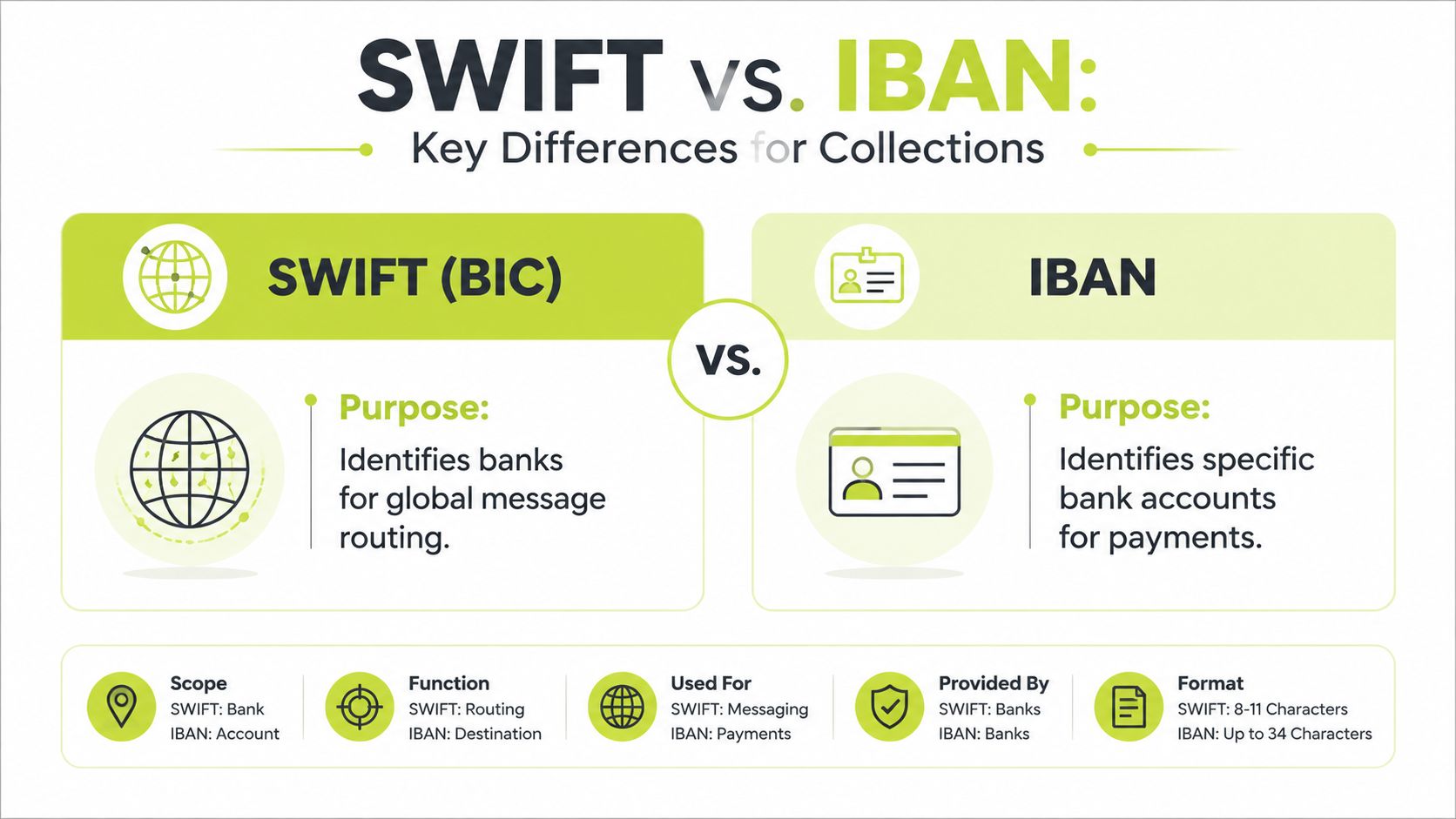
Start with function. SWIFT routes. IBAN identifies.
A SWIFT code is an 8 to 11 character alphanumeric bank identifier. It tells the payment system which financial institution should receive the message. An IBAN can be up to 34 alphanumeric characters and identifies the beneficiary's individual account, including country code, check digits, bank identifier, and account number, as described in PoliteDraft's discussion of cross-border B2B payment routing.
For collections, the implication is immediate. If your client has the right SWIFT code but the wrong IBAN, the payment may reach the right bank and still fail to credit the right account. If they have the right IBAN but omit SWIFT where it's needed, the payment instruction may not route properly at all.
Format and validation
IBAN has a practical edge for data quality.
IBAN includes check digits as part of its standardized structure. Those check digits help detect entry errors before funds move. In plain terms, IBAN gives finance teams a better chance to catch mistakes upstream.
SWIFT doesn't do that job. It's not designed to verify the final account. It's designed to identify the receiving institution.
For AR teams, that difference affects day-to-day work:
- Invoice setup improves when the system asks for both identifiers only where required.
- Client onboarding gets cleaner when forms validate account details before they're saved.
- Cash application runs smoother when incoming remittance data aligns with the correct account instructions.
- Exception handling drops because fewer payments need tracing or correction.
A lot of “slow-paying clients” are actually “easy-to-confuse payment instructions.”
Here's the deeper operational point. Validation isn't just about avoiding bank rejections. It's about protecting the handoff between invoicing, collections, and reconciliation. Once bad payment data enters that chain, every downstream task gets harder.
A short visual explainer helps if you need to brief an internal team or client-facing billing lead:
Geographic scope and where teams get tripped up
SWIFT is global. IBAN is regional by adoption.
That creates the common mistake. Finance teams assume that because an international client is “overseas,” one universal set of bank details should handle every case. It won't. A client in an IBAN country may need account instructions in a format that a North American client never uses.
A simple decision view helps:
If your client is paying from | What your team should confirm |
|---|---|
An IBAN-using country | Confirm the beneficiary IBAN is complete and current |
A non-IBAN market using international wire | Confirm the bank routing details needed for the transfer |
A region with mixed expectations across banks | Confirm instructions directly with your bank and present them clearly on the invoice |
Why both are often required
In many international transactions, especially into IBAN-using countries, SWIFT and IBAN are complementary. One locates the bank. The other identifies the destination account.
That's why strong collection processes don't ask, “Which one do we use?” They ask, “What does this payer need to complete payment correctly the first time?”
If you're focused on accounts receivable automation or AI AR automation, this is one of the first controls to standardize. Payment detail capture shouldn't depend on who created the invoice or which account manager sent the billing note.
A Tale of Two Invoices SEPA vs Global Wire
Two invoices can leave your CRM on the same day, for the same amount, and hit cash on very different timelines because the payment route is different.
That difference matters more in professional services than many teams admit. Margins are tied up in payroll, subcontractors, and utilization. If one payment path lands cleanly and another stalls in bank processing, AR ends up carrying an avoidable timing problem.
Invoice one in Germany
A strategy firm invoices a client in Germany and presents the beneficiary IBAN clearly on the invoice. The client pays through SEPA Credit Transfer.
The European Payments Council states that a SEPA Credit Transfer is designed for euro payments across SEPA markets, with funds made available to the beneficiary by the next business day under the scheme rules, as outlined in its SEPA Credit Transfer overview. For AR, that usually means a narrower receipt window and fewer payment-status emails between the client's AP team and your collectors.
The operational benefit is simple. The payer sees familiar instructions, the bank can process a standardized format, and your team has a better chance of matching cash without extra follow-up.
Why the first invoice is easier to collect
The gain is not just speed.
It is lower friction across the whole collection cycle:
- Cash forecasts hold up better because expected receipt timing is tighter.
- Collectors spend less time on payment tracing and more time on actual overdue accounts.
- Client questions drop because the invoice shows the format their AP process already expects.
- Reconciliation work is lighter when funds arrive on a more predictable path. Teams that want to reduce manual exceptions usually pair cleaner payment instructions with automated payment reconciliation workflows.
For a finance leader, this is a control point. Better routing data does not just help the bank move money. It reduces the admin wrapped around every payment.
Invoice two in a non-IBAN corridor
Now take a second invoice sent to a client paying by international wire outside the SEPA flow.
The invoice needs more than an account number in local format. It often needs the beneficiary bank's SWIFT or BIC code, full beneficiary details, and sometimes intermediary bank information depending on the corridor and the sending bank. SWIFT explains that its network supports cross-border financial messaging between institutions worldwide in its overview of SWIFT for corporates.
That broader reach is useful, but it comes with more operational variation. Fees may be split across banks. Processing can depend on cut-off times, correspondent relationships, sanctions screening, and manual repair if a field is incomplete. Payment can still arrive on time, but the range of outcomes is wider.
A wire that is merely "in transit" can still distort your weekly cash forecast if the invoice was expected to clear this period.
This is also the point where treasury discipline and AR discipline meet. If your team is reviewing corridors, counterparties, and transfer methods, this guide on managing international payment risks is a useful reference.
The operating lesson
SEPA and global wire are not interchangeable invoice scenarios. They require different instructions, different expectations, and different follow-up rules.
A standardized euro payment inside SEPA usually gives AR a cleaner path from invoice to usable cash. A SWIFT-based wire gives you global reach, but often with more variables between payment initiation and settlement. Teams that treat both cases with one generic bank-details template create their own delays.
The practical fix is to align invoicing data to the payment corridor at the start. If a client will pay inside SEPA, present the IBAN in the exact format their AP team expects. If the client will pay by international wire, collect and validate the full wire instruction set before the first invoice goes out. That is how routing data becomes a cash flow control, not a banking footnote.
Connecting Payment Details to AR Performance
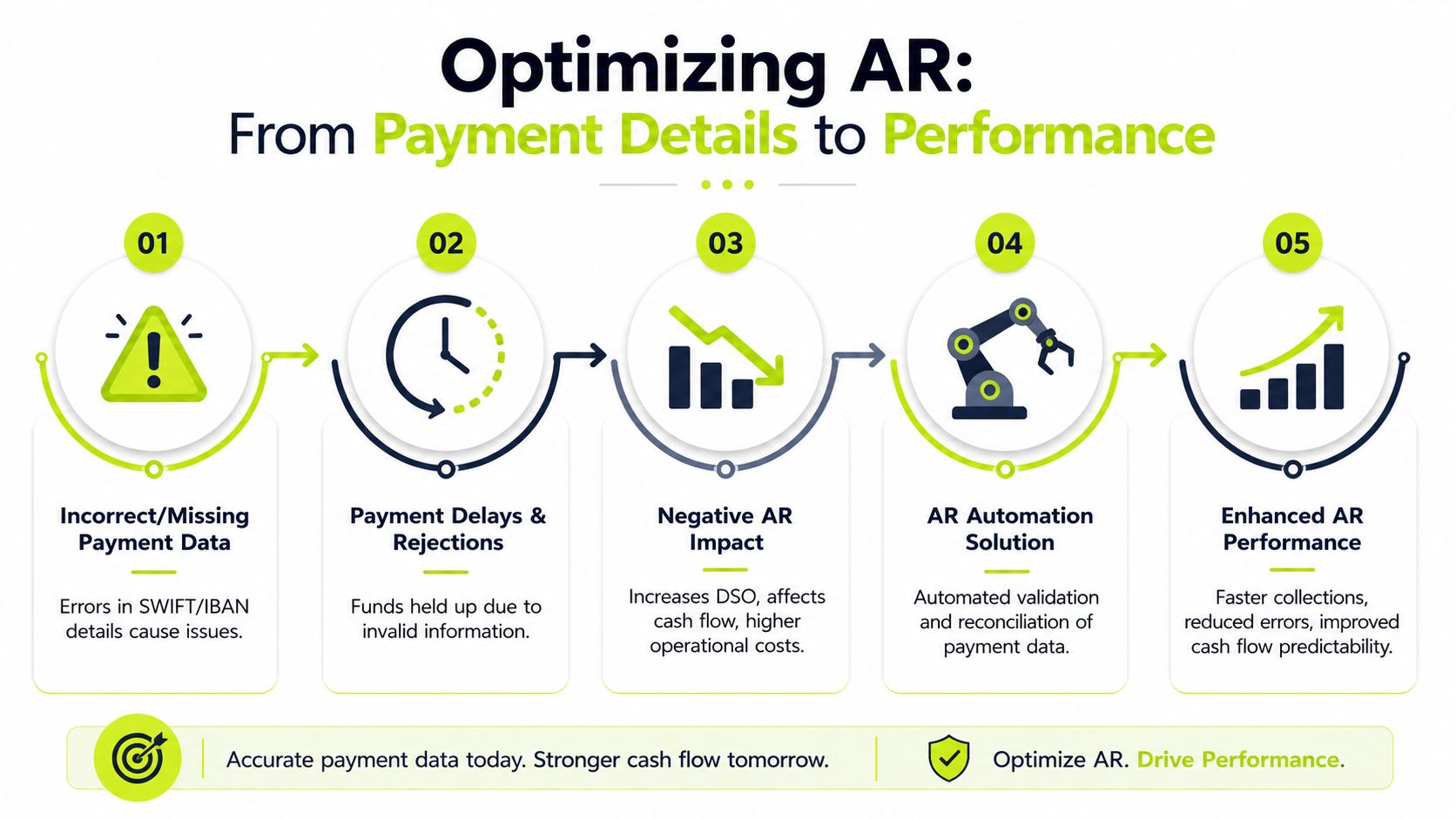
Bad bank data doesn't remain contained inside treasury. It leaks into every AR metric that matters.
A missing identifier delays payment. A malformed account string causes rejection. An invoice with incomplete banking instructions sends the client back to your team with questions. Each one adds time between invoice issue and usable cash.
How friction shows up operationally
When payment instructions are inconsistent, AR teams usually see the symptoms before leadership sees the root cause.
- Invoices age for the wrong reasons. The customer may be ready to pay, but the transfer can't be executed cleanly.
- Collectors spend time on diagnosis, not collection. Instead of resolving overdue balances, they chase remittances and confirm bank details.
- Reconciliation slows down. Receipts that arrive late or with unclear references create matching exceptions.
- Forecast confidence drops. Expected inflows become harder to trust because transfer success depends on manual accuracy.
Why this affects DSO more than teams expect
At this juncture, the Swift vs. IBAN question becomes a performance question.
If a payer needs specific routing data and your billing process doesn't reliably collect it, the invoice is effectively harder to pay. That doesn't always show up as a visible dispute. It often shows up as silence, status ambiguity, or “payment in process” responses that stretch longer than they should.
For firms trying to reduce DSO, the cleanest wins often come from removing payment friction before the reminder sequence even starts. Better payment data means fewer exceptions. Fewer exceptions mean faster cash application. Faster cash application gives collections a more accurate view of what is open.
Operator's view: The best AR process isn't the one with the most aggressive follow-up. It's the one that makes correct payment easy on the first attempt.
Where automation earns its place
Manual collection of bank details breaks in predictable ways. Different client owners keep different records. Invoice templates drift. AP contacts send updates by email, and no one updates the system of record consistently.
That's why firms investing in accounts receivable automation and AI AR automation tend to get stronger results from standardization than from pressure tactics.
A good process should do four things well:
- Capture bank data once in a controlled workflow instead of scattered emails and PDFs.
- Validate required fields before invoices go out.
- Present payment instructions consistently across invoices, portals, and reminders.
- Speed up matching and exception handling when funds arrive.
If you're looking at adjacent finance workflows, this article on how teams optimize ad spend with payment tracking is a good reminder that payment visibility matters well beyond AR. The same discipline that improves collections also improves decision quality elsewhere in the business.
For finance teams evaluating tooling, the relevant question isn't whether automation sounds modern. It's whether your current process can reliably support international payment accuracy at scale. If you're already seeing exceptions, tracing requests, or delayed reconciliation, the answer is usually no. A deeper look at automated payment reconciliation shows why matching speed and data quality are tightly linked.
That's especially true for firms running QuickBooks AR automation. When the accounting system remains the financial source of truth, payment data controls upstream have to be strong enough to protect what lands downstream.
How to Systemize and Automate Bank Data Collection
The fix starts earlier than most firms think. Not at collections. Not at cash application. At client setup.
If your onboarding form doesn't clearly collect the right payment information for the client's geography, your AR team inherits the problem later. If your invoice template doesn't display complete, current payment instructions, your client AP team is forced to guess or ask.
What a controlled manual process looks like
Before automation, get the operating basics right.
- Standardize onboarding fields. Collect bank information in a consistent format and tailor required fields to the client's payment corridor.
- Lock the invoice template. Don't let every practice lead or administrator improvise bank instructions.
- Create one owner for bank data governance. Someone needs responsibility for updates, verification, and exceptions.
- Require confirmation when clients change payment setup. Don't rely on informal email threads to update records.
Why automation scales better
Manual discipline helps, but it doesn't hold up well when invoice volume rises, teams grow, or clients pay across multiple regions.
That's where AR software for professional services becomes more than convenience. The strongest systems use structured workflows to collect payment details, validate completeness, and keep instructions consistent across the client experience. AI AR automation adds another layer by helping teams detect missing fields, route exceptions, and reduce manual back-and-forth before it turns into delayed cash.
For firms already using QuickBooks, QuickBooks AR automation can help close the gap between invoicing, payment capture, and reconciliation. The goal isn't to replace finance judgment. It's to remove repetitive data handling that introduces preventable errors.
The firms that improve cash flow most consistently usually don't chase every overdue invoice harder. They make it easier for clients to pay correctly, then they automate the repetitive parts of collection and matching so the team can focus on true exceptions.
Resolut automates AR for professional services with a steady operational focus: cleaner workflows, accurate payment handling, and a more human collections experience. If your team wants more control over cash flow, fewer avoidable exceptions, and less manual chasing, it's a practical place to start.