
What Are Trade Receivables: CFO Guide to Cash Flow 2026
Understand what are trade receivables and their cash flow impact. This 2026 guide for CFOs covers accounting, KPIs like DSO, and AR automation.
A large client signs the SOW. Delivery starts fast. Revenue hits the P&L. Then payroll clears, partner draws go out, software renewals post, and the bank balance still feels tight.
That gap is where most professional services firms lose control.
For a firm between $3M and $50M, the problem usually isn't whether the work is valuable. It's whether billed work turns into cash on schedule. If it doesn't, you start funding client operations with your own balance sheet. That's manageable for a month or two. It gets expensive after that.
A consulting firm can finish a milestone, issue an invoice, and still wait weeks for approval, portal processing, or client AP cleanup. A marketing agency can book a strong quarter and still feel cash pressure because collections lag behind delivery. An engineering or field services firm may carry even more strain when labor costs hit long before invoices are paid. In industries with longer billing cycles, outside capital support sometimes becomes part of the operating model. If that's relevant, this overview of details on oilfield business funding is a useful example of how firms bridge the delay between invoicing and cash receipt.
The issue isn't abstract accounting. It's operating reality.
Trade receivables sit at the center of that reality. They represent work you've already delivered and revenue you've already recognized, but not cash you can spend today. If you want more control, start by understanding exactly what sits in receivables, what doesn't, and how to tighten the path from invoice to payment. Firms that want a practical starting point usually begin with a sharper look at how to improve cash flow before they change systems.
The Gap Between Revenue and Cash
The cleanest month on your income statement can still be a messy month in your bank account.
A law firm closes several matters and bills them promptly. A consulting firm hits delivery milestones on time. A creative agency ships approved work and invoices according to contract. On paper, the month looks solid. In cash terms, none of that matters until clients pay.
What owners feel first
The first signal is rarely a spreadsheet problem. It shows up as tension.
You hesitate before hiring. You delay a software upgrade. You review payroll timing more closely than usual. You ask whether partner distributions should wait. Revenue is there, but liquidity is thinner than it should be.
That disconnect usually comes from one issue. You've recognized value before you've collected cash.
Revenue tells you what you earned. Trade receivables tell you what clients still owe you for work already delivered.
For professional services firms, this matters more than it does in many product businesses. Your biggest costs are often payroll and subcontractors. Those costs hit on fixed dates. Client payment behavior doesn't.
Why this becomes a management issue fast
Once receivables start stretching, the problem moves beyond collections.
Now forecasting gets weaker. Working capital gets tighter. Sales starts asking for flexible terms. Project leads assume finance will “work it out later.” Nobody intends to create risk, but the business starts absorbing delay as if it were normal.
That's why the question “what are trade receivables” isn't just definitional. It's operational. If you don't isolate the balances tied to actual client billings, you can't manage the timing gap with precision.
A firm can survive a short delay. It struggles when delay becomes habit.
Trade Receivables Defined The Right Way
Trade receivables are amounts owed to the business for goods or services sold on credit as part of normal operations. For a professional services firm, that usually means completed billable work, invoiced to a client, with payment due later.
They are not just “money coming in.” They are a specific balance sheet category with direct cash consequences.
What they are on the balance sheet
Trade receivables are classified as a current asset. They represent an unconditional right to consideration once the performance obligation is satisfied, which is why they matter so much in liquidity planning and working capital analysis, as explained in Taulia's overview of trade receivables and working capital requirements.
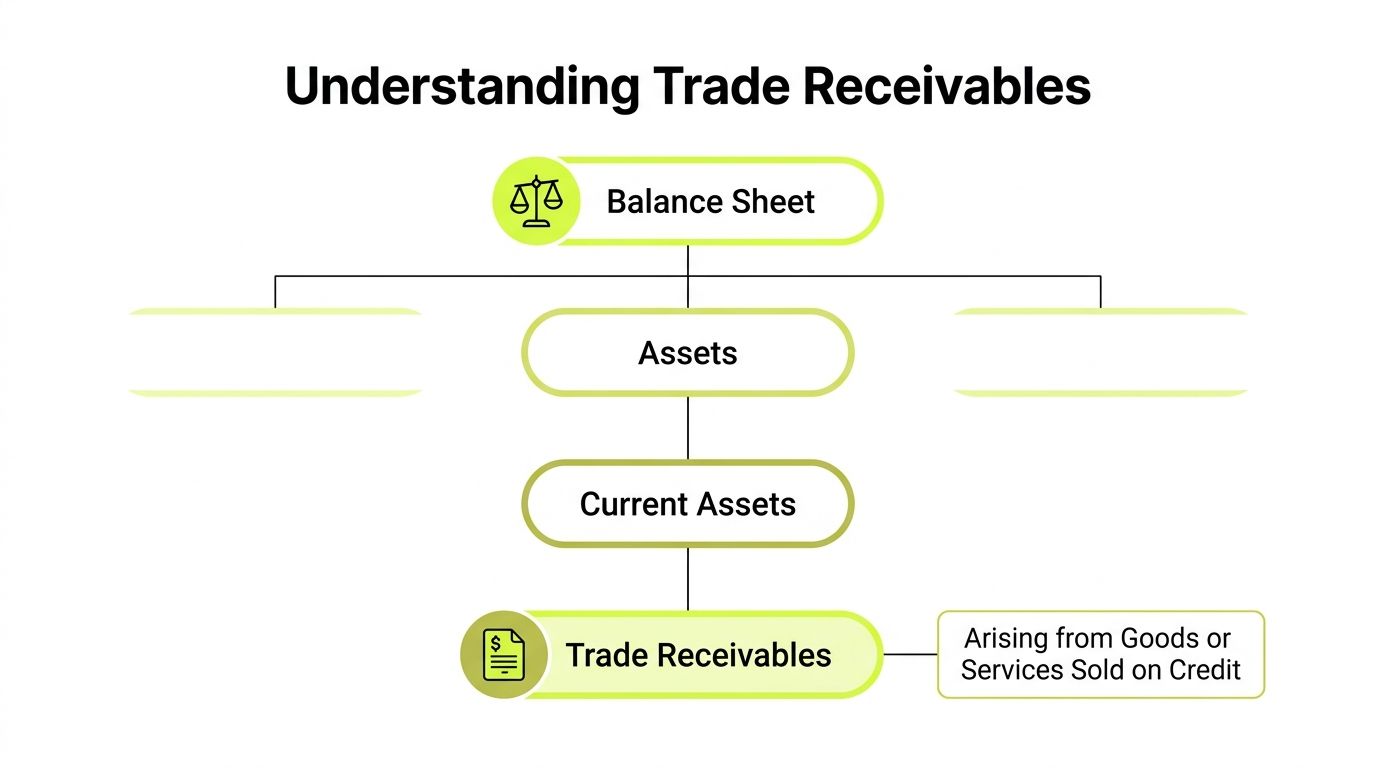
That classification matters because it feeds directly into Working Capital Requirements:
Component | Effect on working capital |
|---|---|
Stocks | Uses cash |
Trade receivables | Uses cash until collected |
Supplier payables | Offsets some cash need |
WCR = Stocks + Trade Receivables – Supplier Payables
For most professional services firms, inventory is minimal or irrelevant. That makes receivables one of the main drivers of working capital pressure.
When a trade receivable is created
Under revenue recognition rules, the receivable is created when the firm has delivered the service and earned the right to payment. In plain terms, once you've satisfied the obligation, the receivable exists even if the client won't pay for weeks.
Here's the simple accounting entry:
Event | Debit | Credit |
|---|---|---|
Invoice issued for completed work | Trade Receivables | Service Revenue |
Later, when the client pays:
Event | Debit | Credit |
|---|---|---|
Cash received | Cash | Trade Receivables |
That's the part many owners underestimate. The revenue is real, but it hasn't strengthened liquidity yet.
What works in practice
The firms with the best control treat trade receivables as an operating asset that needs active management, not as a passive ledger balance.
A few habits help:
- Bill on the trigger, not on the calendar. If work is delivered, invoice it. Waiting for month-end slows cash without improving the client experience.
- Tie billing to contract language. If milestone approval is vague, payment timing becomes vague too.
- Separate earned revenue from collectible cash in forecasts. Collections forecasting should never rely on booked revenue alone.
Practical rule: If a receivable can't be explained by a delivered service and a clear invoice, it shouldn't sit in your core collections view.
Trade Receivables vs Accounts Receivable
Many finance teams blur something that should stay sharp.
People often use accounts receivable and trade receivables as if they mean the same thing. In daily conversation, that's common. In working capital management, it creates noise.
The distinction that changes analysis
Trade receivables are a subset of accounts receivable. They come specifically from selling goods or services on credit. Accounts receivable is broader. It can also include non-trade balances such as tax refunds, insurance claims, or employee advances.
That distinction matters because those balances don't behave the same way.
According to Paystand's discussion of non-trade receivables and collection timelines, non-trade collection cycles often exceed 180 days, compared with a standard 30–60 day trade window. If you lump them together, your aging and cash conversion analysis gets distorted.
Why this hurts DSO and risk control
If your AR report mixes client invoices with unrelated receivables, your collection metrics stop reflecting the actual performance of your client payment process.
You'll see this in three places:
- DSO gets diluted. The metric now reflects items your collections team can't influence the same way.
- Aging reports become less useful. Long-dated non-trade balances make the whole portfolio look worse, even when client collections are stable.
- Collection effort gets misallocated. Staff spend time chasing balances that don't belong in the client collections workflow.
For firm owners, the practical question is simple. Do you want to measure how quickly clients pay for delivered work, or do you want one blended number that hides the answer?
A cleaner operating view
Use two separate lenses.
Category | What belongs here | Why it matters |
|---|---|---|
Trade receivables | Client invoices for delivered services | Core cash conversion and client credit risk |
Non-trade receivables | Refunds, claims, employee-related balances | Separate timeline, separate owner, separate follow-up |
If your team needs a quick refresher on when an invoice becomes a receivable in the first place, this overview of what is a credit sale is a useful companion.
The operational lesson is straightforward. If you want accurate DSO, cleaner forecasting, and better prioritization, isolate trade receivables from the broader AR bucket. Don't let balance sheet convenience override management clarity.
Key Metrics for Managing Trade Receivables
You don't control receivables by staring at the total balance. You control them by watching the right movement.
For most CFOs and Controllers, three views matter most. DSO, the trade receivables turnover ratio, and the aging report. Together, they tell you speed, efficiency, and risk concentration.
DSO tells you how long cash takes
Days Sales Outstanding, or DSO, measures how many days it takes on average to collect receivables relative to turnover. The formula is:
DSO = (Accounts Receivable / Turnover) × Number of Days in Period
CentralPay's explanation of DSO and trade receivables turnover is useful here because it ties the formula directly to cash flow health.
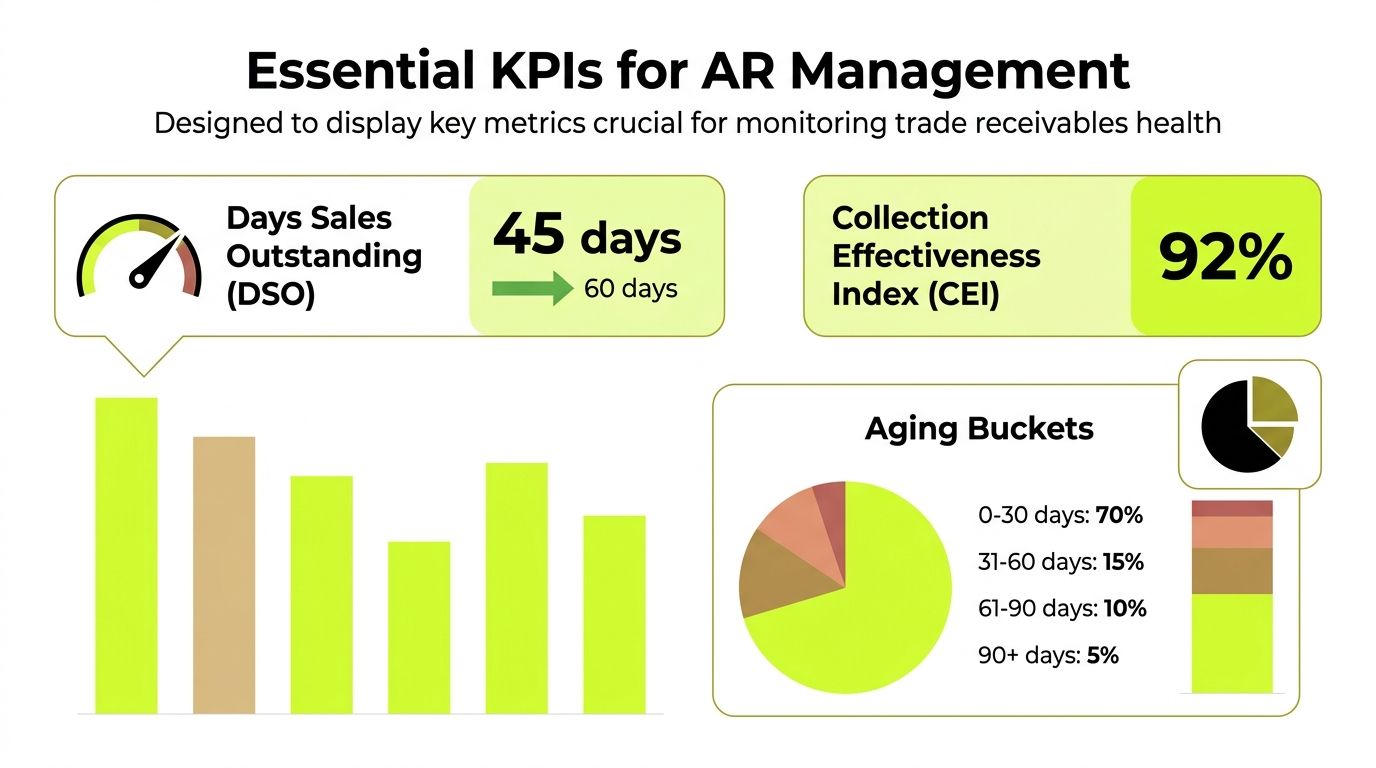
A rising DSO doesn't always mean clients are refusing to pay. It can also signal internal delay:
- Invoices go out late
- Backup documentation is incomplete
- Approvals sit with project managers
- Payment methods create friction
- Disputes aren't tracked cleanly
The metric won't tell you which of those is happening. It tells you where to look.
Turnover ratio tells you collection efficiency
The Trade Receivables Turnover Ratio is:
Net Credit Sales / Average Trade Receivables
A stronger ratio usually means your firm is converting credit sales into cash more efficiently. A declining ratio is an early warning. It can point to weaker credit discipline, softer collection follow-up, or contract terms that are too loose for the way clients pay.
Watch turnover trend by client segment, not just at the firm level. Enterprise accounts, mid-market clients, and one-off project buyers often behave very differently.
Aging shows where risk is sitting
If DSO is the summary, the aging report is the x-ray.
A basic aging structure might look like this:
Aging bucket | What it usually means |
|---|---|
Current | Recently billed, usually still within terms |
31 to 60 days | Slipping, needs active follow-up |
61 to 90 days | Elevated risk, likely process or dispute issue |
Over 90 days | High attention, ownership should be explicit |
For a professional services firm, I'd go one step further and review aging by partner, account manager, or practice lead. That's where accountability becomes real. If finance owns the report but delivery owns the client relationship, both teams need visibility into the same facts.
What to review every month
A short monthly review beats a long quarterly post-mortem.
Use a checklist like this:
- Look at DSO trend. One month can be noise. Several months in one direction usually isn't.
- Review the aging migration. Which invoices moved from current into later buckets, and why?
- Check concentration. A few large balances can distort the whole receivables picture.
- Separate process issues from credit issues. Missing PO numbers and unresolved scope questions are not the same as a client liquidity problem.
Trade receivables are manageable when the team can see movement early. They become painful when leadership only notices them after cash gets tight.
Operational Risks and Manual Management Pitfalls
Manual receivables management usually looks harmless at first. Someone sends invoices from the ERP or accounting system. Someone else follows up by email. Notes live in inboxes, spreadsheets, or team memory. It works until volume rises, a key collector leaves, or client complexity increases.
Then the slippage becomes visible.
According to ACCA's write-up on trade receivables and collection inefficiency, poor receivables management contributes to about 1 in 10 invoices going unpaid globally, and enterprises waste an estimated $200 billion annually on manual follow-up, delayed cash application, and related inefficiencies.
The hidden cost inside manual AR
Most firms notice late payment. Fewer notice the operating drag behind it.
Manual AR creates recurring problems:
- Follow-up is inconsistent. Some clients get reminders too early, others too late.
- Cash application slows down. Money arrives, but open invoices remain unclear in the ledger.
- Disputes scatter across tools. Billing, client success, and finance all hold different pieces of the same issue.
- Collections depend on individuals. If one person knows the history, the process isn't durable.
Each of those problems weakens forecasting. Each also consumes time from people whose work should be more valuable than chasing status updates.
Client trust can erode quietly
Professional services firms can't treat collections like a high-volume commodity business. The same client who owes you money may also be discussing a renewal, expansion, or referral.
That makes tone and timing matter.
A late reminder isn't neutral. It signals that your internal process is loose. An inaccurate reminder is worse. It tells the client your records can't be trusted.
When teams run collections manually, they often swing between two bad modes. They either avoid follow-up because they don't want friction, or they escalate abruptly after too much time has passed. Neither approach protects the relationship.
Good receivables management should feel steady, documented, and professional. Not emotional. Not improvised.
How AR Automation Transforms Receivables Management
Once receivables move past a certain volume, process discipline matters more than good intentions. That's where accounts receivable automation changes the economics.
The goal isn't to remove judgment. It's to standardize the repeatable work so your team can focus on exceptions, client context, and risk.
What automation fixes first
In most firms, the first wins come from consistency.
Automated workflows can trigger invoice creation, schedule reminders, route disputes, and support digital payment paths without waiting for someone to remember the next step. Versapay describes how AR software for professional services helps reduce billing bottlenecks and shorten collection cycles through automated invoicing, reminders, and payment options.
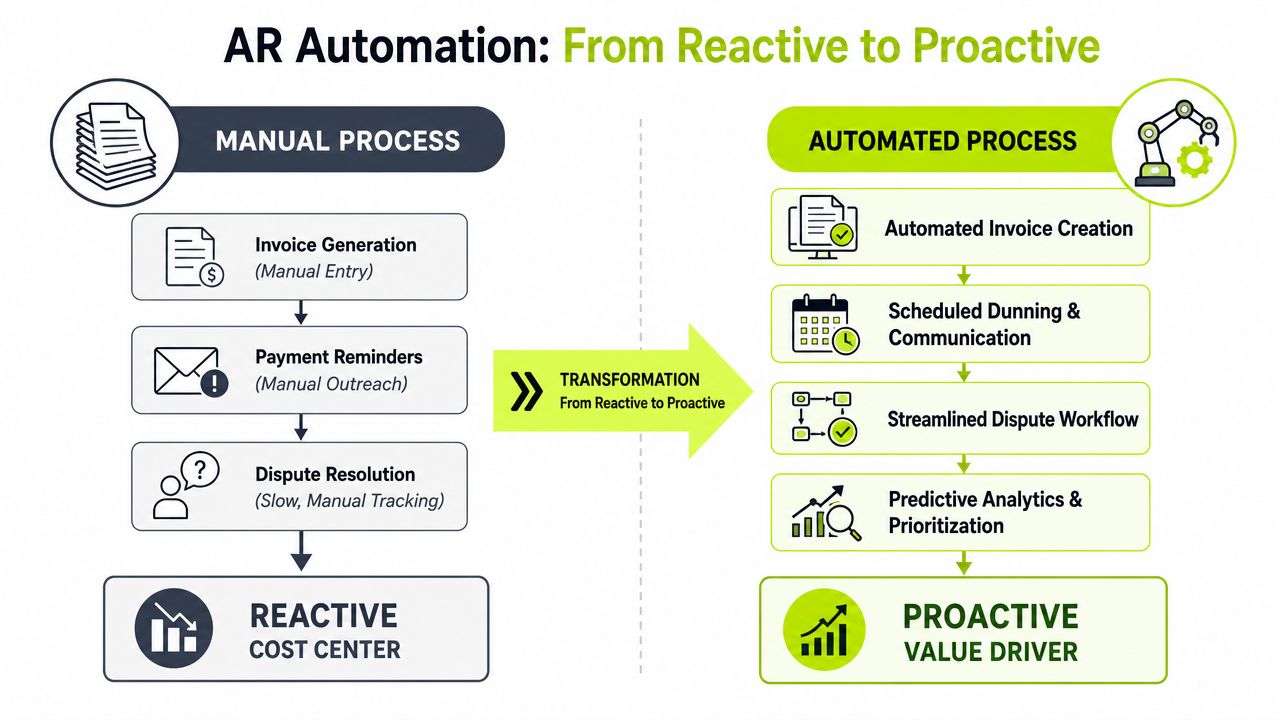
That matters if you're trying to reduce DSO and improve cash flow without adding headcount every time revenue grows.
A practical automation stack usually improves four things:
- Invoice speed through faster generation and delivery
- Reminder cadence through scheduled outreach rather than ad hoc chasing
- Payment experience through easier digital settlement
- Visibility through dashboards that show where invoices are aging and why
For firms running accounting on QuickBooks, that often leads to a search for QuickBooks AR automation rather than a full finance system replacement. That's usually the right instinct. Fix the workflow around collections before you rip out the ledger.
Where AI AR automation adds value
Basic automation handles repeatable tasks. AI AR automation should do more than that.
It should help prioritize accounts, identify likely payment delays, and improve outreach timing based on real payment behavior. Thomson Reuters outlines how AR automation supports real-time metrics and predictive analytics, including earlier identification of likely defaulters and fewer billing errors.
Here's a short explainer worth watching:
That's the difference between reactive workflow and managed workflow. One chases overdue invoices after the fact. The other gives finance a better chance to intervene before an account becomes a problem.
The measurable outcomes that matter
The strongest evidence comes from usage, not vendor language.
Billtrust reports in a study of 500 finance professionals using AR automation that 100% reported measurable gains, fully automated users achieved a 40%+ reduction in Days to Pay, and two out of three AR professionals reported a 50% weekly increase in productivity.
For CFOs, those results matter because they show two things at once. Cash arrives faster, and the finance team spends less time moving work manually through the system.
If your process also touches ERP, billing, and finance operations more broadly, this summary of the benefits of ERP in accounting is worth reviewing. AR automation works best when invoice, customer, and payment data don't have to be reconciled across disconnected tools.
One example in this category is Resolut, which combines credit risk, collections workflows, outreach, billing, and cash application in a single system for teams evaluating what is AR automation. That's relevant for professional services firms that need control without making collections feel mechanical to clients.
From Insight to Action
Trade receivables are simple in definition and demanding in practice.
They represent value your firm has already delivered but hasn't yet converted to cash. If you treat them as just another accounting line, you'll miss what they're telling you about liquidity, client payment behavior, and operating discipline. If you separate trade receivables from broader accounts receivable, measure them cleanly, and manage them with consistency, you gain much better control over working capital.
That's the essential answer to what are trade receivables. They are not just unpaid invoices. They are one of the clearest indicators of whether your firm's operations, billing, and collections are aligned.
A good finance team doesn't need more noise. It needs cleaner segmentation, tighter metrics, and a process that scales. For many firms, that means moving from spreadsheet-driven follow-up to structured accounts receivable automation. Not because automation is trendy, but because control matters when cash timing gets tight.
If your firm is growing, complexity won't stay flat. Client demands won't get simpler. Payment behavior won't become easier to manage on its own.
The firms that stay calm through growth usually do one thing well. They make cash conversion a managed process, not a monthly hope.
Resolut automates AR for professional services with a measured approach that fits how finance teams work. If you want more control over collections, cleaner workflows, and a better path to consistent cash conversion, explore Resolut. It's consistent, accurate, and human.