
What Is Acid Test Ratio and Why It Matters in 2026
What is acid test ratio? Learn the quick ratio formula, how to calculate it with examples, industry benchmarks, and how to improve your firm's liquidity.
The acid-test ratio, or quick ratio, is a stricter liquidity test than the current ratio because it divides cash + marketable securities + accounts receivable by current liabilities and leaves out inventory and other slower assets. It matters because a firm can look comfortable on paper and still be short on cash when payroll, vendors, and tax payments hit.
A lot of CFOs and controllers know that feeling by month-end. The balance sheet looks fine, the current ratio isn't alarming, and yet the cash account feels too thin to absorb a late client payment or a messy collection cycle.
Why a Healthy Current Ratio Can Still Mean Tight Cash
The month closes, and the current ratio looks respectable. On paper, there's enough current assets to cover current liabilities, but the controller still has to watch the bank balance closely because the issue is timing, not just totals.
That happens often in professional services. Inventory barely matters, but receivables do, and so do unbilled work, retainers, and clients that pay late without warning.
A current ratio can hide stress when most of the asset side sits in items that won't turn into cash on demand. The acid-test ratio is tighter because it filters out the slow-moving pieces and asks a more practical question, can the firm meet near-term obligations without selling something or borrowing again? That's the lens lenders and partners care about when they want to know if the firm can absorb a shock.
Practical rule: If cash is thin and receivables are aging, the current ratio is only telling half the story.
For a firm that invoices clients instead of moving product, that distinction matters. The ratio built on the easier assets is closer to the stress test, especially when the billing cycle is uneven and payroll never waits.
If you also track operating cash, the ratio makes more sense when read beside the cash from operations ratio. That pairing shows whether liquidity is coming from actual collections or just sitting inside balance sheet timing.
The Acid-Test Ratio in Plain English
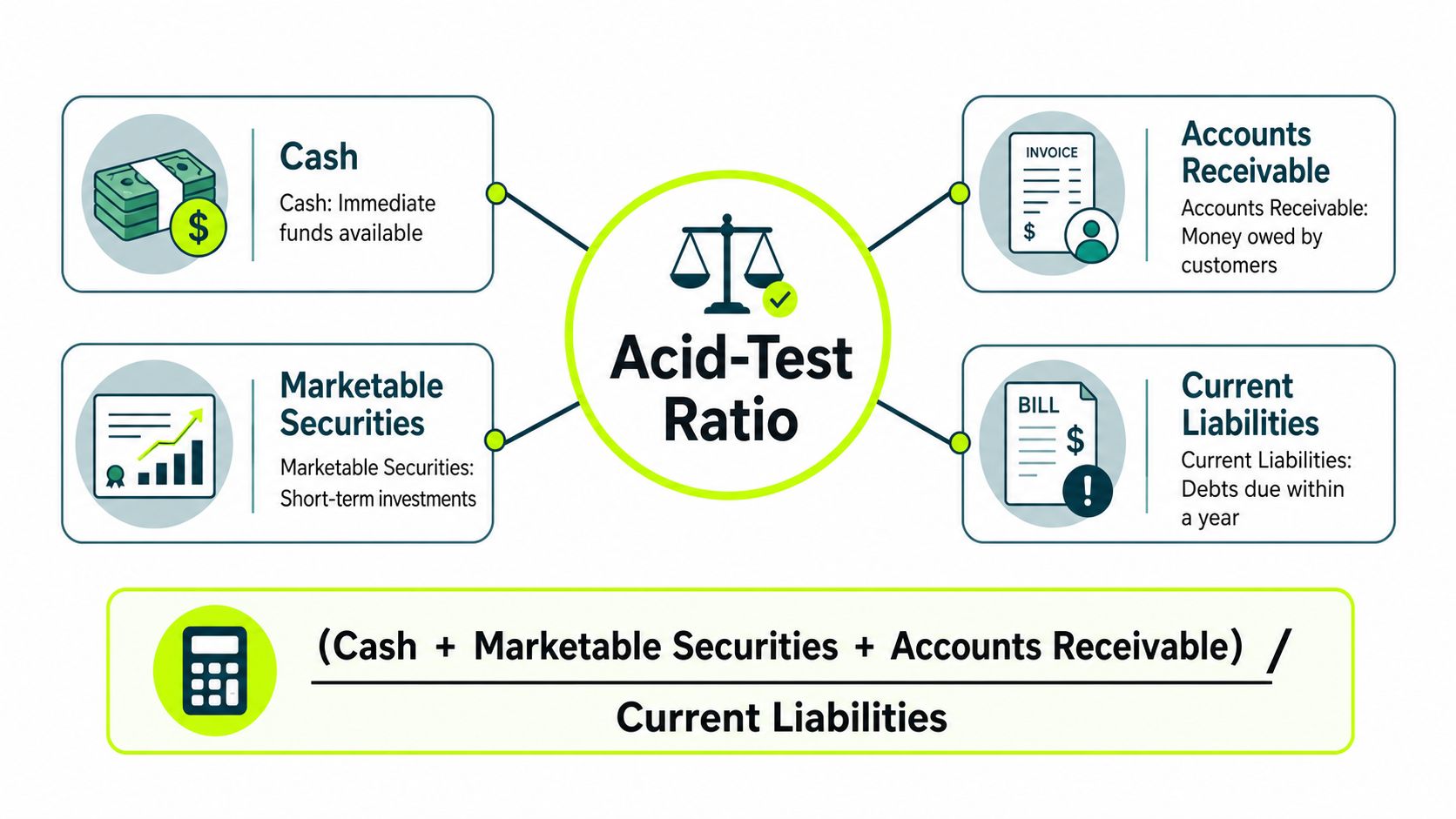
The acid-test ratio is a short-term liquidity measure that answers a direct question, can the business cover current liabilities with assets that are already close to cash? For most finance teams, the formula is cash + marketable securities + accounts receivable, divided by current liabilities. That definition is consistent with standard references on the ratio (Investopedia).
What counts and what doesn't
Cash is straightforward. Marketable securities are short-term investments that can be sold quickly. Accounts receivable counts because customers already owe the firm money, even if it has not hit the bank yet.
Inventory is left out on purpose. In many businesses, turning inventory into cash takes time, and the outcome is not guaranteed, which is why the ratio is more conservative than the current ratio. In a services firm, the same logic applies to anything that sits on the balance sheet but will not pay a bill this week.
A practical way to read the ratio is to ask whether the assets included in the test can realistically cover near-term obligations without waiting on a sale, a refinance, or a fresh draw on credit. That is why the ratio is useful when a firm wants a tighter read on liquidity than the broad current ratio provides.
For a partner or controller, the plain-English test is simple. Can the firm meet current liabilities using only the most liquid assets?
If the answer depends on slow collections or assets that are current in name only, the ratio exposes that strain quickly. That is especially relevant in invoice-heavy firms, where the balance sheet can look comfortable while cash still feels tight.
The logic sits inside the broader balance sheet structure. If you want a clean refresher on how those lines fit together, the assets liabilities equity guide is a useful reference point.
Step-by-Step Calculation With Two Real Firm Examples
A quick ratio only becomes useful when you can run it against your own books. The mechanics are straightforward, but the meaning changes depending on how fast receivables turn into cash.
Here's the basic sequence. Add cash, marketable securities, and accounts receivable. Then divide that total by current liabilities.
Example one, a $12M consultancy
This firm has $420K in cash, $180K in marketable securities, and $1.2M in accounts receivable. Current liabilities total $1.8M. The quick assets add up to $1.8M, so the acid-test ratio is 1.0.
That number would likely comfort a bank more than a ratio below one, but it still invites a follow-up question about receivables quality. If a large slice of that AR is late, the ratio looks better than the payment pattern really is.
Example two, a $30M agency
This agency carries $900K in cash, $300K in marketable securities, and $1.35M in accounts receivable. Current liabilities are $1.5M. Quick assets total $2.55M, so the acid-test ratio is 1.7.
That's a stronger buffer, but concentration risk still matters. If a few large clients dominate receivables, the number can move quickly when one account slows down.
Acid-Test Ratio for Two Professional Services Firms | $12M Consultancy | $30M Agency |
|---|---|---|
Cash | $420K | $900K |
Marketable Securities | $180K | $300K |
Accounts Receivable | $1.2M | $1.35M |
Current Liabilities | $1.8M | $1.5M |
Acid-Test Ratio | 1.0 | 1.7 |
For a controller, the table is less about the score and more about the inputs. If receivables are carrying the ratio, the question becomes how quickly the firm can collect them. A practical primer on reading the statement itself can help here, especially the balance sheet basics for sole traders.
Benchmarks for Professional Services
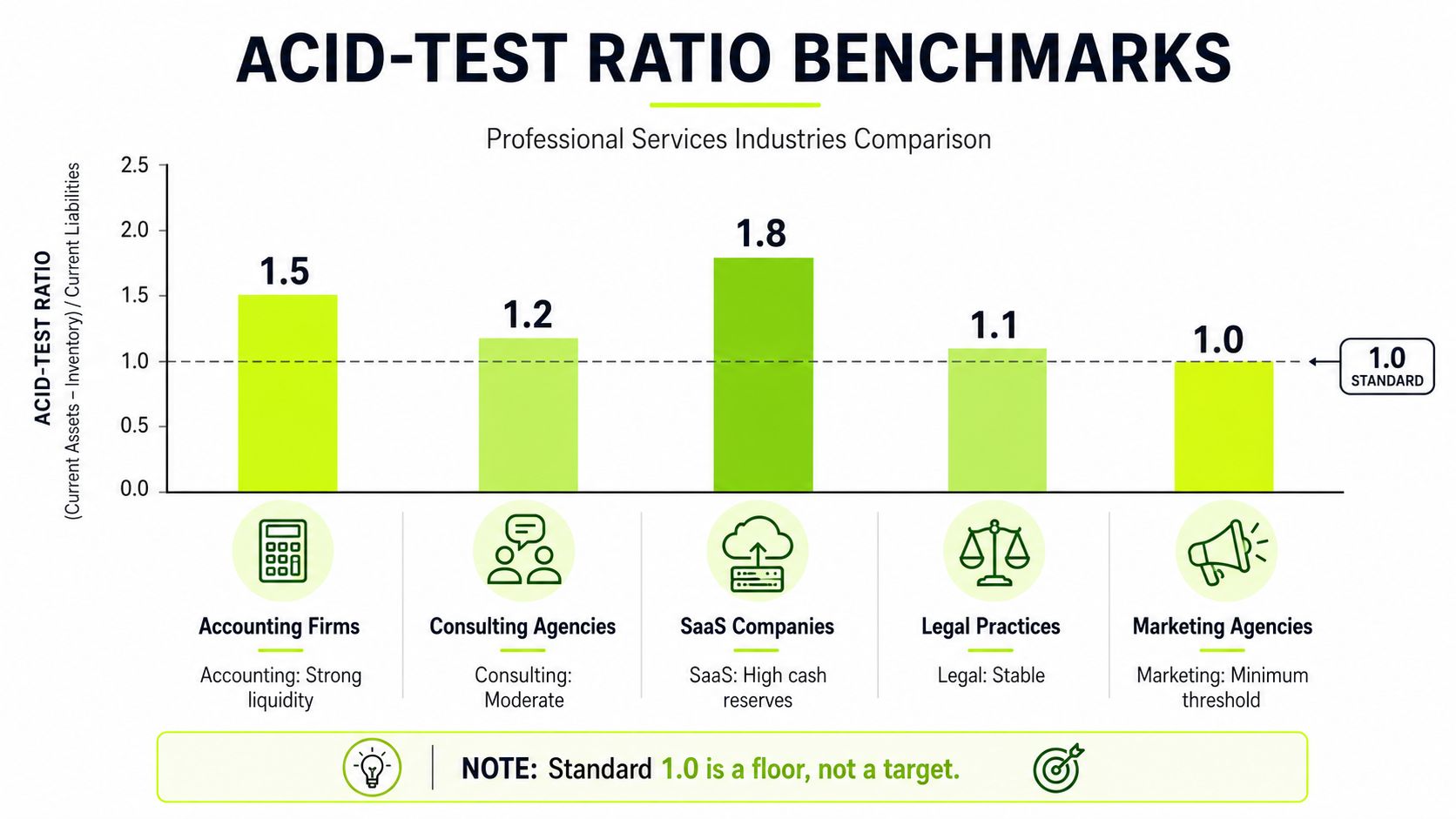
The old rule of thumb says 1.0 is healthy. In practice, that is a floor, not a target, and for professional services it is often too blunt to be useful.
Why sector nuance matters
Consultancies, agencies, legal practices, and SaaS-adjacent firms usually carry little or no inventory. That means the acid-test ratio is driven mostly by cash quality and receivables quality, not by stock turnover. The same source that defines the ratio also points out that inventory exclusion matters less in inventory-light, SaaS-like models, where cash conversion dynamics deserve more attention than a textbook formula gets (Open University).
That is why a firm with long project cycles or concentrated clients often needs a stronger internal benchmark than a company with stable, fast collections. The ratio can look acceptable and still leave too little room for delayed billing or client disputes.
For firms that want a working benchmark, I would separate the target by business model. A retainer-heavy agency can often operate comfortably near the floor if collections are reliable. A consultancy with lumpy billing and slow approvals should expect a wider cushion.
Decision rule: Set your internal benchmark around your receivables behavior, not a generic number from a blog post.
DSO gives that benchmark context, because the quality of quick assets matters more than the headline total. A firm can appear liquid and still tie up too much cash in overdue invoices, which is why it helps to compare the ratio against the average DSO by industry before the next lender review.
For professional services firms, the pattern is simple. A ratio near 1.0 may be fine if invoices turn quickly and client concentration is low. If billing is uneven, approvals drag, or one customer dominates receivables, the same number gives far less comfort.
The visual below shows how those expectations can differ across service models, with the 1.0 benchmark as the reference point.
Acid-Test Ratio vs Current Ratio Side by Side
A firm can show a 2.0 current ratio and still post a 0.9 acid-test ratio. That gap tells you inventory, prepaid items, or other less liquid current assets are doing too much of the work.
The current ratio includes more of the balance sheet. The acid-test ratio strips the picture down to what can realistically help pay a bill soon. For a services business, that distinction matters because prepaid software, deposits, work-in-progress, and similar items may look current without being liquid in a real cash crunch.
One balance sheet, two answers
Assume a firm has $2M in current assets and $1M in current liabilities. If $700K of those current assets sit in inventory and other slower items, the current ratio is 2.0. Remove those slower assets, and the quick asset base drops to $900K, which gives you an acid-test ratio of 0.9.
That spread is not academic. It says the company may be able to cover short-term obligations only if those slower assets convert on time, which is a weaker position than the current ratio suggests.
Metric | Amount |
|---|---|
Current Assets | $2M |
Current Liabilities | $1M |
Current Ratio | 2.0 |
Quick Assets | $900K |
Acid-Test Ratio | 0.9 |
A CFO reading that gap should ask one question first, how much of the current asset base is collectible or usable within the liability window? If the answer depends on inventory sales, client approvals, or other timing assumptions, the quick ratio is the more honest number.

Where the Quick Ratio Misleads You
A clean quick ratio can still flatter a messy ledger. Receivables may sit on the balance sheet even when they are already drifting past the point where anyone should call them liquid.
What to check before trusting the number
Aged receivables are the first issue. If the firm's AR book is technically current but practically slow, the numerator overstates real cash readiness. That matters more in invoice-heavy professional services firms, where reported quick assets can look healthy while cash is still tied up in unpaid client work.
Deferred revenue can distort the denominator in service businesses, because current liabilities can swell even when the underlying work is already contracted and partly earned. Seasonality can also make a good quarter look stronger than the next one will be. A firm with strong billings in one period can still face a gap if collections lag the work it has already delivered.
Then there are obligations that do not show up cleanly in the ratio. Pending tax disputes, litigation, and other contingent items can change the actual liquidity picture even if the formula looks fine today. A controller who only reads the ratio can miss the pressure building outside the balance sheet.
The discipline is to ask whether receivables are collectible on schedule, not just whether they exist. If the cash conversion cycle is broken, the quick ratio becomes a snapshot of accounting form, not operating substance.
If most quick assets are receivables, the collection calendar matters more than the ratio itself.
That is the point most textbook explanations miss. For professional services firms, the numerator is only as strong as the billing and collection process behind it. If you want the balance sheet to tell the truth, the work starts in AR discipline, not in the ratio itself.
That is also why working capital improvement tactics matter here. Better invoicing, tighter follow-up, and cleaner cash application improve the quality of quick assets before they ever show up in a ratio review.
How to Improve the Ratio Without Chasing More Capital
The fastest way to lift the ratio is usually not new financing. It's converting existing receivables into cash faster and keeping current liabilities from piling up unnecessarily.
One lever is credit discipline. Tighten terms where clients routinely stretch payment, and invoice the day work is delivered instead of waiting for the end of the month. That alone can pull cash forward without changing the commercial relationship.
Another lever is collections cadence. Consistent follow-up, better cash application, and faster dispute resolution shorten the time AR sits idle. That improves the numerator and helps reduce DSO, which is often the drag behind a weak quick ratio.
For teams using accounts receivable automation, the practical gains come from the process, not the buzzwords. AI AR automation can help with credit risk assessment, multi-channel follow-up, automated cash application, and a cleaner payment portal, all of which support faster conversion of invoices into usable cash. For firms running QuickBooks AR automation or looking for AR software for professional services, the point is the same, fewer manual handoffs and less time between billable work and banked cash.
- Invoice Earlier: Send bills as soon as work is completed so receivables start aging sooner, not later.
- Collect More Consistently: Use structured reminders and escalation rules so overdue balances don't depend on one person's follow-up style.
- Apply Cash Faster: Match payments quickly to open invoices so the books stay clean and the team can trust the aging report.
- Retire Idle Short-Term Debt: If there's excess cash sitting around, reduce short-term borrowing before it distorts liquidity planning.
A stronger working-capital process helps the ratio, but it also makes the firm easier to manage. Resolut is one option for that workflow, and it automates AR for professional services with credit checks, outreach, billing, and cash application in one system. A practical guide to the operating side is the working capital improvement playbook.

--- Resolut automates AR for professional services, consistent, accurate, and human. If you're trying to improve cash flow, reduce DSO, and make your quick assets more dependable, visit Resolut and see how a cleaner AR process changes the acid-test ratio you report next month.