
What Is Credit Hold in Professional Services
Learn what is credit hold, when to trigger it, and how to protect cash flow and client relationships with smart AR automation and clear policies.
A credit hold is a temporary, policy-driven pause on new billable work or services when a client's account violates predefined risk rules, such as overdue invoices or an exceeded credit limit. In professional services, the decision matters because 43% of credit-based B2B sales are affected by overdue invoices, while an indiscriminate hold can interrupt revenue and damage a relationship when the delay reflects liquidity constraints rather than refusal to pay (Atradius Payment Practices Barometer).
Your team may be in that uncomfortable meeting now. A strategic client has unpaid invoices, the next project milestone is approaching, and the engagement partner wants delivery to continue. Accounts receivable wants protection. Sales wants discretion. The client insists payment is coming.
That tension explains why the answer to what is credit hold needs more nuance than “stop the order.” A hold is a reversible risk-control tool. It limits additional unsecured exposure while preserving a route back to normal terms, such as payment of overdue amounts, a documented payment plan, updated financial information, prepayment, or an approved exception.
What Pausing Client Work Actually Involves
A professional services firm rarely stops a warehouse shipment. It pauses something less tangible and often more commercially sensitive: a new statement of work, change order, expanded scope, project milestone, or additional billable hours.
Consider a client with an overdue invoice and an active implementation project. A blanket stop may protect the outstanding balance, but it can leave the client with an unfinished deliverable and the firm with a strained relationship. A controlled hold may prevent new scope while allowing the team to complete an agreed milestone that adds limited exposure.
For a services firm, “orders” translate into new work, expanded scope, and further billable delivery, as explained in Yonovo's explanation of credit holds. The control therefore has to match the engagement. Restricting every activity can create delivery risk, while allowing unrestricted work can increase unsecured receivables.
A control, not a punishment
The purpose is to preserve cash flow and prevent unpaid receivables from growing. It should not punish a client for missing a date, embarrass an account executive, or create pressure without a resolution path.
A well-designed hold remains reversible. Normal terms may resume after overdue debt is paid, a billing dispute is resolved, prepayment is accepted, revised terms are approved, or an authorized exception is granted. A B2B relationship can often continue during a hold when new work is paid in advance, even though credit-based delivery remains restricted.
Practical rule: A hold should answer three questions clearly: what triggered it, what activity is restricted, and what must happen for release?
The workflow crosses functions. AR confirms the invoice and payment status. Credit evaluates exposure. Project leadership identifies operational consequences. Sales supplies commercial context. Finance or an authorized approver decides whether the restriction matches the risk.
That structure prevents a credit hold from becoming an unrecorded project-management decision. It also protects client trust. The customer should receive one consistent explanation, with the account status, restricted activity, and release conditions aligned across finance, sales, and delivery.
Quantitative and Qualitative Triggers
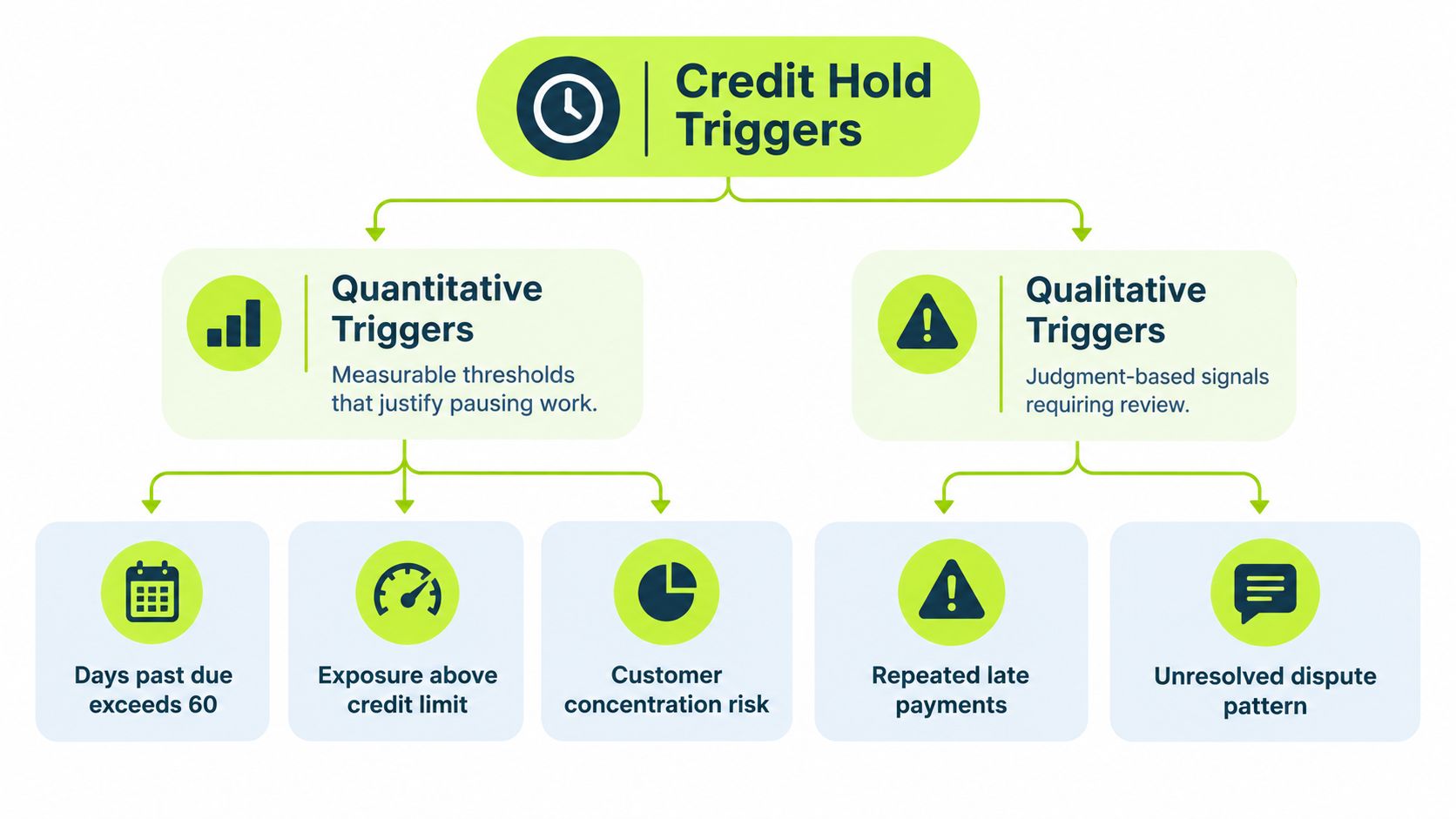
A hold shouldn't begin with a frustrating email or a salesperson's impression that a client is “difficult.” It should begin with defined evidence. The most useful policies combine measurable thresholds with human review, because aging and exposure reveal risk while context explains it.
The quantitative triggers are straightforward:
- Overdue invoices: A firm may escalate invoices at aging milestones such as 60 or 90 days past due, depending on its policy (LegalClarity's overview of credit holds).
- Credit-limit breach: If current open receivables plus a new order exceed the approved unsecured exposure, the new work can be blocked even when no invoice is technically late (Oracle NetSuite credit-hold documentation).
- Unpaid undisputed balances: An amount that has passed its contractual due date and has no active billing issue deserves different treatment from an invoice awaiting corrected documentation.
- Order or scope exposure: A large change order can breach policy even when the underlying account has historically paid reliably.
Warning versus blocking
The most important configuration choice is separating an early warning from a hard block. A warning gives collections time to contact the client, verify the invoice, and understand the payment plan before fulfillment stops. A blocking state prevents new credit-based activity when the account has crossed the agreed risk boundary.
Effective implementation requires separate parameters for credit limit, overdue days, grace amount, and exception authority, with distinct warning and blocking states (Oracle NetSuite documentation).
Qualitative signals then determine whether the system result should stand. Repeated late payments, an unresolved dispute pattern, unreliable promises to pay, or a sharp change in buying behavior may warrant review. Conversely, a single late payment caused by a missing purchase order shouldn't automatically receive the same treatment as an undisputed balance and repeated broken commitments.
Finance leaders building a broader assessment process can also review credit risk assessment tools to compare how systems combine account behavior, exposure, and review workflows.
When a Hold Destroys More Value Than It Protects
A client's invoice is late because the purchase order is missing. The firm responds by stopping all work, including an undisputed project phase. The client experiences that hard block as a trust failure, not a measured credit control.
A late payment can reflect a temporary liquidity problem, an internal approval delay, a missing purchase order, or a genuine dispute over delivered work. Treating every case as credit deterioration may interrupt revenue that would otherwise continue. It can also make payment harder for a client already managing a short-term cash constraint.
Indiscriminate restrictions create commercial risk when lateness does not indicate unwillingness to pay. The decision should account for the reason for delay, the amount at risk, the client's payment history, and the effect of stopping work on both parties.
Use a proportionate response
The practical question is, “What is the minimum intervention that protects the firm's exposure?”
Account condition | Proportionate response |
|---|---|
Invoice is disputed and evidence is incomplete | Pause the disputed amount, assign an owner, and continue unaffected work where policy permits |
Client has a reliable payment history with a temporary delay | Use a warning, payment commitment, or time-limited exception |
New scope would exceed approved exposure | Reduce the available limit or require prepayment for the incremental work |
Undisputed invoices are materially overdue and commitments are unreliable | Place new credit-based work on hold pending payment or approved security |
Client's risk is uncertain | Escalate for a documented credit review before restricting the entire relationship |
This approach protects continuity without allowing exposure to grow unchecked. In professional services, requiring cash in advance for new change orders may control incremental risk more effectively than stopping an entire engagement. Completing undisputed project phases can preserve delivery value while finance resolves a contested invoice.
A hold is justified by the account's trajectory and exposure, not by the emotional temperature of the collections conversation.
Strategic importance belongs in the decision, but it cannot excuse unmanaged risk. A valuable client may receive a senior-approved exception with defined limits and an expiry date. It should not receive unlimited informal credit because sales is concerned about the relationship. Clear boundaries let finance protect cash flow while giving account teams a defensible way to preserve client trust.
Governing the Hold and Release Workflow
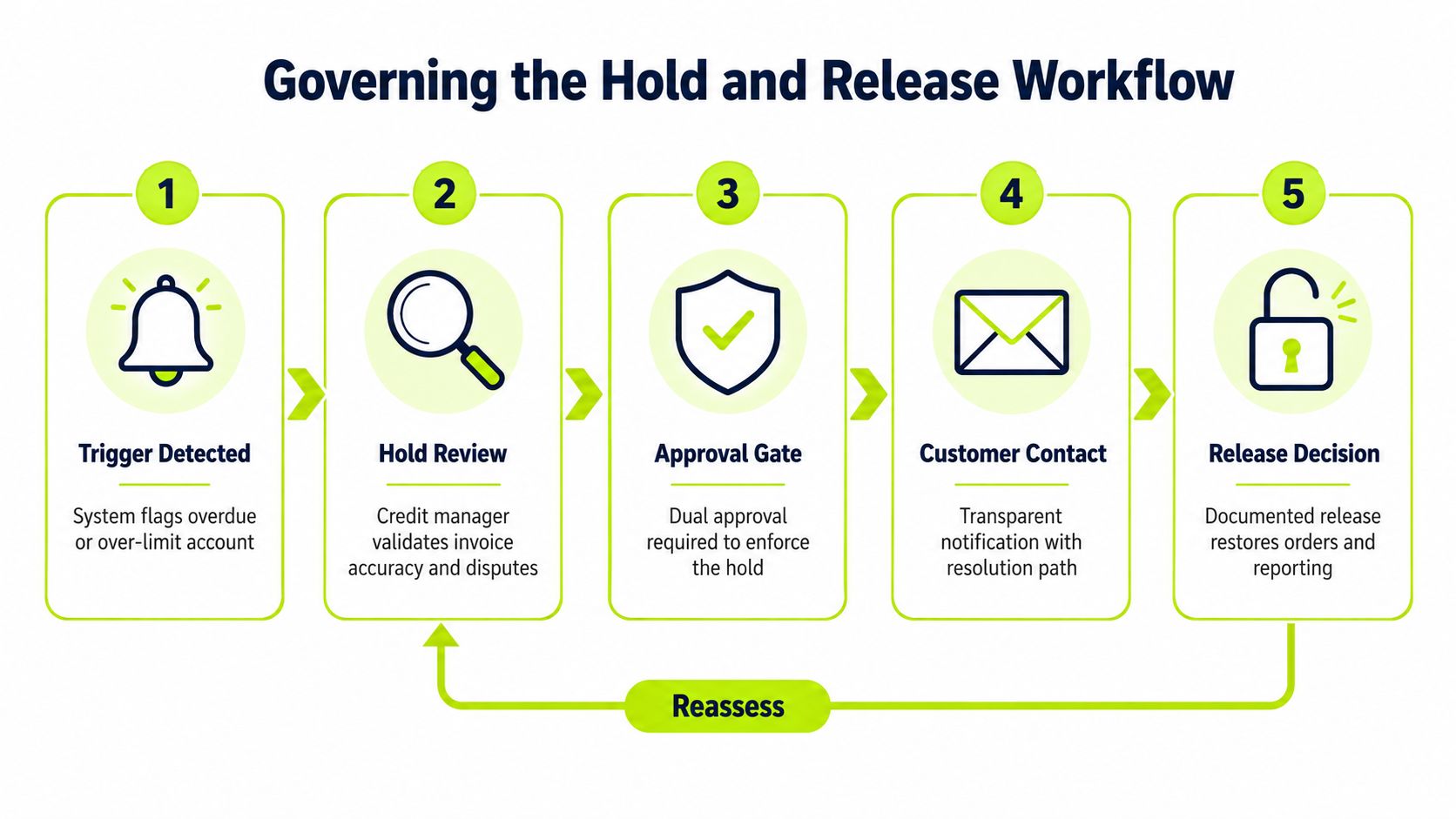
A hold becomes defensible when the firm can show who made the decision, what evidence supported it, how the client was notified, and what will release it. Without that record, the control is vulnerable to inconsistency and internal escalation.
Start with ownership. AR verifies that the receivable is accurate, due, and properly applied. Credit assesses the customer's exposure against policy. Sales supplies commercial context, including active commitments and relationship considerations. A senior approver authorizes exceptions or confirms a hard restriction. This separation mirrors a practical governance model in which AR verifies the receivable, credit assesses exposure, and sales provides context, while the firm tracks effects such as lost orders and churn (European Council document on late payments).
Build the record before the restriction
A useful workflow records:
- The trigger: overdue invoice, limit breach, unresolved dispute, unmatched payment, or incomplete arrangement.
- The validation: invoice accuracy, delivery evidence, purchase-order status, and payment application.
- The decision: full hold, partial restriction, prepayment requirement, or approved exception.
- The communication: clear customer notice, responsible contact, and resolution path.
- The release criteria: payment, dispute resolution, secured terms, revised limit, or documented approval.
A customer notification should be factual and specific. It should identify the affected work, avoid accusatory language, and explain what the customer can do next. The account team should never promise release unless the authorized approver has confirmed the conditions.
The release decision deserves the same discipline as the initial hold. Record the approver, evidence, date, scope of the release, and any revised terms. If the customer pays only part of the balance, the system should show whether exposure has returned within policy or whether a partial restriction remains.
Use approval workflows to structure this handoff when multiple teams must review exceptions. Measure more than recovered cash. Dispute cycle time, customer churn, orders blocked, exceptions granted, and repeat holds reveal whether the policy protects working capital without creating avoidable commercial damage.
Automating AR to Reduce DSO and Friction
A project leader learns that work has stopped only after a client asks why a milestone is late. The account crossed an internal threshold days earlier, but the warning remained in an inbox and no one connected it to the matter record. That failure is operational, not merely financial. A professional services firm needs an automated process that protects exposure while giving account teams time to manage the client conversation.
Accounts receivable automation provides that operating layer. It can monitor due dates, open exposure, disputes, payment commitments, and approval status, then route the account to the appropriate owner. AI AR automation can identify patterns that warrant review before a hard block, while authorized finance staff retain control over exceptions and client-specific judgment.

Professional services firms often use Net 30 terms while experiencing DSO around 35–55 days, so the policy should connect aging, disputed amounts, and current exposure (professional-services DSO benchmarks). A due-date rule cannot distinguish an incorrect invoice from a client using more unsecured credit than the firm approved. That distinction determines whether the next action should be correction, escalation, a warning, or a restriction.
Make the system enforce the policy
Automation should follow a controlled sequence:
- Detect: Flag an overdue or over-limit account.
- Classify: Separate disputed, partially paid, promised, and undisputed balances.
- Route: Send the account to AR, credit, sales, or an approver according to the condition.
- Communicate: Issue consistent reminders that state the next action.
- Control: Pause new scope, require prepayment, or apply a documented exception.
- Release: Restore activity after the approved criteria are met.
For firms using QuickBooks, QuickBooks AR automation can reduce manual follow-up and improve visibility into open invoices, provided payment status connects with project and customer records. Larger firms may need ERP and practice-management integration because the relevant exposure may arise from a new engagement, change order, or additional billable scope rather than a conventional order.
A legal-services team may delegate invoice follow-up and matter-status updates to a virtual legal assistant, while finance retains authority over the hold decision itself. Clear role boundaries prevent administrative work from becoming an unapproved credit concession. Firms evaluating that staffing model can review the best place to hire virtual legal assistants.
The objective is to reduce DSO and improve cash flow without turning every client contact into a collections escalation. Resolut combines risk identification, collections workflows, outreach, billing, and cash application in one operating process. That can support consistent execution, but the system should not decide disputed exceptions without human review.
Automation should flag, prioritize, document, and execute approved actions. Finance leaders still decide whether a dispute changes the risk assessment or whether a strategic relationship warrants secured terms instead of a full hold. The distinction between automation and abdication is clear: software enforces the policy, while accountable people interpret the facts. A practical overview is available in what AR automation means.
Protecting Cash Flow and Client Trust
A credit hold policy is mature when it protects cash without forcing the firm into unnecessary commercial conflict. That requires three qualities: clear triggers, proportionate intervention, and accountable release decisions.
The best policy doesn't treat every overdue invoice as proof of credit deterioration. It asks whether the receivable is valid, whether the client has a credible path to payment, how much new exposure the firm would create, and whether a narrower restriction can achieve the same protection.
That approach also improves the client experience. Customers can accept a firm boundary when the explanation is accurate and the resolution path is visible. They lose trust when a project stops because an invoice was misapplied, a dispute was ignored, or no one inside the firm can explain who owns the decision.
Turn a restriction into a controlled conversation
The firm should be able to state:
- What changed: The account crossed a defined aging, exposure, or approval condition.
- What is affected: New scope, change orders, milestones, or other credit-based services.
- What remains possible: Dispute review, prepayment, secured work, or unaffected delivery.
- Who decides: The named finance or credit authority.
- What releases the hold: Specific payment, evidence, revised terms, or approved exception.
This discipline supports cash flow while preserving professional respect. It also gives sales a credible process to explain rather than an informal exception to negotiate.
Integration matters because finance rarely operates in one application. A firm may need billing, project, CRM, payment, and general-ledger records to agree before it changes a client's work status. Guidance on ERP integration for cash flow is useful for evaluating how those systems should exchange information without creating another manual reconciliation point.
The answer to what is credit hold is therefore operational, not merely definitional. It's a temporary, policy-driven control that limits additional exposure while giving the client a fair and documented route back to normal terms. For a professional services firm, the policy succeeds when AR protects cash, delivery understands the boundary, sales can manage the relationship, and the client receives a clear path forward.
Resolut automates AR for professional services by coordinating risk signals, collections outreach, payment workflows, and hold-related approvals in one consistent process. Visit Resolut to see how your firm can make credit controls more accurate, consistent, and human.