What Is Credit Risk Management and How AR Teams Use It
What is credit risk management? Learn how CFOs assess, score, and mitigate customer credit risk to reduce DSO and improve cash flow.
Credit risk management is the system for identifying, assessing, and mitigating the risk that customers fail to pay. It spans scoring, policy-setting, monitoring, and mitigation, so finance teams can decide who receives credit, under what terms, and when to intervene.
A trusted client can still create a cash-flow problem. The project finishes, the invoice goes out, and payment terms say Net 30. Then day 30 passes, followed by day 40, while payroll, contractors, taxes, and operating expenses continue on schedule.
For a professional services firm, that delay changes more than an aging report. It can force a CFO or Controller to choose between chasing a valuable relationship and protecting working capital. That's why credit risk management belongs in daily AR operations, not only in bank policy manuals.
Introduction Why Credit Risk Quietly Controls Cash Flow
A consulting firm may have a long-standing client with a strong reputation and several successful engagements. The client's project team is responsive, the work is approved, and nobody expects a dispute. Yet the invoice remains unpaid because the client's procurement process changed, its finance team is stretched, or its own cash position weakened.
The receivable looks routine until it becomes urgent. A few late invoices can distort the firm's cash forecast, consume staff time, and create uncomfortable conversations between finance, delivery, and account leadership. In a $3M–$50M professional services business, those pressures are often visible to the CFO, Controller, and owner at the same time.
Credit risk is the possibility that a customer won't pay on time or at all. Credit risk management is the operating discipline used to spot that possibility early and decide what to do before the receivable becomes a write-off.
That discipline also fits into the broader work of manage SMB financial risk, where owners and finance leaders connect receivables, liquidity, profitability, and operating controls instead of treating each issue in isolation.
Practical rule: A customer can be commercially important and still require tighter payment controls.
The mistake is treating credit assessment as a one-time onboarding task. Professional services firms extend credit every time they approve work before receiving payment. The exposure grows as new milestones are delivered, invoices remain open, and a client's payment behavior changes.
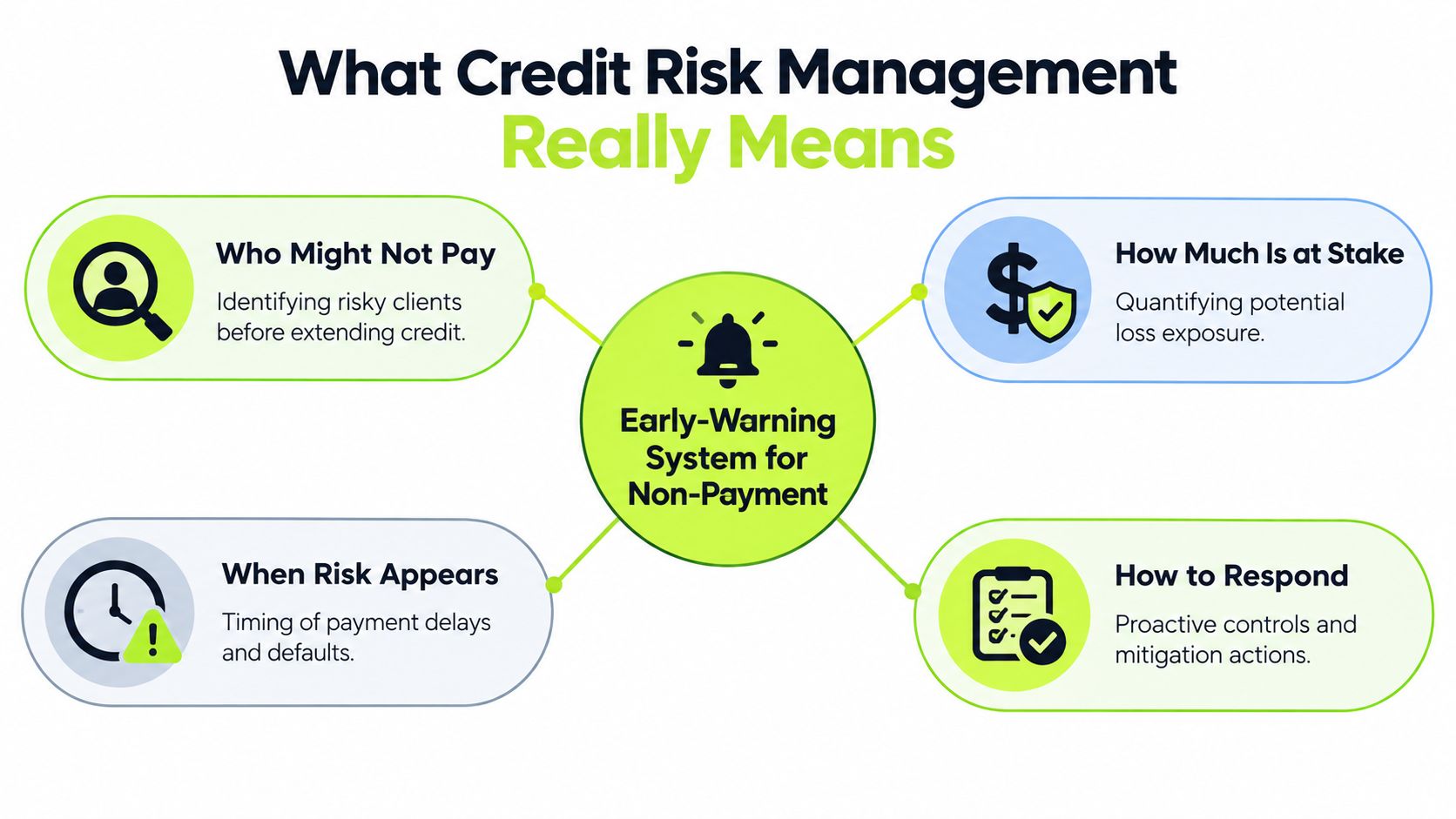
A modern AR process therefore asks four practical questions. Who might not pay? How much exposure is at stake? When is the risk becoming visible? What action should the team take now?
The rest of this guide applies those questions to professional services AR. It connects risk scoring with payment terms, monitoring with DSO, and mitigation with accounts receivable automation, including AI AR automation and QuickBooks-connected workflows.
What Credit Risk Management Really Means in Practice
Think of credit risk management as an early-warning system for non-payment. It doesn't promise that every customer will pay on time. Instead, it helps the finance team identify changing conditions, estimate the exposure, and respond with a measured control.
Start with the four operating questions
Identification means recognizing which customers, invoices, or engagements show signs of risk. Signals can include a history of late payment, unresolved disputes, repeated requests for extensions, or a sudden change in communication.
Quantification means understanding the amount exposed. A small overdue invoice may be manageable, while several open invoices tied to the same customer can affect hiring plans, tax reserves, and delivery capacity.
Timing matters because risk changes over the customer lifecycle. A new client may require approval before work begins. An established client may need review after payment behavior drifts or exposure increases.
Response turns information into action. The response could be a reminder, a revised payment schedule, a credit hold, milestone billing, an approval escalation, or a conversation between the account owner and finance.
Apply the system across the customer lifecycle
Credit risk management begins during onboarding. The firm decides whether the prospective client receives standard terms, requires an upfront payment, or needs additional approval before work starts.
It continues when finance sets a credit limit and defines the conditions for expanding that limit. It remains active while invoices age, payments arrive, disputes open, and project teams request additional work.
For a services firm, this is less like approving a single loan and more like managing an open tab. Every approved hour, deliverable, and reimbursable expense can increase the amount the client owes before cash arrives.
Keep the definition operational
A useful working definition is:
Credit risk management is the repeatable process of identifying non-payment risk, measuring exposure, setting controls, monitoring change, and taking proportionate action.
That definition matters because it gives each team a role. Sales can flag unusual commercial terms. Delivery leaders can communicate scope or acceptance issues. AR can monitor invoices and outreach. The CFO or Controller can set escalation rules and approve exceptions.
An integrated process connects those activities. Without that connection, risk information stays scattered across email, spreadsheets, project systems, and accounting records, leaving the team to discover problems after payment is already late.
How Credit Risk Assessment and Scoring Actually Work
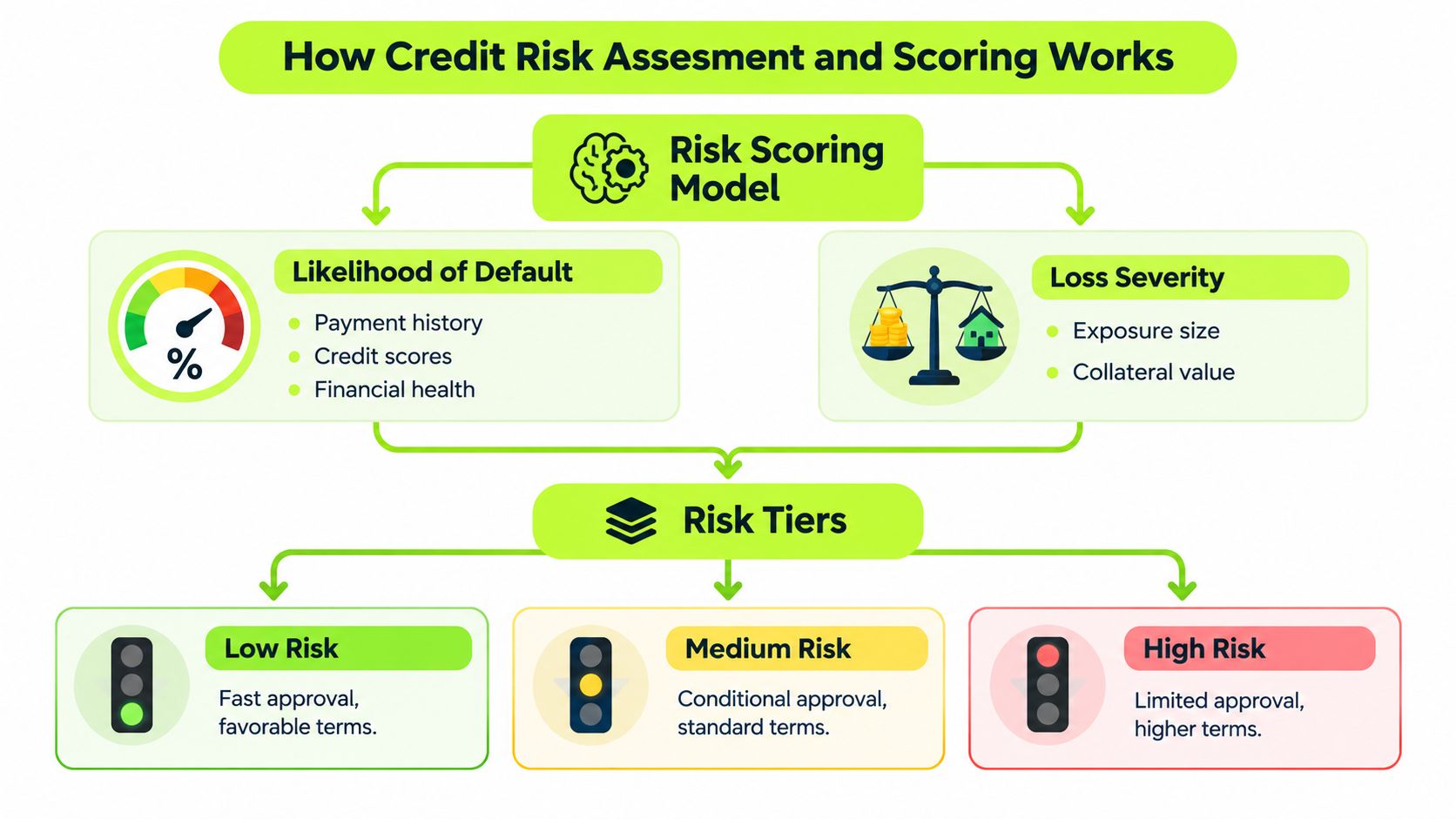
Credit assessment starts by separating two ideas that teams often combine: the likelihood of non-payment and the severity of the loss if non-payment occurs.
A customer with occasional late payments may have a moderate likelihood of delay. If the open balance is small and the firm can pause further work, the exposure may remain manageable. Another customer may pay reliably but carry a large unpaid balance across multiple engagements. That account deserves attention because the potential loss is larger even if the current payment pattern looks acceptable.
Why structured risk buckets matter
Banks have used structured exposure classifications for decades. The Basel Capital Accord, known as Basel I, was published in July 1988 and required internationally active banks to hold capital equal to at least 8% of risk-weighted assets. By 1992, all Group of Ten countries had transposed the framework into law, helping establish credit-risk-based capital rules as a global supervisory standard. The IMF's discussion paper documents this Basel milestone.
Basel I classified assets into risk buckets with weights of 0%, 20%, 50%, and 100%, along with some unrated assets. The point wasn't to treat every exposure as identical. It was to differentiate exposures according to expected risk characteristics. The Basel I overview explains this bucket structure.
Professional services firms don't need to reproduce bank capital models. They can apply the same logic in a simpler form by grouping clients into low, medium, and high-risk tiers, then connecting each tier to terms, limits, and review requirements.
What a score should combine
A useful score may synthesize payment history, current receivables behavior, financial information, customer concentration, dispute patterns, and relevant external signals. The score should support a decision, not replace judgment.
For example, a medium-risk score might lead to standard work approval but tighter milestone billing. A high-risk score might require an upfront deposit, executive approval, or a pause on additional work until an overdue balance is addressed.
Explainability matters because finance leaders need to tell account teams why a customer moved into a different tier. Recent industry research says 72% of CROs report early-stage AI adoption in risk, while 55% cite advanced technology as a top priority for managing critical risks. EY and IIF's survey coverage provides that context.
A score that produces a red flag can create resistance. A score that shows the relevant payment, exposure, and behavioral drivers gives the Controller a defensible basis for action. For readers who want a more technical review of evaluation methods, the LendingXpress underwriting guide offers useful background on structured underwriting thinking.
Risk assessment tools become more valuable when they connect directly to approvals and AR workflows. See credit risk assessment tools for a closer look at how teams can organize that process.
Policy Setting and Continuous Monitoring That Keeps Risk Visible
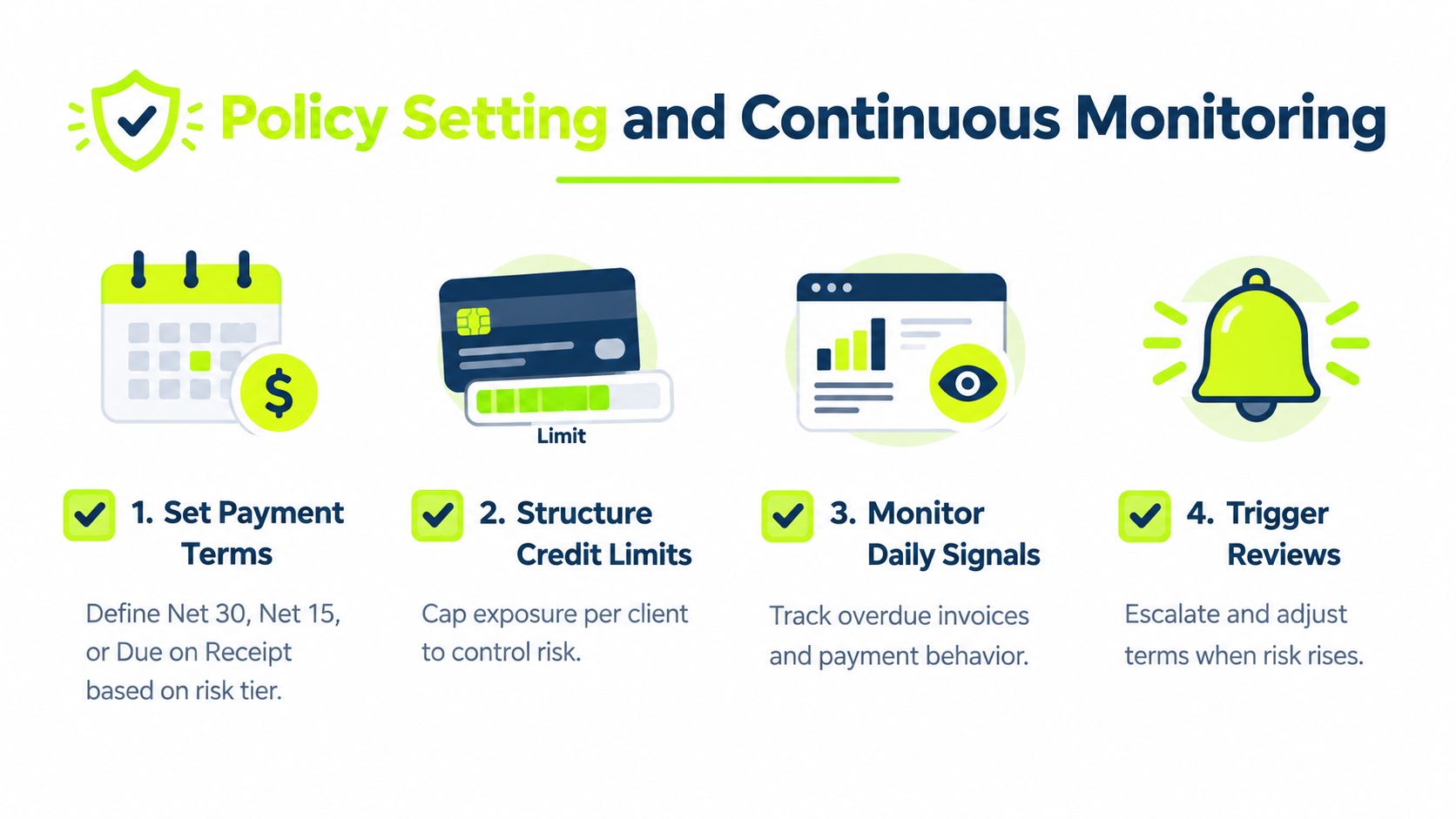
A score matters only when it changes daily decisions. Policy setting turns risk insight into payment terms, exposure limits, approval thresholds, and review triggers that account teams can apply consistently.
Set terms that match the exposure
Common payment terms include Net 30, Net 15, and due on receipt. The appropriate choice depends on the client relationship, engagement economics, expected exposure, and confidence in the customer's payment process.
A firm might use Net 30 for a low-risk recurring client, Net 15 for a new customer with limited history, and due on receipt for a high-exposure project with clear delivery milestones. The policy should also identify who can approve exceptions and what evidence that approval requires.
A 2/10 Net 30 structure gives a customer a 2% discount when payment arrives within 10 days. Accounts receivable guidance from Consero Global also recommends tracking accepted payment methods, including ACH, credit card, wire transfer, and check. Payment friction can turn an approved invoice into a delayed invoice, so the method belongs in the policy.
Monitor the account, not just the invoice
Aging shows what is overdue, but it does not show the entire exposure. A client can remain current while its outstanding balance grows, and several related entities can create concentration risk that is hidden when finance reviews invoices separately.
Basel's 2025 consultative update emphasizes forward-looking macroeconomic data, stress scenarios, expected credit loss models, concentration limits, connected counterparties, and stronger data and management-information governance. The Advisense summary explains how those priorities reshape credit risk management.
For a professional services firm, the operating translation is direct. Monitor total exposure by client and connected entities, track changes in aging, and assess whether broader economic pressure could affect a customer's ability to pay. An integrated AR system can bring these signals together each day, rather than leaving the Controller to assemble them during a periodic review.
Use DSO as an operating signal
Days Sales Outstanding, or DSO, measures how long receivables remain outstanding. The standard formula is (Accounts Receivable / Net Credit Sales) × Number of Days in the Period, with net credit sales excluding cash sales and returns. This DSO reference explains the calculation.
DSO is not a complete credit score. It gives finance a measurable view of collection performance and exposure, however. A rising DSO should prompt investigation, particularly when the increase is concentrated in a client group, engagement type, or billing practice.
Credit status can change after onboarding, which makes continuous review part of the control system. A new overdue balance, slower payment pattern, growing connected-party exposure, or worsening business condition should trigger a defined review, not wait for an annual check.
Finance leaders can use these credit risk management best practices when designing review triggers, ownership rules, and daily AR monitoring.
Mitigation Strategies and How Integrated AR Systems Reduce Exposure
Mitigation begins when the team acts on a risk signal. Manual processes usually depend on someone noticing the issue, remembering the account history, choosing an appropriate message, and recording the result. That approach can work with a small receivables book, but it becomes uneven as client volume and transaction complexity grow.
An integrated AR process brings the signal and the action closer together. It can prioritize overdue invoices, coordinate email and SMS outreach, adjust message timing, offer a payment portal, apply cash automatically, and escalate accounts when the customer doesn't respond.
Compare the operating models
Mitigation Approach | Speed to Act | Consistency and Control |
|---|---|---|
Manual spreadsheet review and follow-up | Depends on staff availability and memory | Varies by person, account, and workload |
Scheduled reminder emails | Faster than ad hoc outreach | Consistent timing, limited personalization |
Integrated AR workflow | Triggers from invoice status, behavior, and policy rules | Centralized history, repeatable escalation, clearer ownership |
AI-assisted AR automation | Prioritizes likely late payers and adapts outreach within defined controls | More targeted communication with human review where needed |
The objective isn't to remove people from the process. It's to reserve human attention for judgment, negotiation, and relationship management, while software handles repetitive coordination.
Design mitigation around the customer
A late-paying client may need a simple payment link, a corrected invoice, or clarification from the project owner. Another may respond better to a direct finance message. A good workflow uses the account context to select the next action instead of sending every customer the same reminder.
Payment flexibility also matters. A portal that supports cards, bank transfers, or digital wallets can remove avoidable friction. Automated cash application then matches incoming payments to open invoices, reducing the delay between receipt and accurate account visibility.
For complex disputes or persistent non-payment, escalation should be defined in advance. Finance can specify when an account moves from reminders to account-owner involvement, formal notice, work restrictions, or outside commercial receivables management services from counsel such as Lerner & Weiss APC.
Measure outcomes without overstating them
Industry evidence points to measurable AR benefits. Billtrust reports that 99% of companies using AI in accounts receivable reduced DSO, and 75% reduced DSO by six days or more. The same study reports a 41% average DSO reduction among organizations with high AR automation levels. Billtrust provides the cited study findings.
Another industry summary reports that AI-powered AR automation often reduces DSO by 20% to 30% within 12 months, while digital world-class performers run DSO about 30% below peer-group averages. It also cites a 30% reduction in some mid-market cases. The summary provides that industry context.
These figures aren't a promise for every firm. They show why CFOs evaluate accounts receivable automation against concrete measures, including DSO, overdue balance, collector workload, dispute cycle time, and cash application accuracy. A platform such as Resolut can combine risk identification, collections orchestration, omnichannel outreach, billing, and cash application in one AR workflow. For a broader view of implementation choices, review credit risk management solutions.
Real World Applications in Professional Services AR
A consulting firm is preparing to onboard a large enterprise client. The opportunity is commercially attractive, but the firm expects a substantial amount of work before the client's procurement team releases payment.
The finance team reviews available payment history, proposed scope, expected billing milestones, and the amount of exposure that could accumulate before the first payment. The result isn't an approval or rejection alone. It informs the operating terms.
The firm may approve the engagement with milestone billing, a defined credit limit, and a requirement that the account owner resolve invoice disputes quickly. The project can proceed, but the firm doesn't leave the exposure unmanaged. A connected AR system records the terms, monitors open invoices, and flags a change in payment behavior for review.

A trusted accounting client starts to drift
An accounting firm has worked with a client for years. The client has generally paid, but recent invoices are taking longer to clear, responses to reminders have become less predictable, and the open balance is spreading across several recurring services.
No single signal proves that the client will default. Together, the changes justify a review. The Controller checks the aging trend, confirms the total exposure, and asks the account lead whether the client has raised cash-flow concerns or disputed work.
The firm then uses a measured response. It sends a clear reminder with a payment option, offers a conversation about invoice timing, and considers moving future work to milestone billing until payment behavior stabilizes. The client receives a consistent experience, while finance creates a documented control around the account.
Connect the workflow to QuickBooks
QuickBooks may remain the accounting system of record, but finance teams often need more than a ledger view to manage credit risk. QuickBooks AR automation can connect invoice status, customer history, outreach activity, risk signals, and payment application in one operating flow.
That connection helps the team answer practical questions without rebuilding the account manually. Which customers are becoming slower to pay? Which invoices need action today? What communication has already occurred? Which account has exceeded its approved exposure?
For professional services firms, the value is visibility with context. The team can protect cash flow without treating every late invoice as a crisis or every valuable client as risk-free.
Bringing Control Back to Your Receivables
Credit risk management is a continuous system, not a credit check filed during onboarding. The operating loop is straightforward: assess the customer, set terms and limits, monitor changes, and mitigate exposure.
For CFOs, Controllers, and firm owners, that loop creates a clearer relationship between AR activity and cash flow. It also gives sales, delivery, and finance a shared framework for handling exceptions without relying on informal memory.
The practical standard is consistency. The right process identifies risk early, explains why an account needs attention, applies the agreed response, and leaves a useful record for the next decision.
Accounts receivable automation can support that standard by coordinating outreach, payment options, cash application, and human review. Used carefully, AI AR automation doesn't replace judgment. It helps the team direct judgment where it can protect both the receivable and the client relationship.
A professional services firm doesn't need a bank's entire risk architecture. It needs a connected AR discipline that makes exposure visible and turns signals into timely action.
Resolut automates AR for professional services by connecting credit risk identification, collections workflows, client outreach, payment options, and cash application in one system. Visit Resolut to see how an integrated approach can support more consistent receivables control around your QuickBooks-centered stack.