
What Is Deduction Management: Boost Cash Flow in 2026
Discover what is deduction management and why it's critical for professional services. Learn process, best practices, & how to improve cash flow.
A client pays your invoice short. No email. No call. Just a remittance note that says “rate discrepancy,” “hours disputed,” or nothing useful at all.
Your team has seen this before. Someone in delivery says the client was unhappy with a milestone. A partner says they probably promised a concession. Finance writes off part of the balance because the amount feels too small to escalate. Then it happens again with the next invoice.
Most professional services firms don't call this deduction management. They call it client service, cleanup, or the cost of keeping relationships smooth. But if you want a practical answer to what is deduction management, it's this: a disciplined process for identifying, validating, disputing, resolving, and preventing any instance where a client pays less than the invoiced amount.
That matters more than many firm owners realize. In other industries, deduction management has moved well beyond clerical cleanup. As CPG Vision notes in its discussion of deduction management as strategic cost management, the discipline has evolved from a back-office administrative function into a strategic capability that protects profitability and strengthens commercial relationships. The same logic applies to a consulting firm, agency, engineering practice, or outsourced services business.
For firms in the $3M to $50M range, this is often the missing layer between invoicing and actual cash control. You can send invoices on time and still lose margin through disputed hours, scope confusion, unapproved discounts, and quiet write-offs. That's why deduction management belongs in the same conversation as accounts receivable automation, AI AR automation, reduce DSO, and improve cash flow.
The Hidden Costs You're Already Paying
The leakage usually starts small.
A client questions ten hours on a bill. A project lead says, “Just take it off.” Another invoice gets paid net of a discount that nobody in finance approved. A fixed-fee engagement runs long, and the overrun never makes it into a change order. The work was real. The revenue was earned. The collection didn't follow.
What this looks like in a service firm
In retail, a deduction might come from a shortage or pricing claim. In a service business, the same pattern shows up under different names:
- Disputed hours on a time-and-materials invoice
- Scope creep write-offs when work was delivered without signed approval
- Self-applied client credits tied to dissatisfaction or delay
- Unapproved discounts promised in a meeting, then discovered by accounting later
- SLA-related fee reductions when delivery terms aren't documented cleanly
None of these feel dramatic on their own. Together, they create a habit. Finance starts expecting short pays. Delivery starts assuming some work won't be billable. Partners start negotiating from gross revenue while the controller is left managing net reality.
Practical rule: If a client pays less than the invoice and your team doesn't consistently code the reason, track the dispute, and close the loop, you have a deduction management problem.
Why this is more than billing admin
Many firms misread the issue. They treat it as a collections nuisance instead of a control function.
That's a mistake. A short payment changes realized revenue, gross margin, utilization economics, and cash forecasting. It also tells you something operational. Maybe rates weren't approved. Maybe scope wasn't documented. Maybe delivery and finance are working from different versions of the agreement.
A strong deduction process does two things at once. It protects current cash, and it exposes the process failures that are creating preventable write-offs.
For a busy CFO or controller, that's the key objective. Deduction management isn't about arguing over every client complaint. It's about separating valid concessions from avoidable leakage, then giving the firm a repeatable way to respond.
Anatomy of a Service Firm Deduction
A professional services deduction rarely arrives labeled clearly. It shows up as a short payment, a delayed payment with a dispute attached, or an internal request to “adjust this one just to move on.”
The useful move is to classify the reason before you decide the response.
Four categories that matter
Most service firm deductions fall into a handful of recognizable buckets.
- Billing errors. The invoice has the wrong rate, the wrong hours, duplicate line items, or incorrect tax or fee treatment. These are finance-control issues first.
- Scope disputes. The work may have been done, but the client disputes whether it was in scope. This usually points back to weak statement-of-work discipline, poor change-order habits, or vague approval trails.
- Service quality issues. The client links payment reduction to missed expectations, rework, delay, or dissatisfaction. Sometimes the claim is valid. Sometimes it's a tactic.
- Unauthorized concessions. A partner, account lead, or project manager agrees to a discount verbally, but the deal never reaches accounting in a controlled way.
Why classification comes before collection
You can't manage all short pays the same way.
A billing error should be corrected quickly. A scope dispute needs contract support, timesheets, email approvals, and probably someone from delivery involved. A service issue might call for a credit memo if the firm clearly missed the mark. An unauthorized concession is often an internal governance problem disguised as a client issue.
This is also why invoice matching matters. If your team can't quickly tie the payment variance back to the invoice, contract terms, and project records, the dispute drags. If you want a clean primer on that workflow, this overview of invoice reconciliation in finance operations is worth reviewing.
A practical translation table
Retail-style deduction concept | Service firm equivalent | Typical root cause |
|---|---|---|
Pricing discrepancy | Rate mismatch | Contract rate not updated or billed incorrectly |
Shortage claim | Hours or deliverables disputed | Work logged but not accepted by client |
Compliance penalty | SLA or milestone reduction | Missed response time, documentation gap, or delivery miss |
Promotional allowance | Unapproved discount or fee concession | Verbal promise not recorded in billing terms |
The point of this table isn't analogy for its own sake. It's operational clarity. Once finance gives these issues standard categories, patterns become visible.
Most write-offs look like isolated exceptions until you group them by reason code and client.
That's when you find the repeat offenders. It might be one engagement partner who negotiates outside policy. It might be one client who regularly disputes time after the work is complete. It might be one service line with weak scope definition at kickoff.
Without that classification discipline, every deduction feels custom. With it, the problem becomes manageable.
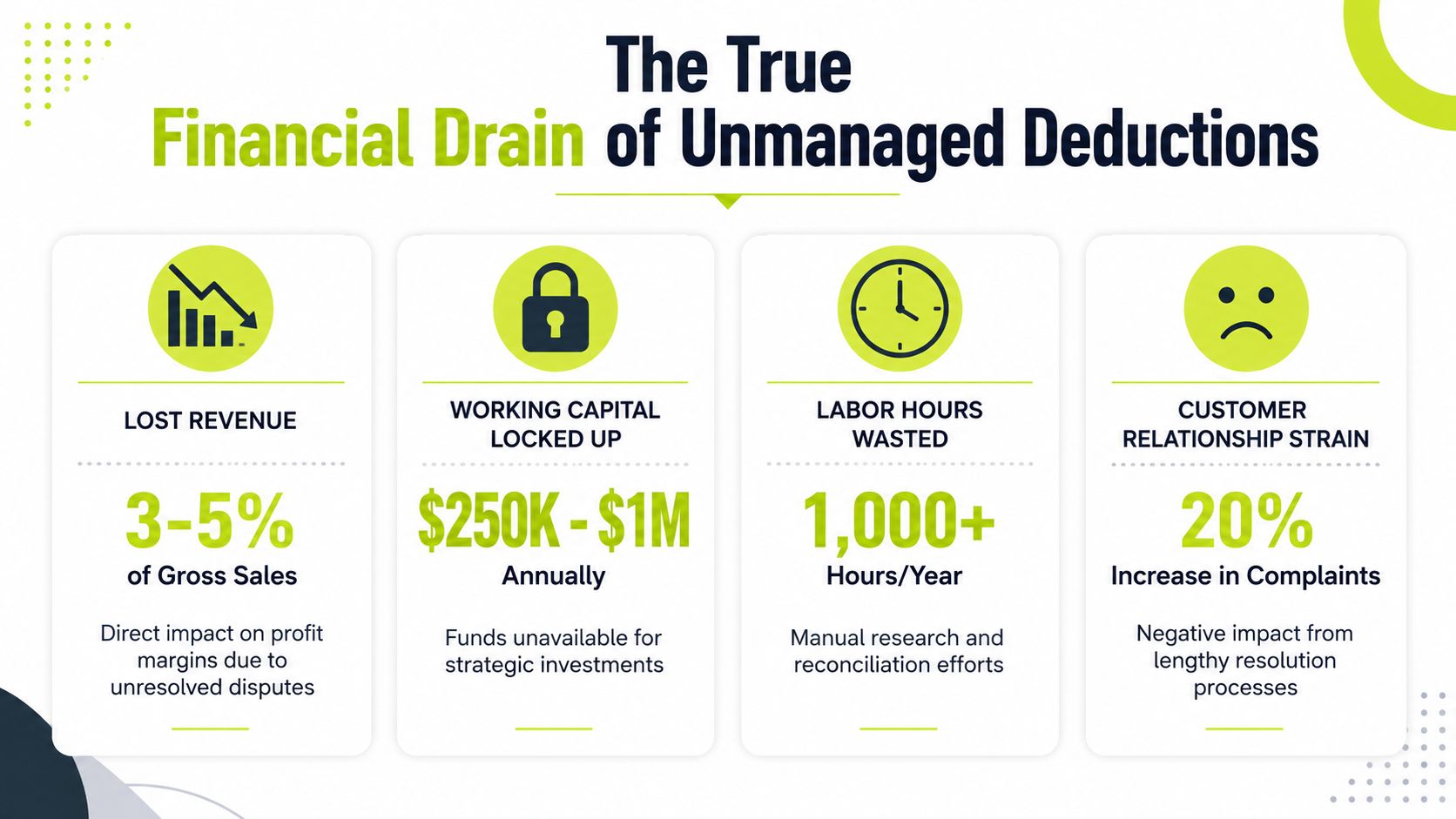
The True Financial Drain of Unmanaged Deductions
Unmanaged deductions hurt twice. First, you lose collected revenue. Second, you spend expensive staff time cleaning up the mess after the cash is already delayed.
In broader AR operations, the scale is large enough to show what poor control looks like. Auxis reports that U.S. companies face approximately $22 million in deductions each month, with roughly 10% of those claims being invalid, translating to over $264 million annually when businesses fail to manage deductions effectively. Professional services firms don't have the same deduction mechanics as retail, but the lesson carries over cleanly. If you don't identify invalid short pays and resolve them fast, earned revenue slips into write-offs.
The direct cost
The first cost is obvious. A client pays less than billed, and your firm accepts the difference.
Sometimes that's appropriate. Sometimes the invoice was wrong. Sometimes delivery fell short. But many firms never make a real validity decision. They just clear the balance because the issue sits too long, the documentation is messy, or the account team doesn't want friction.
That isn't customer service. It's weak revenue control.
The working capital cost
The second cost is slower cash conversion. A disputed invoice often stays partially open while finance, delivery, and client contacts sort out what happened. That slows collections and muddies the cash forecast.
Days Deductions Outstanding, or DDO, becomes useful. High DDO means short pays aren't being resolved quickly. It signals process drag. The issue isn't only the disputed amount. It's the time your firm's cash sits in limbo while the team reconstructs approvals, scopes, rates, and emails.
The labor cost
There's also the administrative burden. A controller knows this pattern well:
- Finance pulls remittance data and notices the short pay
- Project management checks timesheets and milestone notes
- A partner searches email for the discount or client complaint
- Accounting decides manually whether to dispute, credit, or write off
That workflow is expensive because it uses senior people to compensate for weak process design.
If a deduction takes three departments to explain, the process is already too costly.
Visual ideas for finance teams
Two visuals tend to make this issue click with owners and practice leaders:
- A waterfall chart that starts with billed revenue and shows each concession, short pay, and write-off reducing collected revenue
- A client heat map with deduction volume by account and reason code, so recurring patterns are visible fast
- A cinematic monthly close snapshot showing invoices issued, short pays identified, disputes opened, credits approved, and balances written off
For firms trying to improve cash flow and reduce DSO, unmanaged deductions are often the quiet layer between billed work and collected cash. You won't fix that with better invoicing alone.
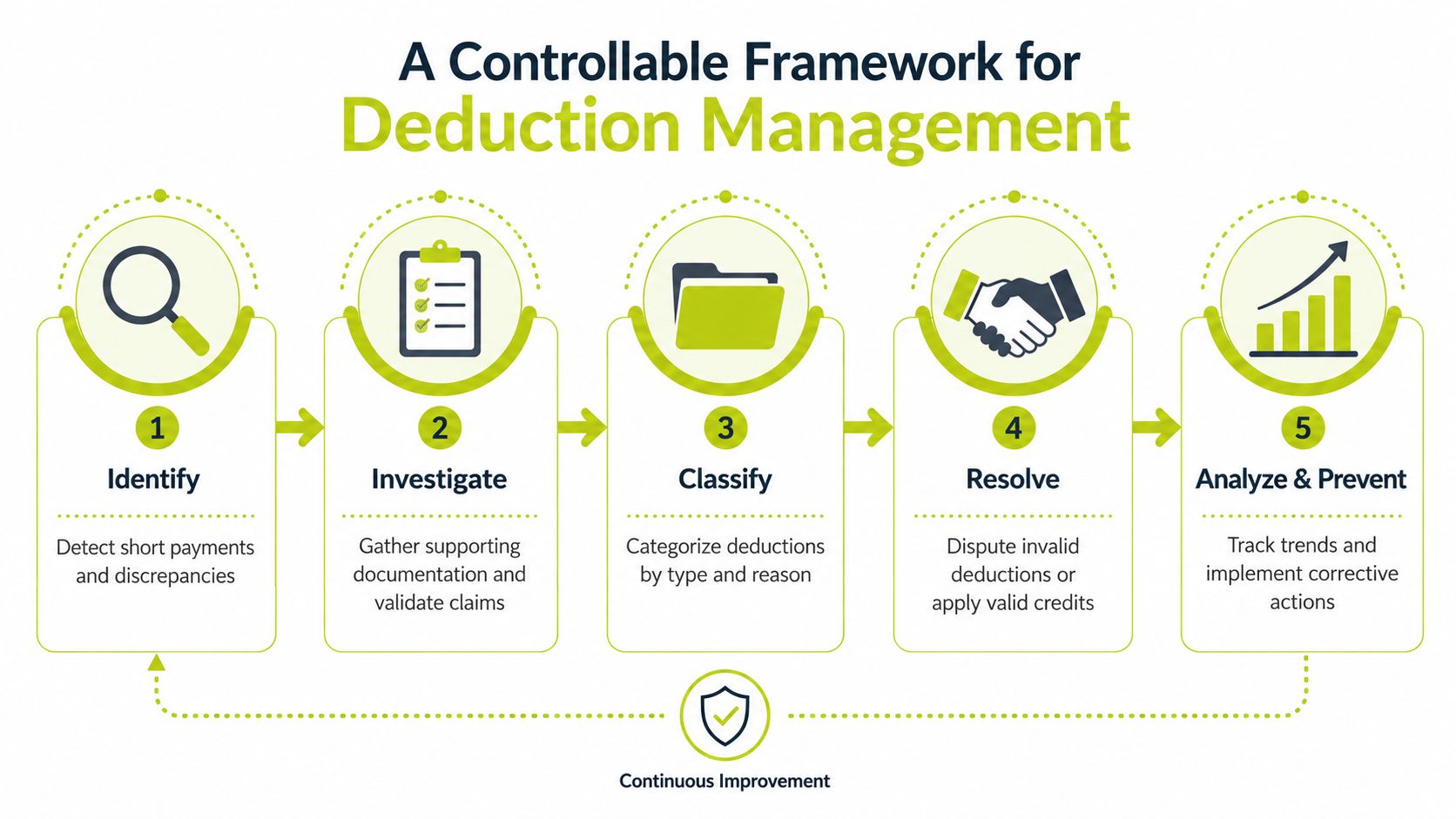
A Controllable Framework for Deduction Management
The process has to be simple enough to run every week, not just during a clean-up project. Good deduction management isn't built on heroic effort. It runs on a defined sequence.
The clearest version comes from the broader deduction workflow used in AR operations. Inymbus describes the process as capture, classification, validation, prioritization, dispute, tracking, and analysis, and notes that breakdowns early in the flow increase cycle times and lower recovery rates. That sequence works well for service firms too.
Step one and step two
Start with identification. Every payment has to be matched against open invoices so short pays are visible immediately. If the team discovers discrepancies weeks later, recovery odds drop and internal memory gets worse.
Then move to validation and classification. The question isn't only “Did the client underpay?” It's “Why?” The answer should be coded in a controlled way. Rate error. Scope dispute. Service credit. Unauthorized concession. Missing backup. Whatever categories fit your firm, define them and use them consistently.
Step three and step four
Next comes prioritization. Not every issue deserves the same response. Use a few practical filters:
- Materiality. Larger deductions get senior review fast.
- Client pattern. A repeat issue with one account deserves a tighter response than a one-off confusion.
- Documentation strength. If you have signed SOWs, approved change requests, and clean timesheets, push harder.
- Relationship context. Some issues belong in an executive conversation, not a back-and-forth between AR and AP.
After prioritization, move to dispute and resolution. Build the case file. Pull the contract, timesheets, approved estimates, email approvals, acceptance records, and invoice detail. Then decide the appropriate close:
Situation | Best response |
|---|---|
The client is wrong and your support is clean | Dispute and request payment |
Your invoice is wrong | Correct it quickly |
The work was real but approval is weak | Negotiate a partial resolution and fix the process |
Delivery fell short | Issue a controlled credit, not an undocumented write-off |
The final step most firms skip
The last stage is analysis and prevention.
That's where deduction management becomes a control system instead of a cleanup function. Review reason codes monthly. Look for concentration by client, partner, project type, and service line. If one root cause keeps appearing, change the upstream process.
The best deduction teams don't just close cases. They stop the same case from happening again.
Measuring What Matters for Financial Control
Most firms already watch DSO. That's useful, but it's not enough. A firm can improve collections generally while still leaking cash through unresolved short pays and informal concessions.
The better approach is to separate broad AR performance from deduction-specific control.
The core scorecard
A practical scorecard for service firms should include these measures:
- DSO to track overall payment timing
- DDO to track how long deduction-related issues remain unresolved
- Total deductions by client and reason code to expose pattern risk
- Recovery rate to show how much disputed value is recovered
- Valid credits vs. preventable concessions to distinguish real service failures from process failures
For the broader AR lens, Thomson Reuters notes that AR automation tools provide real-time analytics for metrics such as DSO and Collection Effectiveness Index, helping firms quantify how payment delays affect cash flow. That same visibility helps finance teams see whether deduction handling is tightening up or being buried inside write-offs.
What each metric tells you
Here's the operational read:
Metric | What it reveals |
|---|---|
DSO | Whether invoices are being collected on time overall |
DDO | Whether disputes and short pays are being resolved fast enough |
Deduction volume by client | Which accounts create friction repeatedly |
Deduction volume by root cause | Which internal process is breaking most often |
Recovery trend | Whether your dispute process is effective or mostly symbolic |
This is where dashboards matter. If the only report you see is monthly write-offs, the problem is already past due. If you can see deductions by client, team, and root cause in near real time, finance can intervene before a pattern gets normalized.
A related discipline is understanding how collection performance should be interpreted overall. This guide on how to calculate and interpret collection rates is useful because it sharpens the distinction between billed revenue and realized cash, which is exactly the gap deduction management sits inside. And if you're tightening the accounting mechanics around applied cash and exceptions, this overview of payment reconciliation workflows fits naturally into the same control model.
A simple management cadence
Review deduction metrics monthly with finance, delivery, and client leaders. Ask only a few questions:
- Which clients are short-paying repeatedly?
- Which reasons are increasing?
- Which issues are valid service credits?
- Which ones came from avoidable internal failures?
That conversation is where AR software for professional services starts to earn its keep. Visibility changes behavior.
From Manual Grind to Automated AR Orchestration
Manual deduction management breaks down for a simple reason. The work sits across too many systems and too many people.
The invoice lives in your accounting platform. Timesheets sit in a PSA or project tool. Contract terms are in a PDF. Approval history is in email. Payment detail lands in the bank feed or remittance file. Then someone in AR tries to connect all of it in a spreadsheet while month-end is already moving.

What automation changes
At this point, accounts receivable automation becomes operational, not theoretical.
An automated workflow can detect short payments as they occur, match them to invoices, assign reason codes, route exceptions to the right owner, and maintain a case file with supporting documents. That compresses response time and makes it much harder for a dispute to disappear into email.
The measurable benefit is meaningful. HighRadius reports that Automated Deductions Management can reduce manual errors by up to 90% in advanced implementations by replacing manual claim collection, invoice matching, and dispute investigation. You should treat that as a ceiling, not a blanket promise for every firm. But the direction is clear. Well-structured automation removes repetitive handling and reduces avoidable mistakes.
What works and what doesn't
What works:
- Automatic short-pay detection from remittance or bank data
- Reason-code routing so finance doesn't triage every issue manually
- Centralized documentation for contracts, SOWs, approvals, and timesheets
- Workflow ownership with deadlines and clear status tracking
- Root-cause reporting back to delivery, sales, and leadership
What doesn't work:
- Shared inboxes with no assignment discipline
- Spreadsheet logs nobody trusts
- Write-off approvals without root-cause coding
- Relying on project leaders to “remember what happened” weeks later
If you're evaluating the broader move from manual invoice handling to workflow automation, the 2026 invoice automation guide is a solid companion read. And if your current bottleneck is matching incoming cash to the right invoices before disputes can even be identified, it helps to understand how cash application automation fits upstream of deduction handling.
Why this matters for smaller firms
Mid-sized firms often assume automation is only for large enterprises. That's outdated.
A professional services business with growing invoice volume doesn't need an enterprise deduction department. It needs reliable exception handling, clean audit trails, and fewer manual touches. That's where AI AR automation, QuickBooks AR automation, and modern AR workflow tools can make a practical difference. The payoff is fewer unresolved short pays, cleaner close cycles, and more time for your team to handle the exceptions that need judgment.
The best finance automation doesn't replace judgment. It protects judgment from being wasted on clerical work.
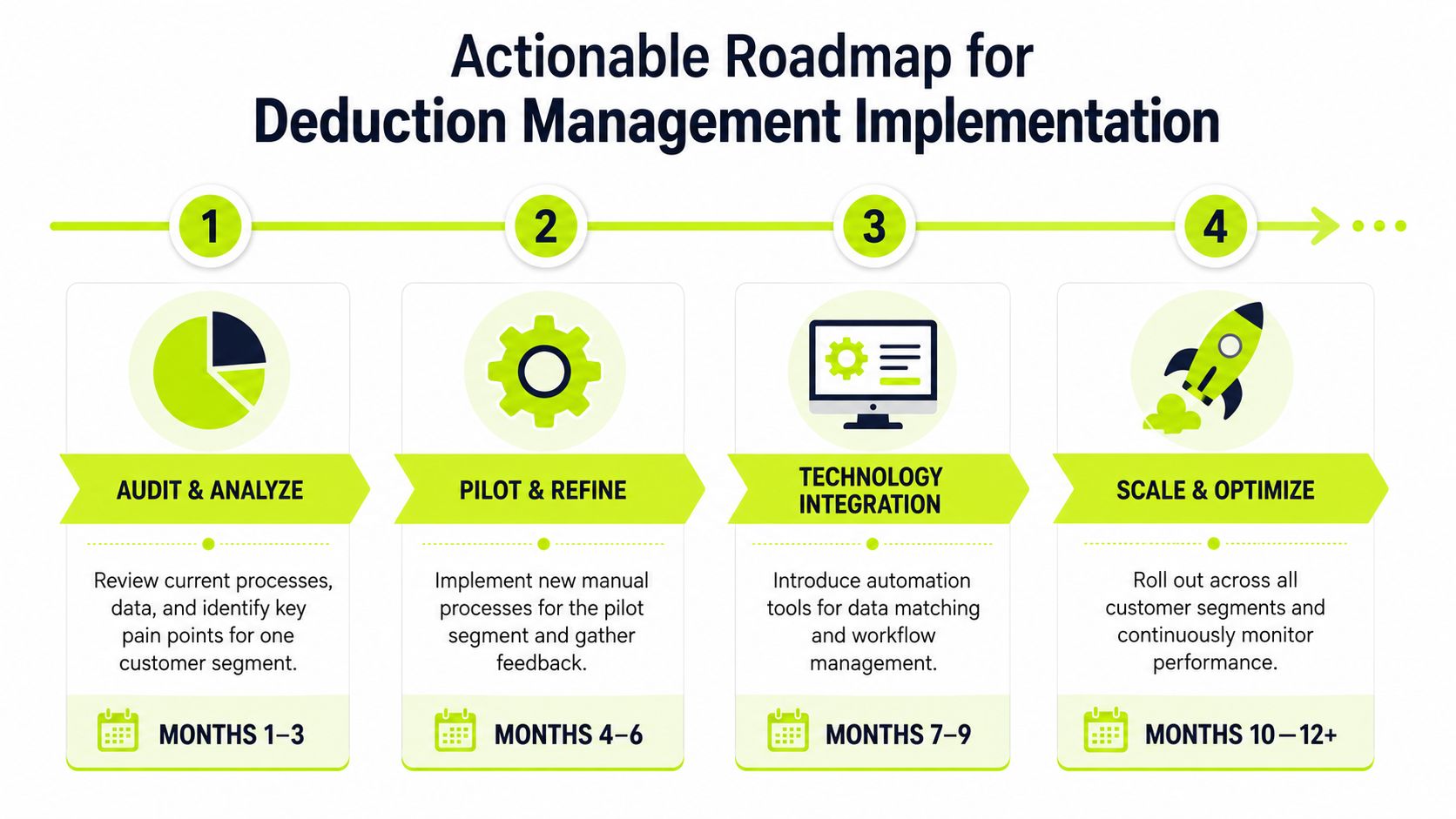
An Actionable Roadmap for Implementation
You don't need a massive transformation project to get this under control. Most firms can build traction in phases.
The key is to start with visibility, then standardize the process, then automate what's repeatable.
Phase one and phase two
Phase one is audit and analysis. For one quarter, track every short pay, write-off, dispute, and client credit in one place. Don't aim for perfection. Aim for a usable log with amount, client, invoice, reason, owner, and resolution.
Phase two is policy and standardization. Create a short formal policy that answers a few basic questions:
- Which reason codes are valid
- Who owns investigation
- Who can approve credits
- When a partner must be involved
- What documentation is required to close the case
That policy does more than guide AR. It sets behavioral expectations across the firm.
Phase three
Phase three is workflow design. Build a repeatable sequence around detection, classification, evidence gathering, approval, dispute, and closure. Keep it simple enough that the team will use it under pressure.
A lightweight service-firm workflow often looks like this:
- Payment posts short
- AR flags the variance
- Reason code assigned within a defined time window
- Delivery or account owner supplies support
- Finance decides dispute, correction, or credit
- Outcome logged for reporting
Phase four
Phase four is automation and optimization. Once the categories and approvals are stable, layer in technology. AR software for professional services earns trust at this stage, because the workflow is already defined.
Prioritize tools that can support:
- Invoice and payment matching
- Exception queues
- Approval workflows
- Client-level analytics
- Integration with systems your team already uses, including QuickBooks where relevant
For many firms, QuickBooks AR automation is the practical entry point because it improves visibility without forcing a full finance stack replacement.
Two visual ideas to support rollout
Implementation gets easier when leadership can see the issue clearly. Two useful visuals:
- A phased roadmap slide showing current state, standardization, pilot automation, and scaled control
- A before-and-after swimlane diagram comparing today's manual back-and-forth with the future exception workflow
Start narrow if needed. One client segment. One office. One service line. Control beats ambition here.
Take Control of Your Revenue
Deduction management isn't a retail-only term. It's a finance discipline for any business that invoices clients and gets paid short.
In a professional services firm, the deductions just wear different clothes. They show up as disputed hours, scope creep write-offs, service credits, and undocumented discounts. If they aren't identified, classified, and resolved through a controlled process, they distort revenue, weaken forecasting, and drain cash.
That's why the answer to what is deduction management should matter to CFOs, controllers, and firm owners. It gives a name to a problem many service firms already have. More important, it gives you a way to manage it.
The firms that do this well aren't harsher with clients. They're more precise internally. They know what was earned, what was legitimately conceded, what should be disputed, and which upstream process needs fixing. That precision helps reduce DSO, improve cash flow, and make your AR operation less dependent on memory and manual cleanup.
If you want more control over collected revenue, start there.
Resolut helps professional services firms bring structure to AR work that usually lives in spreadsheets, inboxes, and tribal knowledge. If you're looking for a calmer way to tighten collections, improve visibility, and support consistent follow-through, Resolut automates AR for professional services, consistent, accurate, and human.