How to Ask for Payment Over the Phone
Learn how to ask for payment over the phone with proven scripts, timing rules, and objection-handling techniques that protect client relationships and improve
Tuesday morning, the aging report shows an invoice at 47 days past due. You've already sent the reminder, checked the client history, and stared at the balance long enough to know the next step is a phone call. The invoice isn't enormous, the relationship is healthy, and nobody wants to be the person who makes a routine payment issue feel personal.
That hesitation is normal. It also costs time when it turns into another unanswered email.
The right call isn't a confrontation, a threat, or an apology for doing your job. It's a short business conversation with a defined outcome: payment today, a partial payment with a date, a documented commitment, or a clean handoff to dispute resolution. Knowing how to ask for payment over the phone is a process skill, not a personality test.
The Call You Don't Want to Make
The awkwardness usually comes from a false choice. You either preserve the client relationship by staying quiet, or you press for payment and risk damaging trust. In a well-run professional services firm, neither option is necessary. You can protect the relationship by being precise, calm, and consistent.
Start with the facts. The invoice was issued, the work was delivered, the due date passed, and the balance remains open. Your job isn't to imply bad intent. Your job is to find out what happened and secure the next workable step.
A useful call doesn't need a dramatic opening. It needs a clear purpose. You're confirming that the invoice reached the right person, checking whether a dispute or approval issue is blocking payment, and asking for a specific action. If the customer can pay, agree on the payment method and timing. If they can't, turn the conversation toward a concrete commitment.
Practical rule: A payment call should leave the account more specific than it was before you dialed.
That means “we'll look into it” isn't a successful outcome. Neither is “send me the invoice again” if you don't confirm what happens after the resend. The call has created progress only when you know who owns the next action, what amount is involved, and when the action will occur.
Four outcomes worth pursuing
Same-day payment is the cleanest result. Confirm the payment rail, send any required link or remittance details, and record the commitment while you're still on the call.
A partial payment with a firm date works when timing, rather than willingness, is the problem. Ask what amount can move now, then establish when the remaining balance will be paid.
A documented promise to pay is appropriate when the customer has a clear future payment date but can't release funds immediately. Capture the amount, date, method, and owner in writing.
A dispute handoff is better than continuing to chase an amount the customer says is incorrect. Identify the disputed item, request the supporting detail, and move the account to a controlled resolution workflow.
The tone matters, but the structure matters more. A warm caller with no defined close creates another vague promise. A concise caller who listens and documents can preserve goodwill while improving cash flow.
Why Phone Belongs Second in the Sequence
A customer who has already seen the invoice is easier to reach than one hearing from an unknown caller. Phone outreach works best as the second move in a controlled escalation, after the account has received the amount, due date, and payment instructions in writing.
A practical sequence starts with the invoice and payment instructions on day one, followed by an automated reminder on day seven. A softer SMS or second email can follow around day 21. The first meaningful live call usually belongs around day 30 to 45, especially when the account has not responded or the balance justifies personal attention.
In Chaser's 2026 accounts-receivable survey, email was used by 91% of organizations for payment chasing, phone by 56%, and SMS by 23%. The same survey found that combining SMS and email made businesses 49% more likely to be paid within two weeks. The figures support a sequence rather than a single-channel contest. (accounts-receivable channel data)
Phone adds value when the written reminders have failed to produce a decision. A live conversation can expose a missing purchase order, an unresolved service concern, or the person who actually controls payment. It also has a clear limitation: reaching a phone number does not mean reaching the decision-maker. The CFPB reported phone as the most common form of debt-collection contact reported by consumers, at 85%, while industry commentary cited right-party-contact rates for voice outreach at only 2% to 8%. (CFPB debt-collection survey)
Channel Performance in the Collections Sequence
Channel | Typical Use Day | Best Role in Sequence |
|---|---|---|
Day 1 and day 7 | Establish invoice context and provide payment instructions | |
SMS | Around day 21 | Create a brief, visible reminder and reinforce urgency |
Phone | Around day 30 to 45 | Resolve blockers, confirm the decision-maker, and secure a commitment |
Written recap | Immediately after a call | Document amount, date, method, and ownership |
McKinsey reported a benchmark in which traditional channels such as phone produced about 48% payment action, while multichannel digital approaches reached 73%. Phone therefore works better as an escalation tool than as the opening move. The customer has context before the caller asks for time, and the call can focus on converting “I can't pay right now” into a specific date, amount, and next action. (McKinsey collections digitization analysis)
Cold-dialing every overdue account fills activity reports but can waste collector time. Selective calls reserve human attention for accounts where a conversation can identify the blocker, reach the right owner, or secure a documented commitment.
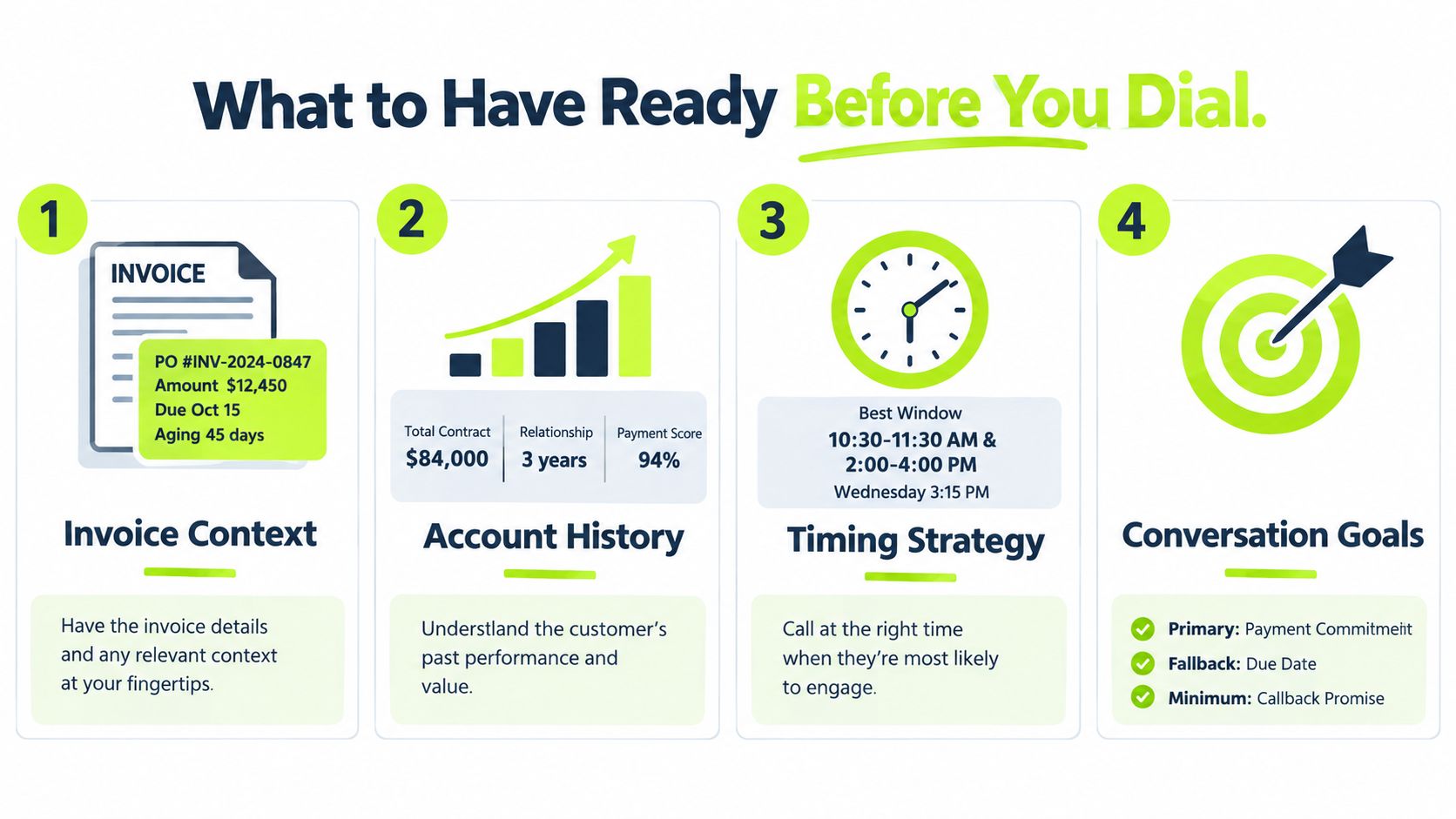
What to Have Ready Before You Dial
Preparation is what separates a professional payment request from a search through disconnected systems while the customer waits. Before dialing, open the invoice, account record, prior correspondence, and payment history in one working view.
Build the account brief
Invoice context should include the invoice number, amount, original purchase order, due date, and aging bucket. If the customer asks a basic question, you should answer without putting them on hold to find the balance.
Account history adds judgment. Know the total contract value, length of the relationship, prior late payments, and any service or delivery notes. A long-standing client with a clean history may need a different tone from an account that regularly breaks commitments.
Prior touches tell you what the customer has already seen. Record which emails were sent, whether anyone replied, and whether previous call attempts ended in voicemail. Don't open with “I'm following up” if the customer has already explained the issue in writing.
Decision-maker confirmation prevents a common operational mistake. Check whether the contact approves payments, receives purchase orders, signs checks, or routes invoices. Also find out whether accounts payable runs payments mid-month, at month-end, or through another internal schedule.
Set a goal and a fallback
Write down the primary outcome before you call. It might be payment today. Your fallback could be a partial payment, a confirmed due date, or a callback with the person who can approve the payment.
A structured pre-call workflow from TOOLii can help standardize this preparation when several people share collections responsibilities. The point isn't to make the call feel scripted. It's to stop preventable errors, such as quoting the wrong amount or asking an AP coordinator to approve something they can't control.
Having this stack ready saves roughly 90 seconds per call, according to the operating benchmark in this process. It also prevents fumbling. Customers notice when a collector doesn't know the invoice history, and that uncertainty weakens the ask before the conversation has started.
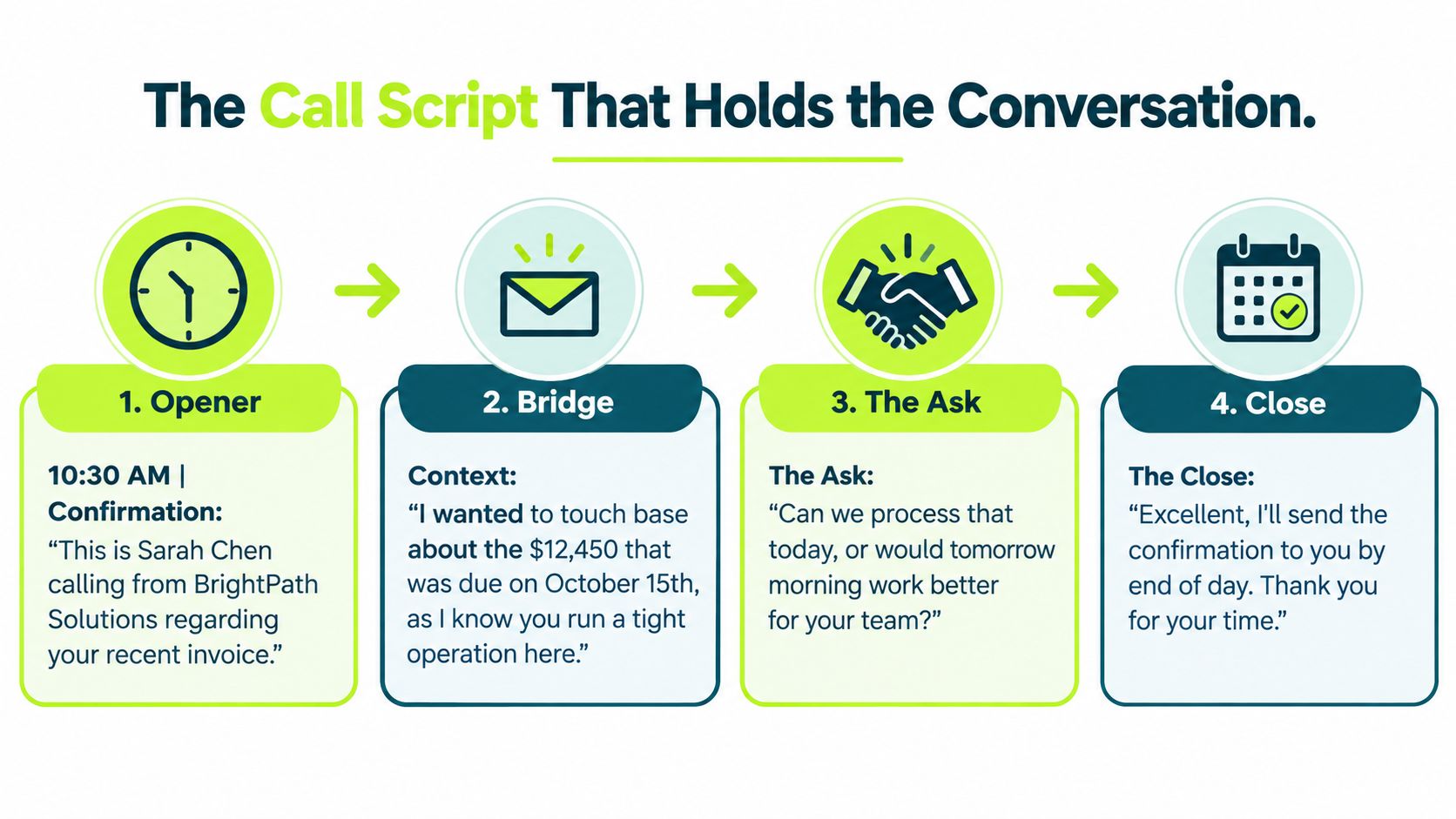
The Call Script That Holds the Conversation
Use the phone when you're ready to have a focused conversation, not when you need to fill a dialing quota. The default dialing blocks are 10:30 to 11:30 a.m. and 2:00 to 4:00 p.m., with Wednesday and Thursday as the strongest starting days. A collections guide also identifies mid-morning and early afternoon as useful windows and recommends avoiding Mondays and Fridays where possible. (phone collections timing guidance)
The script below is deliberately short. It gives the caller control without forcing the customer into unnatural language.
Beat one, confirm the person
Keep the opener under 15 seconds.
“Hi, this is [name] from [firm]. Am I speaking with the person who handles payment approval for your account?”
If the answer is yes, continue. If not, avoid explaining the entire account to a gatekeeper. Ask:
“Is there a better time today, or should I try them directly?”
That question is useful because it offers two simple routes without turning the gatekeeper into an obstacle.
Beat two, connect the invoice to the purpose
Once you have the right person, state the invoice number, amount, and original due date.
“I'm calling about invoice [number] for [amount], which was due on [date]. I wanted to check whether there's anything holding up payment.”
Don't bury the purpose under relationship small talk. A respectful tone doesn't require a long preamble.
If the customer says they need the invoice again, send it while you're speaking and confirm the next action. If they say they need approval, identify the approver and ask when that person will review it.
Beat three, make the ask
Use a direct question with a practical choice.
“Can we process that today, or would tomorrow morning work better for your team?”
If the balance is disputed, stop treating the call as a payment close. Ask what line item or service is in question, who will provide the detail, and when you'll receive it. If the invoice is approved but timing is difficult, move to the commitment pattern covered below.
Beat four, close in the customer's words
Repeat the agreement using the customer's stated amount and date.
“To confirm, you'll submit [amount] by [date] using [ACH, card, or wire], and I'll send the recap today. Is that correct?”
Confirm the payment method on file, any reference number the customer needs, and the owner of the next action. End with a recap in 20 seconds or fewer.
“Thanks. I'll send the invoice and payment details today. You'll process [amount] on [date] through [method], and I'll check the remittance once it's submitted.”
For an expanded version, see this collections call script. If the customer prefers a text-based payment path, a concise guide to text to pay explained can help your team connect the call to a payment experience without making the customer repeat the request.
This short video can help teams rehearse the sequence and delivery before putting it into production.
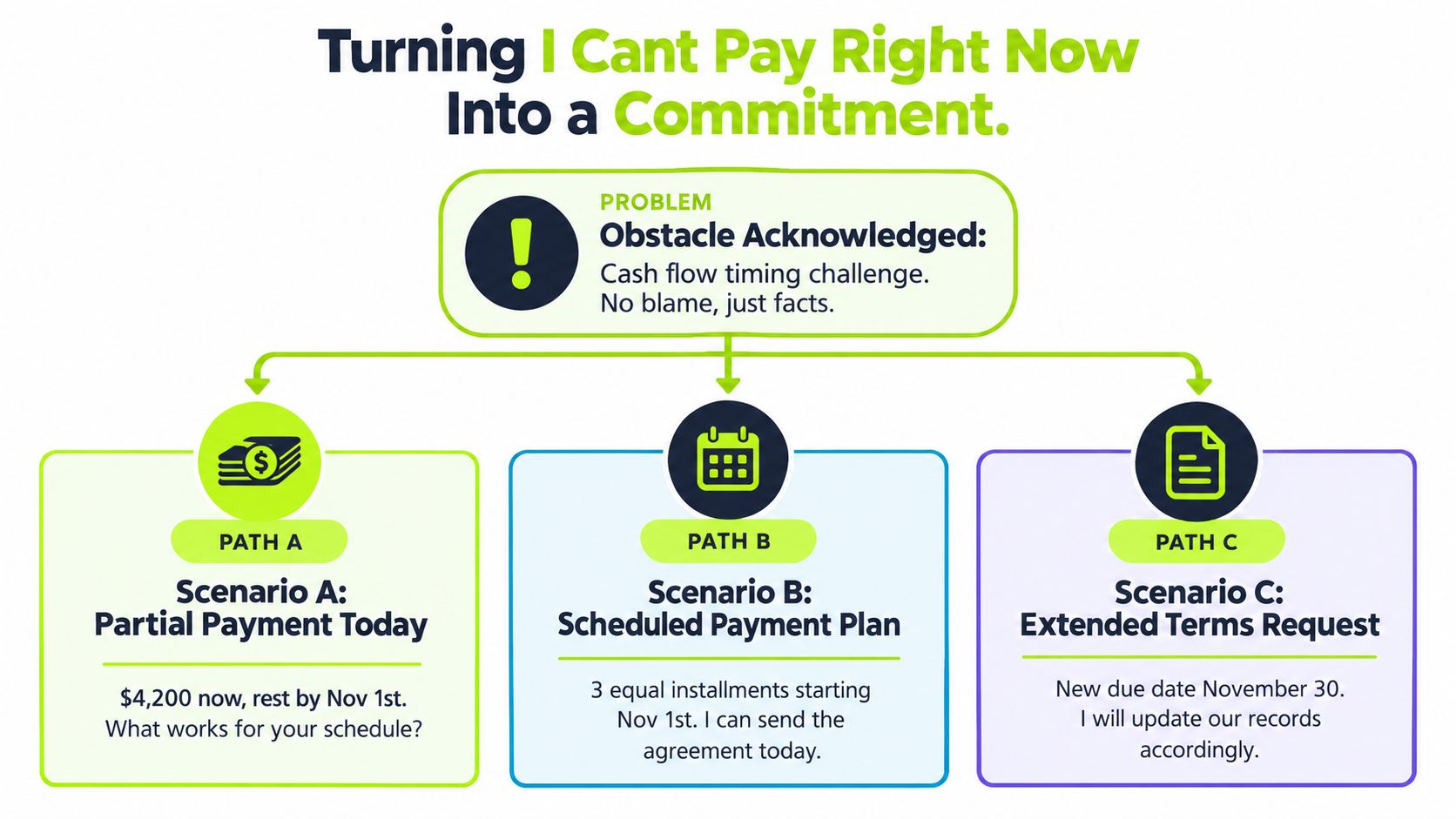
Turning 'I Can't Pay Right Now' Into a Commitment
"I can't pay right now" is often the beginning of the collection conversation. It tells you the customer isn't ready for a same-day payment, but it doesn't tell you whether the problem is cash timing, approval, a dispute, or reluctance. Your job is to separate those possibilities without sounding interrogative.
Start by reflecting the obstacle back neutrally.
“Understood. The issue is timing rather than a question about the invoice. Let's work out what can move now and what date the remainder can be released.”
Then ask for one concrete number.
“What amount can your team pay today?”
Don't jump straight to a payment plan before testing for a partial payment. A customer who can't release the full balance may still be able to release something, and that first payment establishes movement rather than another open-ended promise.
Separate amount, date, and method
Handle the agreement in three passes:
- Amount: “What can you submit today, and what balance will remain?”
- Date: “On what specific date will the remaining balance be paid?”
- Method: “Will that be ACH, card, or wire, and who will initiate it?”
The order matters because vague answers often hide inside vague timing. “We'll get to it this week” isn't a commitment. A commitment has a defined amount, a calendar date, and a payment rail.
For example:
“We can submit a partial payment today and clear the remainder on November 1.”
The collector should follow with:
“What amount can you release today, and should I expect the remaining balance by ACH on November 1?”
That converts a general statement into a recordable agreement. If the customer can't make a partial payment, ask whether a scheduled plan or an extended due date is more realistic, then document who must approve it.
Send the recap before the day ends
The recap email should state:
- Agreed amount: What will be paid now and what remains.
- Payment date: The exact date, not “later this week.”
- Payment method: ACH, card, wire, or another approved rail.
- Reference details: Invoice number and any remittance information.
- Owner: The person responsible for initiating or approving payment.
Send it immediately after the call and ask the customer to correct anything inaccurate. A payment plan agreement template can give your team a consistent format for more involved arrangements.
Disciplined collections improve DSO. A professional-services source defines DSO as the average time required to convert services rendered into cash, using DSO = (Average Accounts Receivable ÷ Total Credit Sales) × 365. It gives 36.5 days as an example result and describes under 30 days as strong performance, 30 to 45 days as average, and over 60 days as poor for professional services. (DSO formula and benchmarks)
Handling the Four Objections That End the Call
An objection isn't a reason to keep talking without direction. It's a signal to change the next action. The collector should leave each call with either a payment commitment, a documented investigation, or a scheduled follow-up owned by a named person.
Objection | On-Call Response | What to Capture | Next Step |
|---|---|---|---|
“We dispute the invoice.” | “Which service, line item, or amount is disputed?” | Specific reason, disputed amount, supporting contact | Request the dispute in writing within 48 hours, update the dispute log, and route it to AR resolution |
“We already paid.” | “What was the payment date, method, and reference number?” | Date, rail, amount, remittance reference | Reconcile against the remittance log before closing the call |
“There's no budget right now.” | “What amount can you release now, and what firm date works for the balance?” | Partial amount, remaining balance, date, method | Send the written commitment and schedule the follow-up |
“I'll call you back.” | “Would [specific day] at [specific time] work if I call you?” | Callback day, time, owner, reason | Set the automated follow-up before hanging up |
Treat disputes as controlled handoffs
Don't argue about a disputed invoice from an incomplete record. Ask the customer to identify the issue in writing within 48 hours, then pause ordinary collection activity on the disputed amount while the resolution owner investigates.
The account record should show the disputed line, the customer's explanation, the internal owner, and the next review date. That keeps the collector from making repeated calls while the delivery or account team has no visibility into the problem.
Reconcile “already paid” immediately
“Already paid” can mean the customer sent funds, someone else approved them, or the payment was initiated but not matched. Ask for the payment date, method, amount, and reference number during the call. Check those details against the remittance log before you mark the invoice resolved.
If the payment can't be found, send a short written request for the remittance advice and set a specific reconciliation task. Don't restart the entire collection sequence until you know whether the money is missing, unapplied, or never sent.
Measuring Whether the Calls Are Working
Call volume is an activity measure. Cash movement depends on what happens after the conversation. A full dialing queue can still produce little cash if calls reach the wrong person, end in vague promises, or generate no reliable follow-up.
Track the promise-to-pay rate by recording calls that produce a specific amount and date, then comparing them with conversations that end in general assurances. Track the right-party contact rate by separating payment decision-makers from voicemails, gatekeepers, and wrong-party contacts. Track the DSO delta by comparing days sales outstanding at the start and end of each collection window.
Contact quality matters more than dial volume. A busy list can conceal weak conversion to decision-makers, especially when collectors count attempts without recording who answered or what happened next.
Collections Call Metrics That Predict Cash Flow
Metric | What It Measures | Realistic B2B Services Baseline | How to Track |
|---|---|---|---|
Promise-to-pay rate | Calls producing a documented amount and date | Establish your own baseline by account segment | Record the commitment fields on every connected call |
Right-party contact rate | Attempts reaching someone who can approve or resolve payment | Segment by client type, balance, and contact channel | Mark decision-maker, gatekeeper, voicemail, and wrong party separately |
DSO delta | Movement in days sales outstanding across the collection window | Compare like-for-like periods and aging mixes | Calculate DSO at the beginning and end of each collection window |
A basic CRM, accounting system, or collections worksheet can capture these fields. Consistency matters. If one collector records “promised” and another records “follow up,” management cannot tell whether the process converts conversations into cash.
Use the collection effectiveness index alongside these measures for a broader view of collectible receivables and recovery performance. Reward accurate records, reached decision-makers, kept commitments, and declining overdue balances, rather than dialing activity alone.
Automation earns its place here when it sequences reminders, flags when a phone escalation fits the account, records outcomes, and keeps promises visible. It should reduce administrative work while leaving judgment with the collector during sensitive client conversations.
Resolut automates AR for professional services with consistent workflows, accurate follow-up records, and human-controlled payment conversations. Visit Resolut to see how it can help your team reduce DSO and improve cash flow without turning collections into a blunt exercise.