Intelligent Payment Routing That Improves Cash Flow
Learn how intelligent payment routing boosts authorization rates, cuts costs, and speeds reconciliation for professional services AR workflows.
Invoices go out on time. Clients say they've paid. Your team still spends Friday afternoon matching remittances, chasing missing receipts, and updating a cash forecast that keeps moving.
For many professional services firms, that gap between “payment initiated” and “cash applied” is where control gets lost. The issue isn't always collections effort. Sometimes the payment path itself is the problem. A client clicks pay, a card attempt fails for a processor reason, an ACH flow stalls, or the payment lands without clean records flowing back into accounting.
That's why intelligent payment routing matters to CFOs and Controllers. It's usually discussed as a checkout topic. In practice, it's also an accounts receivable automation topic. The route a payment takes affects whether it succeeds, how quickly it settles, how easily it reconciles, and how soon you can trust the cash position on your dashboard.
Introduction Why Payment Routing Decides Cash Flow
A familiar month-end scene. You've sent the invoice. The client isn't disputing it. Your collector has already followed up once. But the payment still hasn't posted, and your team can't tell whether the issue is timing, method, or a failed transaction sitting somewhere between the client and your ledger.

That's where Intelligent Payment Routing shifts from a payments topic to a finance control lever. It decides which payment path should handle a transaction in the moment, based on expected success, cost, and operational fit. For a firm trying to improve cash flow, that decision can matter as much as the reminder email that got the client to click “pay” in the first place.
One reason this deserves attention is simple. Nearly 1 in 13 online payments fail, often for reasons unrelated to the customer's ability or intent to pay, according to Stripe's guide to intelligent payment routing. If you invoice clients digitally, that failure rate isn't abstract. It shows up as delayed cash, extra staff follow-up, and forecast noise.
Why finance leaders should care
Payment routing isn't only about ecommerce conversion. In professional services, it touches three operating concerns:
- Cash timing: A successful first payment attempt shortens the distance between invoice delivery and usable cash.
- Client experience: Clients are less likely to feel chased when the payment process works cleanly the first time.
- Back-office effort: Fewer failed or misrouted payments mean less manual intervention for AR and accounting.
Practical rule: If a client is willing to pay, finance should remove as much payment friction as possible before adding more follow-up pressure.
This also connects directly to forecasting. If you're tightening your weekly cash view, a stronger payment system makes your collections forecast more reliable. Teams that are rebuilding discipline around working capital often pair AR workflow changes with a broader bank liquidity forecasting guide so payment timing and treasury planning stay aligned.
The rest of the operating question is straightforward. How does routing work, what does it optimize, and when does it help a professional services firm reduce DSO instead of just adding another layer of software?
How Intelligent Payment Routing Actually Works
Think of intelligent payment routing like GPS for receivables. A static setup sends every payment down the same road, whether traffic is clear or blocked. A routing engine checks live conditions and chooses the path most likely to get the payment through.
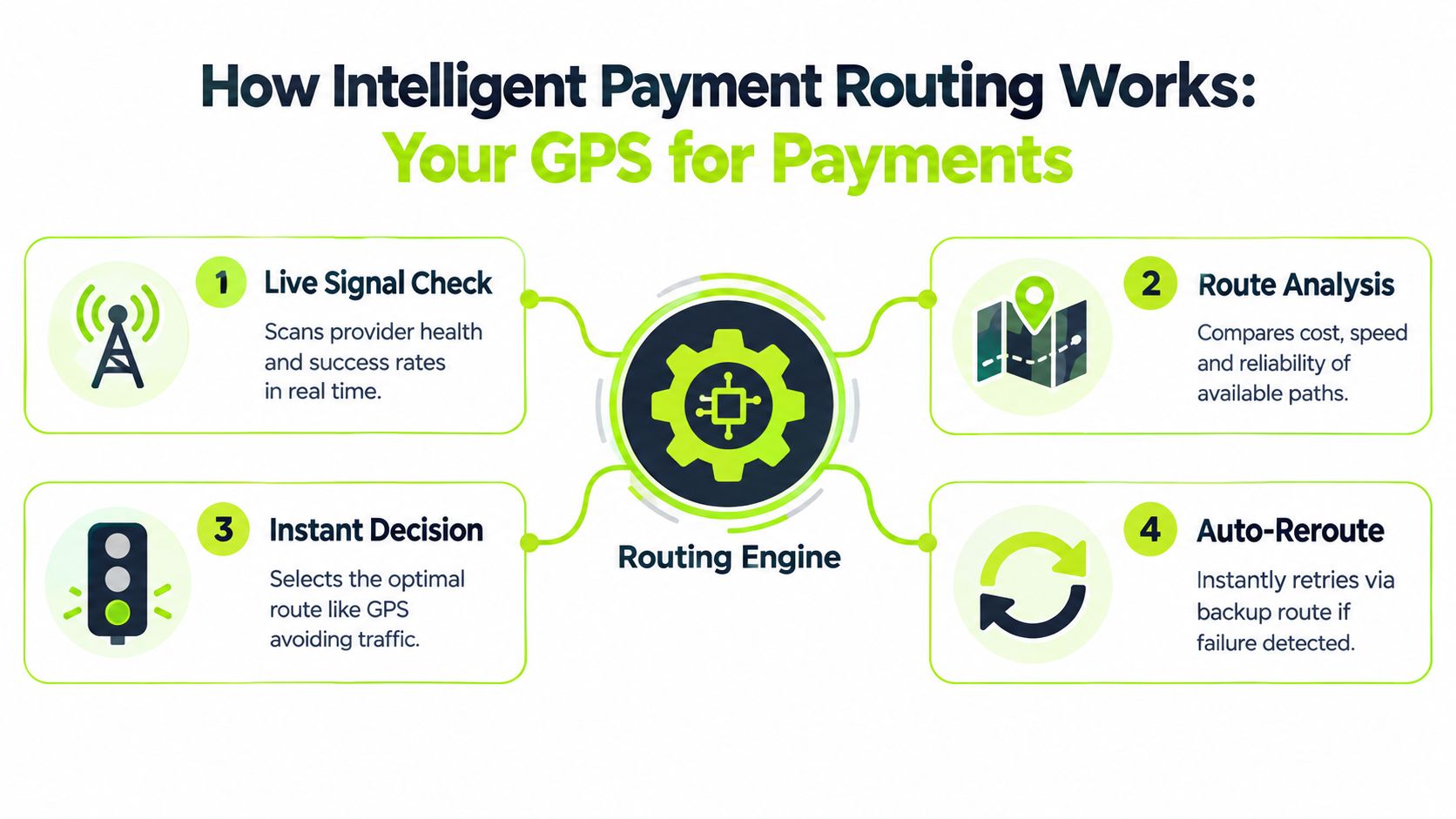
Static rules versus live decisioning
A simple rules-based setup might say:
- Send all Visa transactions to provider A.
- Send all ACH payments through provider B.
- Retry once if the processor times out.
That can work. But it doesn't learn. It doesn't adjust when one provider slows down, when issuer behavior changes, or when a certain payment type performs better on a different route.
By contrast, intelligent routing uses real-time transaction attributes such as BIN range, issuing bank, transaction amount, currency, merchant category code, and historical acquirer performance to choose the path with the highest expected authorization rate and lowest latency, as described in independent market research on intelligent payment routing.
What the engine is actually evaluating
At a practical level, the routing engine asks a set of operational questions in milliseconds:
- Who issued the payment instrument? Issuer behavior differs.
- What kind of transaction is this? Card, ACH, local rail, and cross-border flows behave differently.
- What's the current provider condition? Latency and uptime affect whether a payment gets through smoothly.
- What has worked before for similar transactions? Historical performance informs the best path now.
A useful walkthrough sits below.
Why this matters in AR, not just checkout
In an AI AR automation context, the routing decision sits inside a broader sequence. A client receives an invoice, chooses a payment method, and expects the transaction to complete without extra steps. If the first route fails but the system can recover automatically, your team may never need to intervene.
The finance benefit isn't the routing decision by itself. It's the combination of successful payment, clean record creation, and fewer exceptions for staff to resolve.
For CFOs, that distinction matters. A static setup can process payments. An intelligent one can improve how your payment stack behaves under real conditions. That difference becomes more valuable when your firm handles a mix of client sizes, payment methods, and billing patterns.
Decision Criteria That Determine the Best Route
The best route isn't the cheapest processor. It's the route that balances approval probability, cost, and speed for the specific transaction in front of you. That's why intelligent payment routing is better understood as an optimization problem, not a checklist.
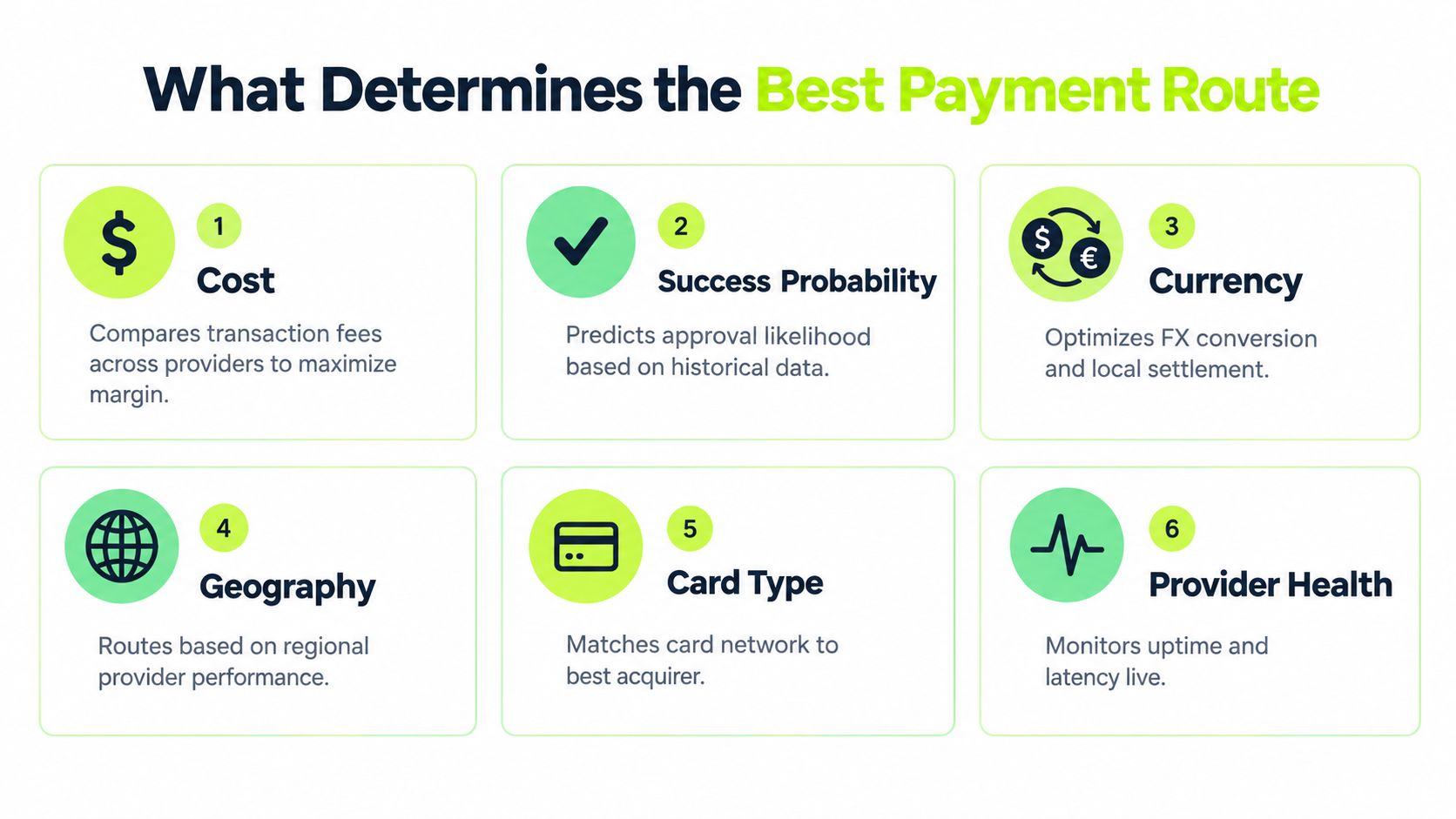
The inputs that actually move the decision
Several transaction features commonly change the right answer.
- Issuer and BIN data: Some issuers respond better through certain acquiring relationships.
- Amount and currency: A larger invoice or a foreign-currency transaction can change both cost and acceptance risk.
- Geography: Local availability matters. Cross-border behavior can reduce performance if the route doesn't fit the market.
- Payment method: Card and ACH have different economics, timing, and exception patterns.
- Provider health: A route that looks good on paper can still be the wrong choice if it's slow or unstable right now.
That's one reason routing shouldn't live only inside an engineering conversation. Finance owns the trade-off between lower processing cost and faster, cleaner cash realization.
Routing Decision Criteria at a Glance
Decision Input | What It Optimizes | Why It Matters |
|---|---|---|
BIN range and issuing bank | Approval probability | Different issuers can respond differently to the same payment attempt |
Transaction amount | Cost and risk handling | Higher-value invoices may justify a route with stronger reliability or controls |
Currency | Settlement fit | The wrong path can create avoidable friction in non-domestic transactions |
Geography | Local acceptance | In-region routing often aligns better with local issuer expectations |
Card type or payment rail | Method-specific performance | The best card route may not be the best ACH workflow |
Provider latency and uptime | Speed and reliability | Slow or unstable providers create operational delays even when fees are lower |
Why lowest cost often loses
A low-fee route can still be expensive if it fails more often or creates reconciliation work later. Finance teams usually see that cost in three places. Delayed collections, added staff time, and more client back-and-forth.
Research aimed at authorization optimization notes that orchestration works best as a portfolio of levers. Network tokenization typically adds about 2 to 5 percentage points of authorization uplift on card-not-present traffic, while direct acquirer-issuer connections can add another 1 to 2 points on affected BINs according to Payment Brief's analysis of card acceptance optimization. The operational lesson is that route quality depends on infrastructure depth, not just surface-level rules.
When you compare providers, ask two finance questions. Which route gets the cash in with the fewest exceptions, and which route produces records your team can reconcile without cleanup?
If you're evaluating payment stack design more broadly, a side-by-side payment gateway comparison for finance teams can help separate provider coverage from actual operating fit.
When Intelligent Routing Beats Simple Rules
Not every firm needs a highly adaptive routing model on day one. For some professional services workflows, simple rules are enough. The finance question is where intelligence produces enough operational benefit to justify the added setup and monitoring.

Cases where simple rules can be enough
If your firm mainly invoices domestic clients, uses one or two payment methods, and sees limited variation in payment behavior, a straightforward setup may perform well. Examples include:
- Stable domestic ACH volume: If most clients pay by bank transfer and record flow into accounting is clean, complexity may not add much.
- Low route variation: If one processor consistently handles your card volume without material issues, static defaults can be practical.
- Small exception load: If your team rarely investigates failed attempts, there may be less value in adaptive logic.
Cases where intelligent routing tends to win
The equation changes when the payment environment gets less predictable.
- Card-not-present client payments: Approval behavior varies more, and recovery options matter more.
- Cross-border client base: Local availability, currency, and issuer patterns create more route dispersion.
- Mixed-method receivables: Firms that accept both card and ACH need better logic around method selection, retries, and posting.
- Higher payment volume: Small gains compound when applied repeatedly.
A useful signal comes from enterprise-scale payments. In a pilot across more than 20 enterprise merchants, Adyen reported average 26% cost savings and a 0.22% uplift in authorization rates versus earlier debit performance, with participants including eBay, 24 Hour Fitness, and Microsoft, according to Adyen's intelligent payment routing announcement. CFOs shouldn't copy enterprise architecture blindly, but the result shows why basis-point improvements can matter at scale.
The trade-off finance should weigh
Simple rules are easier to govern. Intelligent routing is more adaptive, but it depends on data quality, transaction history, and clear exception handling. In AR, that means you shouldn't over-engineer the payment path if your larger bottleneck is still invoice timing or follow-up discipline.
Start with the failure points your team can actually observe. If failed attempts, retries, and payment exceptions are already consuming staff time, routing intelligence becomes easier to justify.
For firms focused on AR software for professional services, the right answer is often staged adoption. Clean up outreach, payment options, and reconciliation first. Then add more routing where the data supports it.
Impact on Authorization Rates Reconciliation and DSO
Finance teams don't benefit from routing in theory. They benefit when approved payments become posted cash faster, with fewer manual touches between the client action and the ledger result.
Small payment gains can become cash-flow gains
Professional services firms often focus first on invoice quality and reminder cadence. Those matter. But once the client is ready to pay, the payment stack determines whether the attempt succeeds and lands cleanly.
That's important because payment acceptance and AR performance are connected. If the payment path works better, fewer invoices stay open for avoidable reasons. If the payment record posts directly into your billing and accounting systems, your team can close the loop faster.
Reconciliation is part of the return
For professional services, payment processing typically means accepting client payments by card or ACH bank transfer, with the transaction record flowing directly into billing and accounting systems. That direct record flow is a key mechanic for reducing manual reconciliation and improving cash application speed, as explained in Finix's overview of payment processing for professional services.
That back-office effect is easy to underestimate. A payment that clears but doesn't map cleanly into the invoice and ledger still creates work. In practice, routing quality and reconciliation quality belong in the same conversation.
DSO moves when the whole chain works
Professional services firms often work from a 30- to 60-day DSO benchmark, and 55 days can be a practical starting point for an AR automation target. One implementation path cited for the sector uses a 37% average DSO reduction, which would move a 55-day firm to about 35 days, according to this AR automation benchmark discussion for professional services.
That doesn't mean routing alone produces the result. It means routing supports the outcome when combined with disciplined outreach, integrated payment options, and fast cash application.
A practical finance model looks like this:
- Invoice goes out correctly
- Client gets a friction-light payment option
- The payment is routed through the most suitable path
- The result flows back into accounting without manual repair
- AR closes the invoice quickly and accurately
If your current bottleneck is matching bank activity back to invoices, payment operations and ledger operations need to be designed together. automated payment reconciliation becomes part of the same control framework as routing and collections.
Intelligent Routing Inside AR Orchestration Platforms
Inside an AR system, routing isn't a standalone feature. It sits inside an operating sequence that decides when to ask for payment, which method to present, what to do if the client pays, and when a human should step in.
What the workflow looks like in practice
A common AR automation control model uses four mechanics: trigger outreach based on invoice status and due date, adapt tone by customer segment and risk, pause automatically when payment or dispute activity occurs, and escalate to a person when judgment is required, as outlined in this guide to follow-up automation.
That model matters because payment routing works best when it responds to the same signals as the rest of the collections process. If a client is low-risk and usually pays by ACH, the system can present that path first. If a card attempt fails for a recoverable reason, the platform can retry or offer an alternate rail without restarting the collection cycle.
A concrete sequence finance teams can govern
One AR framework for accounting firms recommends a defined timing sequence:
- Invoice dispatch
- A 7-day reminder
- A 14-day escalation
- A 30-day overdue alert
- Closed-loop payment confirmation
It also recommends pausing the sequence when a client disputes the invoice, according to this payment reminder workflow for accounting firms.
That's where QuickBooks AR automation and payment orchestration start to overlap. The payment choice, the follow-up cadence, and the accounting record all need to stay synchronized.
Why orchestration matters more than isolated payments tooling
A payment attempt doesn't happen in isolation. Someone sent the invoice, someone approved the terms, and someone needs the cash application to be right. An orchestration layer coordinates those events so the system can decide how a payment should be attempted, retried, rerouted, recorded, and reconciled.
For example, a platform such as Resolut can sit in that workflow as an accounts receivable automation system that combines outreach logic, payment handling, and cash application in one operating layer. That's often more useful to a Controller than a narrow payment widget because the control point is the whole receivables process, not only the transaction screen.
If you want the underlying model, this overview of payment orchestration in finance operations is a practical starting point.
Bringing Control and Calm to Your AR Workflow
Finance teams don't need more payment complexity. They need fewer surprises.
That's the best reason to look at intelligent payment routing through an AR lens. It isn't about pushing clients harder. It's about choosing better payment paths, reducing preventable failures, and making sure successful payments become usable accounting records without delay.
What control looks like in day-to-day operations
For a CFO or Controller, better control usually shows up in ordinary ways:
- Cleaner exception queues: Fewer payment issues sitting between AR and accounting
- More reliable cash visibility: Less guesswork in short-term forecasting
- Consistent client treatment: Reminders pause when they should, and escalations happen only when needed
The deeper value is operational calm. Your team stops treating every slow payment as a collections problem when some of them are payment path problems.
Good AR design doesn't just ask, “Did we send the reminder?” It also asks, “Did we make it easy for the client to complete and record the payment correctly?”
A sensible next step
If your firm wants to reduce DSO, start by mapping the full chain from invoice to posted cash. Look for friction in three places. Failed payment attempts, inconsistent method selection, and manual reconciliation.
Once those are visible, it becomes easier to judge whether simple rules are enough or whether intelligent routing belongs inside your AI AR automation stack. For many professional services firms, that's the point where AR software for professional services stops being an admin tool and starts acting like a working-capital system.
The firms that improve cash flow most reliably usually don't chase harder. They execute more consistently.
Resolut automates AR for professional services with structured outreach, payment orchestration, and cash application designed to keep collections consistent, accurate, and human. If you want to evaluate how routing, reconciliation, and follow-up fit together in your own workflow, visit Resolut.